
Scott Speaks, Walks and Talks to Fontana boss David Bates in 1995
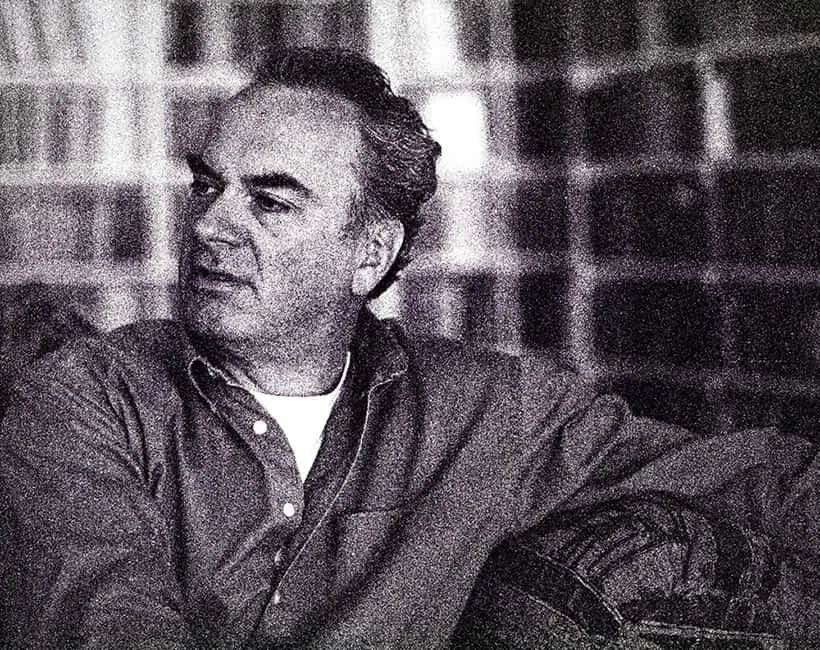
Scott Walker Interview, XFM, 29 November 1995
Dave’s Garage with David Bates
Tracks Chosen by Scott Walker
Pledging My Love - Johnny Ace
Flamingos - I Only Have Eyes For You
PJ Harvey - To Bring You My Love
Ligeti: Violin Concerto › II. Aria, Hoquetus, Chorale. Andante con moto - Pierre Boulez, Saschko Gawriloff, Ensemble Intercontemporain
The Drifters - Let the Music Play
Jimmie Rodgers - The Long Hot Summer
Nine Inch Nails - Mr. Self Destruct
Arturo Benedetti Michelangeli - Mazurka No. 25 in B Minor, Op. 33, No.4
David Bates interviewed by Stephen Kijak
David Bates is widely recognised as one of the most important and influential figures in British A & R history. He joined Phonogram as an A & R scout in 1976, at the height of punk and over his 30+ year career he engineered the success of artists as, seminal, diverse and successful as Def Leppard, Tears For Fears, The Teardrop Explodes, Robert Plant, Was Not Was, Wet Wet Wet, Oleta Adams, James and Texas. While running the Fontana label, he signed Scott Walker to a one-album deal which would result in 1995’s Tilt. Stephen Kijak first interviewed David for the film Scott Walker: 30 Century Man and caught up with David again recently to revisit his Tilt-era memories...
STEPHEN KIJAK: So David, what is your Scott Walker story, where does it all start?
DAVID BATES: When I was at school in the 60s, there used to be a lunchtime record player and you all took it in turns to play records. And whereas I'd be wanting to play Cream and The Stones and The Beatles, all the girls wanted to play was Scott Walker and the Walker Brothers. So when you're that young, you're sitting there and you hated it because that's all the girls wanted to play. So he was never very popular.
“Years later, having signed The Teardrop Explodes, Julian Cope ended up being my flatmate and it was Julian who was the most massive Scott Walker fan. And of course, I'm looking at it and I'm thinking, "Man, that's so uncool, Scott Walker." And he's going, "No, no, no, you don't get it. Let me tell you why he's great." So Julian would spend quite some time just playing amazing things for me to appreciate. And that's when I turned around. I never realized it wasn't pop stuff. This was unbelievable.”
Julian did the compilation (“Fire Escape In The Sky: The Godlike Genius of Scott Walker” (1981, Zoo Records) that came out and that made a lot of people sit up and go, "Wow, this guy is unbelievable." He put that together there at the Flat.
SK: How then does Scott come into your life professionally?
DB: Years go by and then I get a phone call to say, "Scott Walker would like to meet you.” It just came out of the blue. And Scott came in and he very much looked like Scott, very mild, very calm, very quiet, very considered. He explained that he wanted to make this album and he thought Fontana would be the right home for him because of the artists that I was involved with and the things that I had done.
At that time, I was head of A&R for Phonogram, which in today's modern terms is Universal and I had the Fontana label. Tears for Fears were on it. I had the Tom Tom Club. I had Jerry Harrison. I had Tom Verlaine who had left Television. I had Pere Ubu. I signed James, Cocteau Twins, House of Love - so there was a whole range of creative arty artists on the label.
Scott thought that I might be sympathetic to what he wanted to create. And I said, "Sure, I'm absolutely sympathetic with what you want to create. How do we do this? " And he said, "Well, you just give me some money, not much. I want to go away and I'll book the studios. I'll take care of everything myself and just let me get on with it. "
SK: How did he get on with it? How did you help him realise Tilt?
DB: He was very clever. He would book what we call downtime. That's the time the studio is not being used. It's in-between sessions. So, somebody would book a studio from 10 till 7 and the rest of the time wouldn't be used. So he would book that dead time. I mean, sometimes he would book it from midnight till four o'clock. He would get more bang for his bucks by picking and choosing the dead time. And that's kind of how it went. And every so often he would just either pop in to say everything's going great, or I'd just get a phone call. And that was my creative input; nothing!
SK: That must have been very liberating for him.
DB: He found the home he wanted. It was somebody sitting there going, "I get it. " I was in a position of being incredibly successful and people always said, "You can have one in three." So, this was my one in three. I'm used to dealing hits all day long, and this is what I demand of all my artists. In this case, Scott got a pass! Let's do something that's just wonderful. There was nobody else that I had that I'd ever agreed this kind of arrangement with before. And honestly, there's never been an artist since. I knew that the sales weren't going to be equal to the costs. I didn't figure we were going to get that. This was done because I thought it was a good thing to have Scott on board. I thought it was great as a statement to the artistic community.
Also, Charles and Cathy (Scott’s managers) were very easy to deal with. These are two very intellectual, intelligent, calm, well-spoken, thoughtful people. They would explain what they thought Scott would like and it was always placed on their care and concern for Scott. That was their entire raison d’etre. What was the best for Scott. Scott was a unique human being and he was very fragile and he was sensitive and he was a deep thinker. And he needed someone that would be able to understand that and deal with that. And Charles and Cathy, with their personalities, were the right people to interpret Scott's wishes and wants. He was very lucky that he found them very, very lucky, because that was an ideal partnership.
SK: In the documentary, you described the first playback of Tilt. Is that still a potent memory all these years later?
DB: Oh yeah, yeah. Very much so. Eventually when the call came to say, "Okay, I'm ready, you must come” I went to the studios in Chiswick (Metropolis) and we went into this particular room, it wasn't a very big room, it's just in the control room. And on the one side there's these two huge Genelec speakers. I mean, they're probably six foot by four foot speakers. They're huge, and they're just the most beautiful sounding speakers on the planet. And I sit down at the control desk and the record comes on, and boy, is it loud! It is unbelievably loud. And after the first or second track, I said, "Scott, is there any chance that we could turn this down?" And so we turned it down a bit for the next track and then he stopped and said, "David, I really would like to play this in all of its full glory at the volume of my choice.” “Why? I can hear this fine." He said, "Yes, but this is the last time I'm ever going to hear this record." And he meant it. As far as he was concerned, he'd made the record, he'd done everything he wanted to do with it, and he was now going to listen to this complete for the final time. He's done. He doesn't want to hear it ever again. So that was it. We played it at full volume for the rest of the way.
SK: And there was the playback for the press, the tastemakers...
DB: I talked with the team over at the label and we knew that there were a number of massive Scott Walker fans out there. A lot of famous people were fans. So we needed to find a room to invite them and the press, radio, TV, and the key record label people from around the world. And we came up with the Royal College of Art, which is next door to the Royal Albert Hall. They've got a refectory in the very top floor. It's a massive room. It's the most beautiful room, a beautiful setting. And I needed to get the same kind of speakers that were used in the studio to be put up and I thought, "Well, I'm going to play it quite loud too now because I get the chance!" And everyone turned up from Alan Yentob, Salman Rushdie, there were famous actors, actresses, even Robbie Williams was there. Pulp were there, members of Radiohead were there. It was just lots and lots of famous people milling around with people from the record company and then the press and the TV people and the radio people. So, everyone was impressed by everyone else being there.
And I played the record and you could see it was going to be mixed. There were obviously the commercial heads who were going, "Well, that's not going to be played in the morning, that's for sure." And there are Alan Yentob and those guys were all thinking, "Well, maybe we could do something on BBC 2 and one of the arts programmes." So there was a lot of different vibes to it. And some people were going, "I get it. " And then their theories were starting as to what the record was about, what he was singing about, and what did he mean? So it was good. And the press coverage over the next week was probably better than anybody would've expected for a playback. It was amazing.
“In France it was enormous. I think it was Libération, the review was three pages. That would be like the equivalent of the Times putting three pages of a review. It's just not heard of. Nobody does three pages about a record, but they did. And as somebody said at the end of all of this, "Do you know what? If every word that had been written about Tilt had been a sale, we'd have sold millions.””
The reaction to the record and the appreciation and the mystery of the record continues to today. I think that Tilt is the masterpiece. That is the one.
SK: Did you start thinking into the future, to working with him on the next record?
DB: think at some point, I can't remember whether it was Charles or whether it was Scott that said, "Don't expect the follow-up anytime soon." The contract was just for the one record, so nothing was ever discussed or anything. I'm glad that the baton was picked up by someone else that believed in what was going to happen because it had been clearly marked with Tilt that this would be what it was going to be. When I listened to the other records that Scott's done, I can hear Scott's journey. I can appreciate the journey he's gone on and where he was going to.
March 3, 2026
Guest List Scott Walker, Playlist, March 2026
by David Bates
Today Bates continues his lifelong engagement with music as a curator and playlist maker, bringing decades of listening, discovery and record-making experience to carefully sequenced selections designed to tell a story.
This playlist traces a loose map of the musical world around Scott Walker. It includes songs he personally selected for a 1996 XFM radio appearance, expanding outward to include artists and recordings he mentioned or referenced in interviews across the years. The result is less a conventional “influences” list than a listening journey, moving between pop, chanson, avant-garde and beyond, through the sounds that intersected with one of modern music’s most singular imaginations.
I have taken the tracks from the db Scott xfm interview
Plus things Scott mentioned in interviews
Composers performances artists tracks etc
Put it all together
Thought…
how would Scott do this…??
So varied..
So wild
So
thats how i played it
normally takes days…
But it came quickly…
David Bates 2026