Remembering the 2017 Late Night Prom: The Songs of Scott Walker (1967-1970)
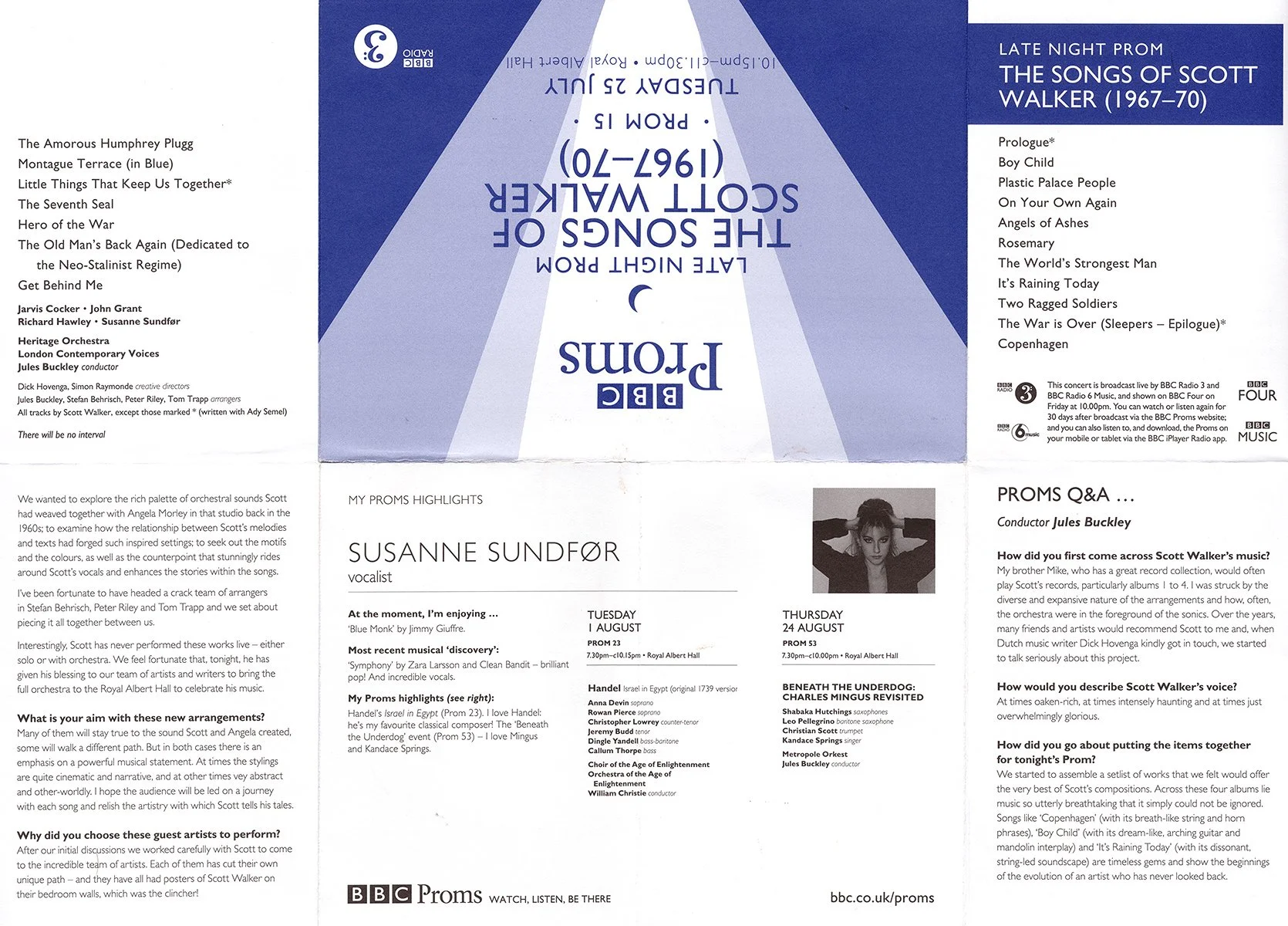
The Songs of Scott Walker (1967-70) Programme
BBC Proms // Prom 15 // Tuesday 25th July 2017 // 10.15pm-c11.30pm // Royal Albert Hall // BBC Radio 3
Prologue*
Boy Child
Plastic Palace People
On Your Own Again
Angels of Ashes
Rosemary
The World's Strongest Man
It's Raining Today
Two
Ragged Soldiers
The War is Over (Sleepers - Epilogue)*
Copenhagen
The Amorous Humphrey Plugg
Montague Terrace (in Blue)
Little Things That Keep Us Together* The Seventh Seal
Hero of the War
The Old Man's Back Again (Dedicated to the Neo-Stalinist Regime)
Get Behind Me
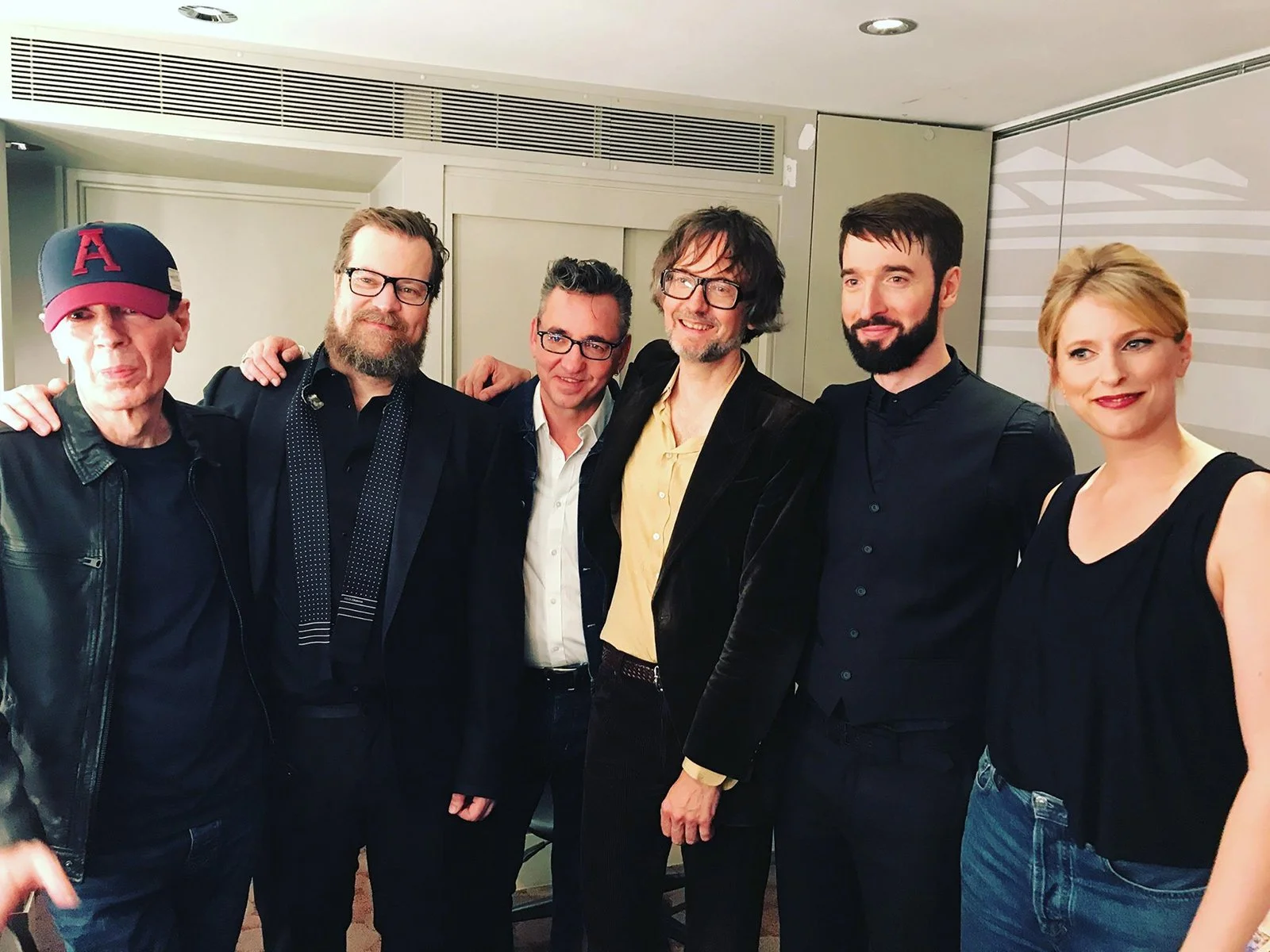
Jarvis Cocker • John Grant. •. Richard Hawley • Susanne Sundfør
Heritage Orchestra
London Contemporary Voices
Jules Buckley conductor
Dick Hovenga, Simon Raymonde creative directors
Jules Buckley, Stefan Behrisch, Peter Riley, Tom Trapp arrangers
All tracks by Scott Walker, except those marked * (written with Ady Semel)
There will be no interval
PROMS Q&A Conductor Jules Buckley
How did you first come across Scott Walker's music? My brother Mike, who has a great record collection, would often play Scott's records, particularly albums I to 4. I was struck by the diverse and expansive nature of the arrangements and how, often, the orchestra were in the foreground of the sonics. Over the years, many friends and artists would recommend Scott to me and, when Dutch music writer Dick Hovenga kindly got in touch, we started to talk seriously about this project.
How would you describe Scott Walker's voice? At times oaken-rich, at times intensely haunting and at times just overwhelmingly glorious.
How did you go about putting the items together for tonight's Prom? We started to assemble a setlist of works that we felt would offer the very best of Scott's compositions. Across these four albums lie music so utterly breathtaking that it simply could not be ignored. Songs like 'Copenhagen' (with its breath-like string and horn phrases), 'Boy Child' (with its dream-like, arching guitar and mandolin interplay) and 'It's Raining Today' (with its dissonant, string-led soundscape) are timeless gems and show the beginnings of the evolution of an artist who has never looked back.
We wanted to explore the rich palette of orchestral sounds Scott had weaved together with Angela Morley in that studio back in the 1960s; to examine how the relationship between Scott's melodies and texts had forged such inspired settings; to seek out the motifs and the colours, as well as the counterpoint that stunningly rides around Scott's vocals and enhances the stories within the songs.
I've been fortunate to have headed a crack team of arrangers in Stefan Behrisch, Peter Riley and Tom Trapp and we set about piecing it all together between us.
Interestingly, Scott has never performed these works live - either solo or with orchestra. We feel fortunate that, tonight, he has given his blessing to our team of artists and writers to bring the full orchestra to the Royal Albert Hall to celebrate his music.
What is your aim with these new arrangements? Many of them will stay true to the sound Scott and Angela created, some will walk a different path. But in both cases there is an emphasis on a powerful musical statement. At times the stylings are quite cinematic and narrative, and at other times vey abstract and other-worldly. I hope the audience will be led on a journey with each song and relish the artistry with which Scott tells his tales.
Why did you choose these guest artists to perform? After our initial discussions we worked carefully with Scott to come to the incredible team of artists. Each of them has cut their own unique path - and they have all had posters of Scott Walker on their bedroom walls, which was the clincher!
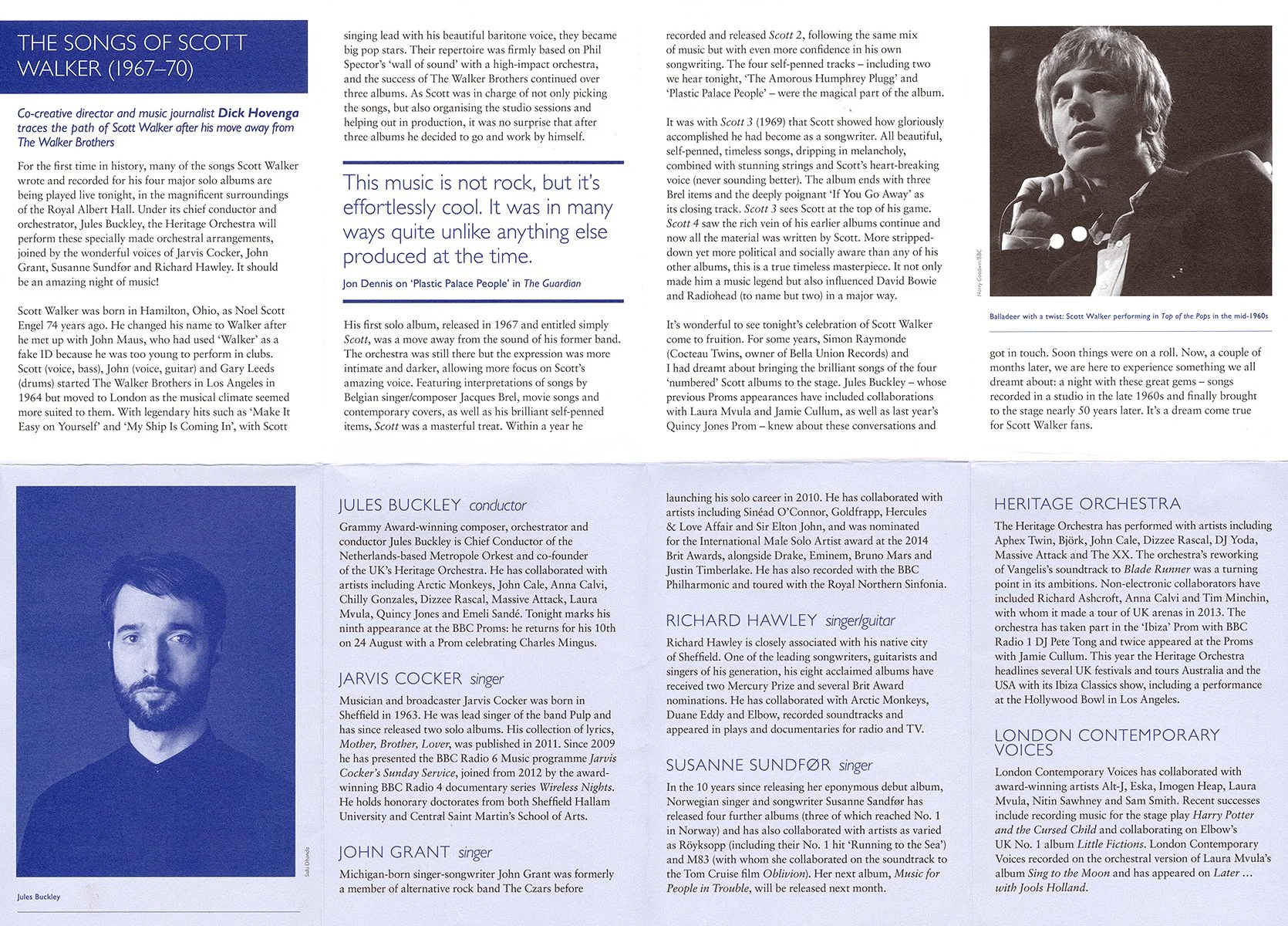
Co-creative director and music journalist Dick Hovenga traces the path of Scott Walker after his move away from The Walker Brothers
For the first time in history, many of the songs Scott Walker wrote and recorded for his four major solo albums are being played live tonight, in the magnificent surroundings of the Royal Albert Hall. Under its chief conductor and orchestrator, Jules Buckley, the Heritage Orchestra will perform these specially made orchestral arrangements, joined by the wonderful voices of Jarvis Cocker, John Grant, Susanne Sundfør and Richard Hawley. It should be an amazing night of music!
Scott Walker was born in Hamilton, Ohio, as Noel Scott Engel 74 years ago. He changed his name to Walker after he met up with John Maus, who had used 'Walker' as a fake ID because he was too young to perform in clubs. Scott (voice, bass), John (voice, guitar) and Gary Leeds (drums) started The Walker Brothers in Los Angeles in 1964 but moved to London as the musical climate seemed more suited to them. With legendary hits such as 'Make It Easy on Yourself' and 'My Ship Is Coming In', with Scott singing lead with his beautiful baritone voice, they became big pop stars. Their repertoire was firmly based on Phil Spector's 'wall of sound' with a high-impact orchestra, and the success of The Walker Brothers continued over three albums. As Scott was in charge of not only picking the songs, but also organising the studio sessions and helping out in production, it was no surprise that after three albums he decided to go and work by himself.
This music is not rock, but it's effortlessly cool. It was in many ways quite unlike anything else produced at the time.
Jon Dennis on 'Plastic Palace People' in The Guardian
His first solo album, released in 1967 and entitled simply Scott, was a move away from the sound of his former band. The orchestra was still there but the expression was more intimate and darker, allowing more focus on Scott's amazing voice. Featuring interpretations of songs by Belgian singer/composer Jacques Brel, movie songs and contemporary covers, as well as his brilliant self-penned items, Scott was a masterful treat. Within a year he recorded and released Scott 2, following the same mix of music but with even more confidence in his own songwriting. The four self-penned tracks - including two we hear tonight, 'The Amorous Humphrey Plugg' and 'Plastic Palace People' - were the magical part of the album.
It was with Scott 3 (1969) that Scott showed how gloriously accomplished he had become as a songwriter. All beautiful, self-penned, timeless songs, dripping in melancholy, combined with stunning strings and Scott's heart-breaking voice (never sounding better). The album ends with three Brel items and the deeply poignant 'If You Go Away' as its closing track. Scott 3 sees Scott at the top of his game. Scott 4 saw the rich vein of his earlier albums continue and now all the material was written by Scott. More stripped- down yet more political and socially aware than any of his other albums, this is a true timeless masterpiece. It not only made him a music legend but also influenced David Bowie and Radiohead (to name but two) in a major way.
It's wonderful to see tonight's celebration of Scott Walker come to fruition. For some years, Simon Raymonde (Cocteau Twins, owner of Bella Union Records) and I had dreamt about bringing the brilliant songs of the four 'numbered' Scott albums to the stage. Jules Buckley – whose previous Proms appearances have included collaborations with Laura Mvula and Jamie Cullum, as well as last year's Quincy Jones Prom - knew about these conversations and got in touch. Soon things were on a roll. Now, a couple of months later, we are here to experience something we all dreamt about: a night with these great gems - songs recorded in a studio in the late 1960s and finally brought to the stage nearly 50 years later. It's a dream come true for Scott Walker fans.
JULES BUCKLEY conductor
Grammy Award-winning composer, orchestrator and conductor Jules Buckley is Chief Conductor of the Netherlands-based Metropole Orkest and co-founder of the UK's Heritage Orchestra. He has collaborated with artists including Arctic Monkeys, John Cale, Anna Calvi, Chilly Gonzales, Dizzee Rascal, Massive Attack, Laura Mvula, Quincy Jones and Emeli Sandé. Tonight marks his ninth appearance at the BBC Proms: he returns for his 10th on 24 August with a Prom celebrating Charles Mingus.
JARVIS COCKER singer
Musician and broadcaster Jarvis Cocker was born in Sheffield in 1963. He was lead singer of the band Pulp and has since released two solo albums. His collection of lyrics, Mother, Brother, Lover, was published in 2011. Since 2009 he has presented the BBC Radio 6 Music programme Jarvis Cocker's Sunday Service, joined from 2012 by the award- winning BBC Radio 4 documentary series Wireless Nights. He holds honorary doctorates from both Sheffield Hallam University and Central Saint Martin's School of Arts.
JOHN GRANT singer
Michigan-born singer-songwriter John Grant was formerly a member of alternative rock band The Czars before launching his solo career in 2010. He has collaborated with artists including Sinéad O'Connor, Goldfrapp, Hercules & Love Affair and Sir Elton John, and was nominated for the International Male Solo Artist award at the 2014 Brit Awards, alongside Drake, Eminem, Bruno Mars and Justin Timberlake. He has also recorded with the BBC Philharmonic and toured with the Royal Northern Sinfonia.
RICHARD HAWLEY singer/guitar
Richard Hawley is closely associated with his native city of Sheffield. One of the leading songwriters, guitarists and singers of his generation, his eight acclaimed albums have received two Mercury Prize and several Brit Award nominations. He has collaborated with Arctic Monkeys, Duane Eddy and Elbow, recorded soundtracks and appeared in plays and documentaries for radio and TV.
SUSANNE SUNDFØR singer
In the 10 years since releasing her eponymous debut album, Norwegian singer and songwriter Susanne Sandfør has released four further albums (three of which reached No. 1 in Norway) and has also collaborated with artists as varied as Röyksopp (including their No. 1 hit 'Running to the Sea") and M83 (with whom she collaborated on the soundtrack to the Tom Cruise film Oblivion). Her next album, Music for People in Trouble, will be released next month.
HERITAGE ORCHESTRA
The Heritage Orchestra has performed with artists including Aphex Twin, Björk, John Cale, Dizzee Rascal, DJ Yoda, Massive Attack and The XX. The orchestra's reworking of Vangelis's soundtrack to Blade Runner was a turning point in its ambitions. Non-electronic collaborators have included Richard Ashcroft, Anna Calvi and Tim Minchin, with whom it made a tour of UK arenas in 2013. The orchestra has taken part in the 'Ibiza' Prom with BBC Radio 1 DJ Pete Tong and twice appeared at the Proms with Jamie Cullum. This year the Heritage Orchestra headlines several UK festivals and tours Australia and the USA with its Ibiza Classics show, including a performance at the Hollywood Bowl in Los Angeles.
LONDON CONTEMPORARY VOICES
London Contemporary Voices has collaborated with award-winning artists Alt-J, Eska, Imogen Heap, Laura Mvula, Nitin Sawhney and Sam Smith. Recent successes include recording music for the stage play Harry Potter and the Cursed Child and collaborating on Elbow's UK No. 1 album Little Fictions. London Contemporary Voices recorded on the orchestral version of Laura Mvula's album Sing to the Moon and has appeared on Later... with Jools Holland.
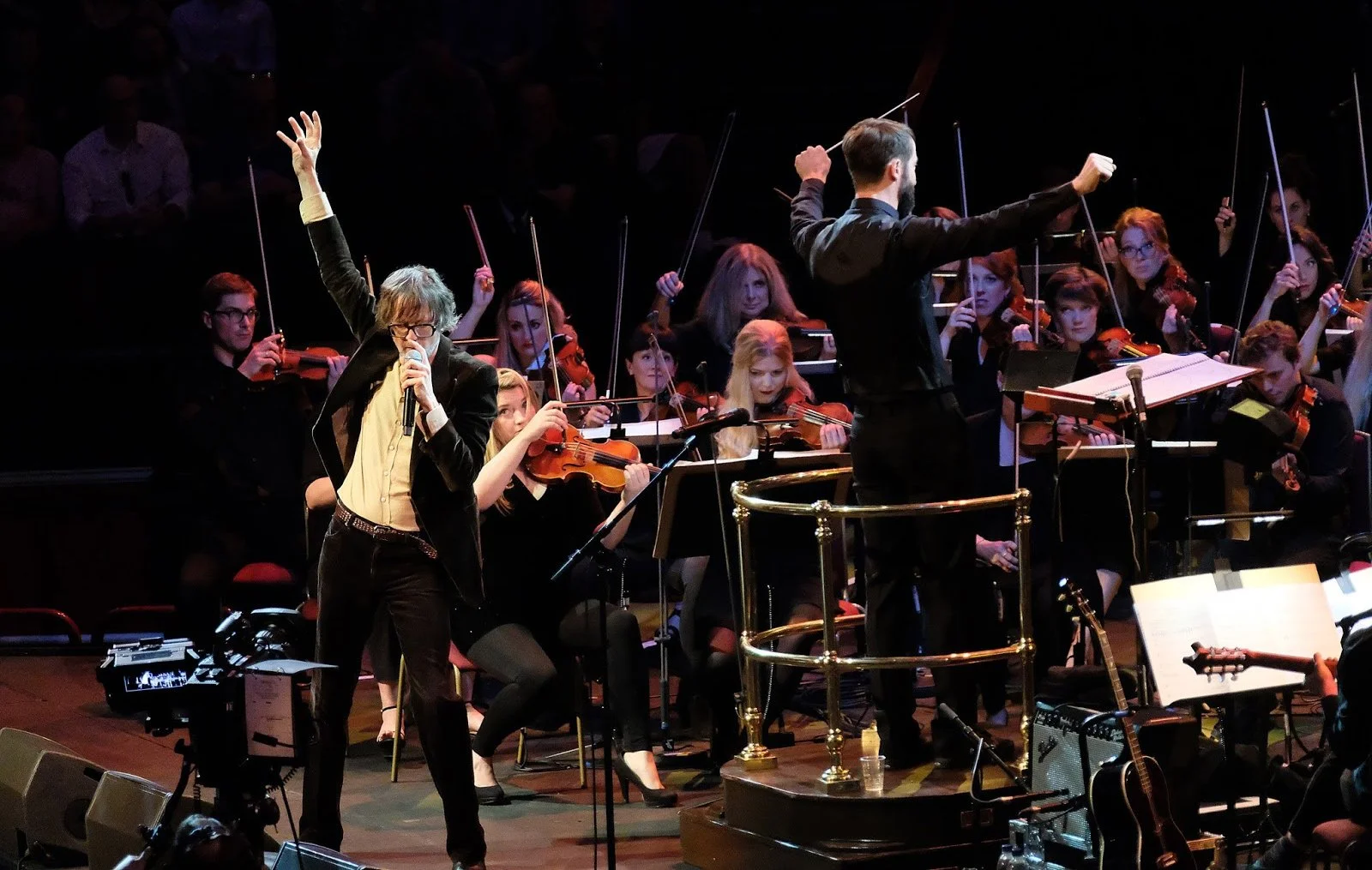
Audio Media International. 3 November 2017
By Colby Ramsey
Behind the scenes at The Songs Of Scott Walker BBC Prom
From teen pop heartthrob to experimental orchestral composer, Scott Walker has built up a substantial and vastly influential body of work in a career spanning five decades.
Some of his most significant work was arguably released on his solo albums Scott, Scott 2, Scott 3 and Scott 4 between 1967 and 1970, with iconic tracks such as Plastic Palace People (Scott 2) and The Old Man’s Back Again (Scott 4) released during this time.
In July, the Royal Albert Hall played host to a special Late Night Prom paying tribute to this period of Walker’s life and music as part of its annual Proms series of classical performances.
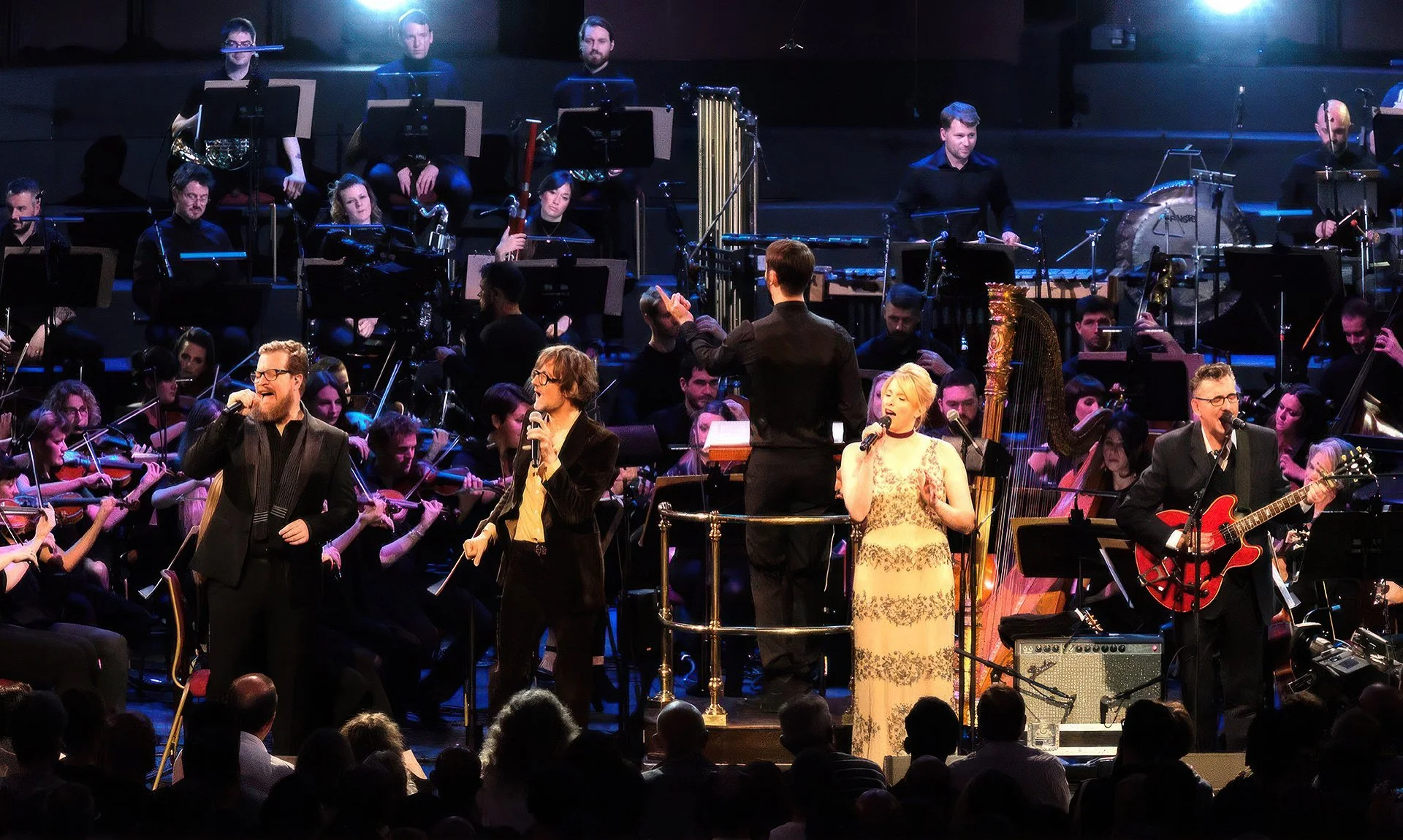
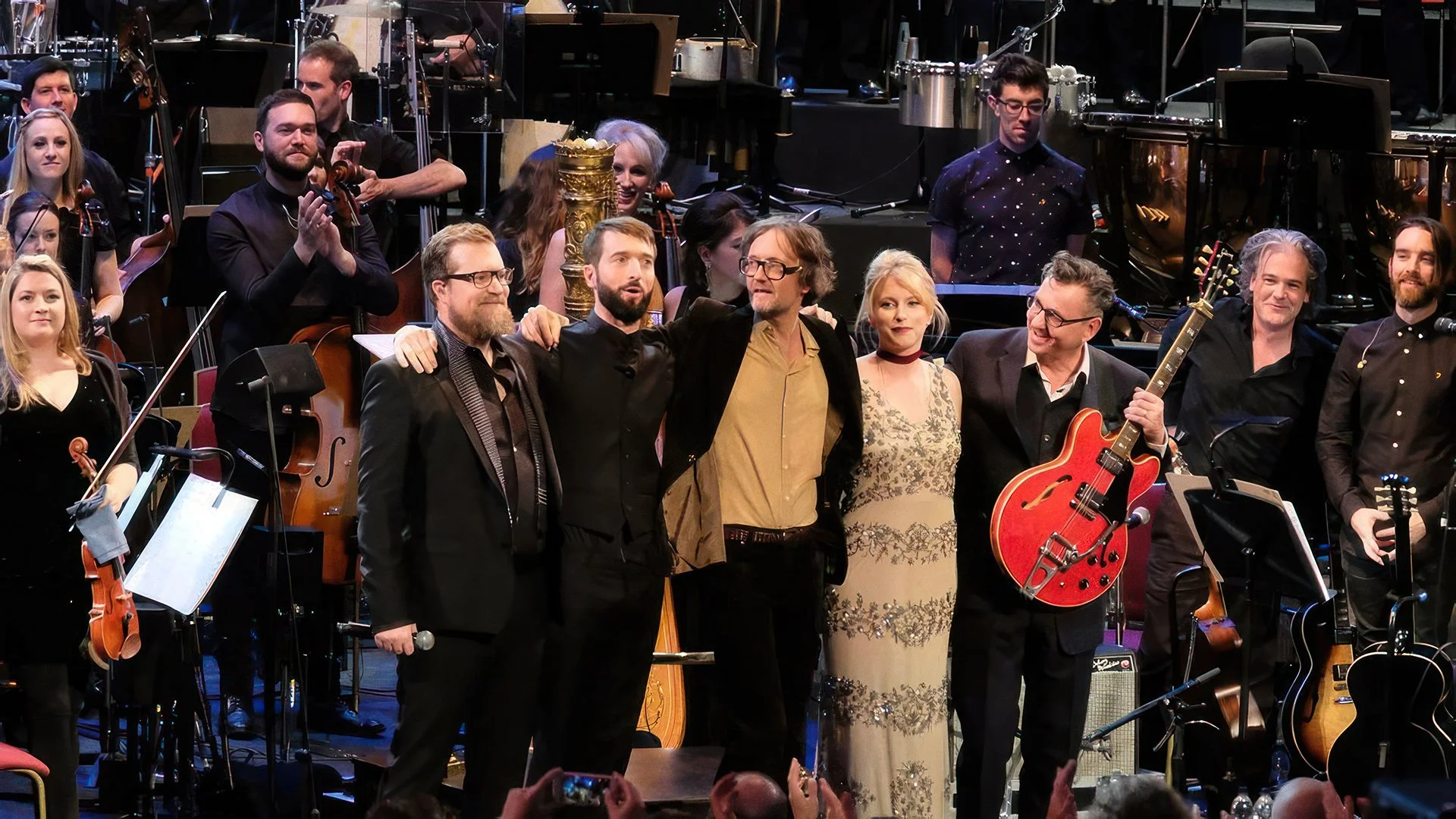
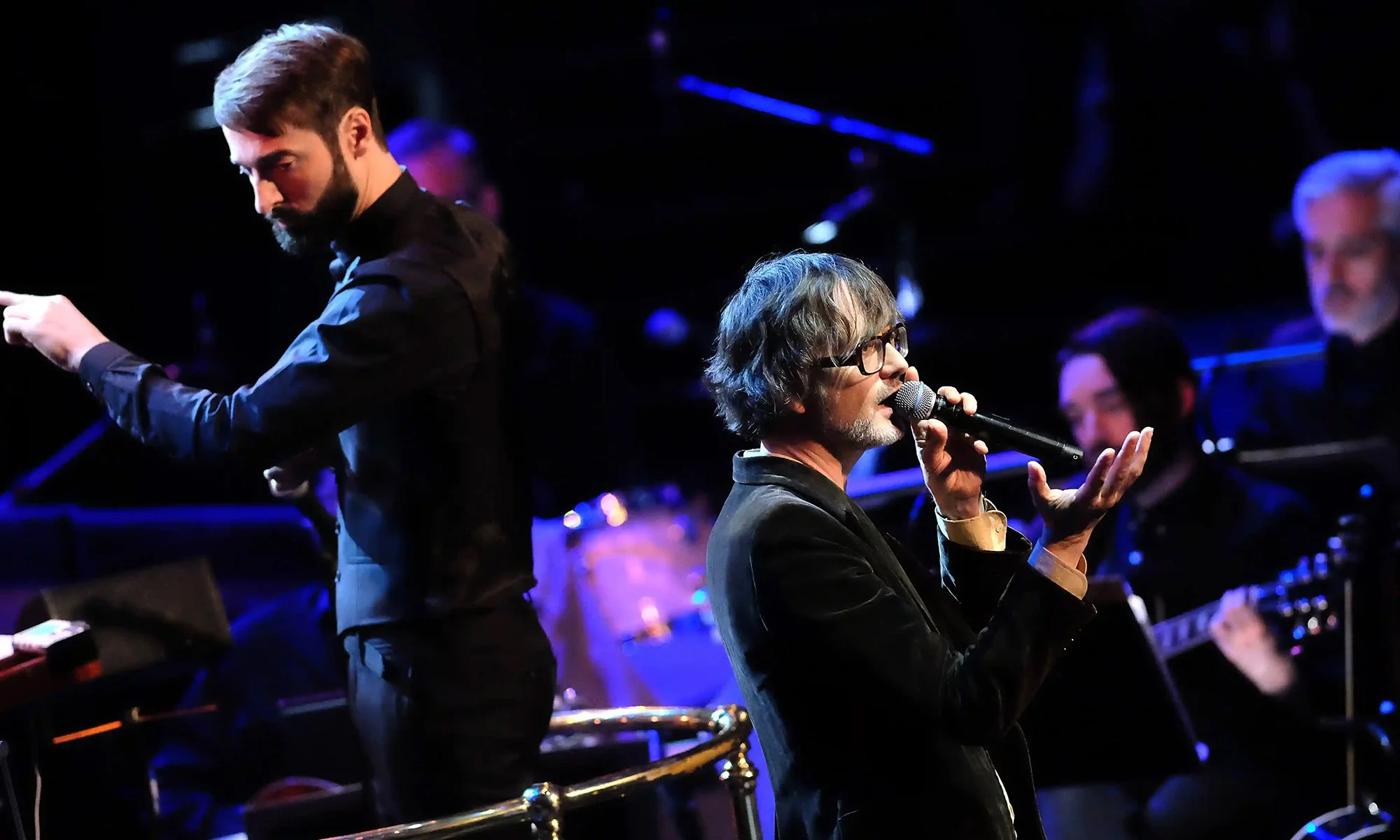
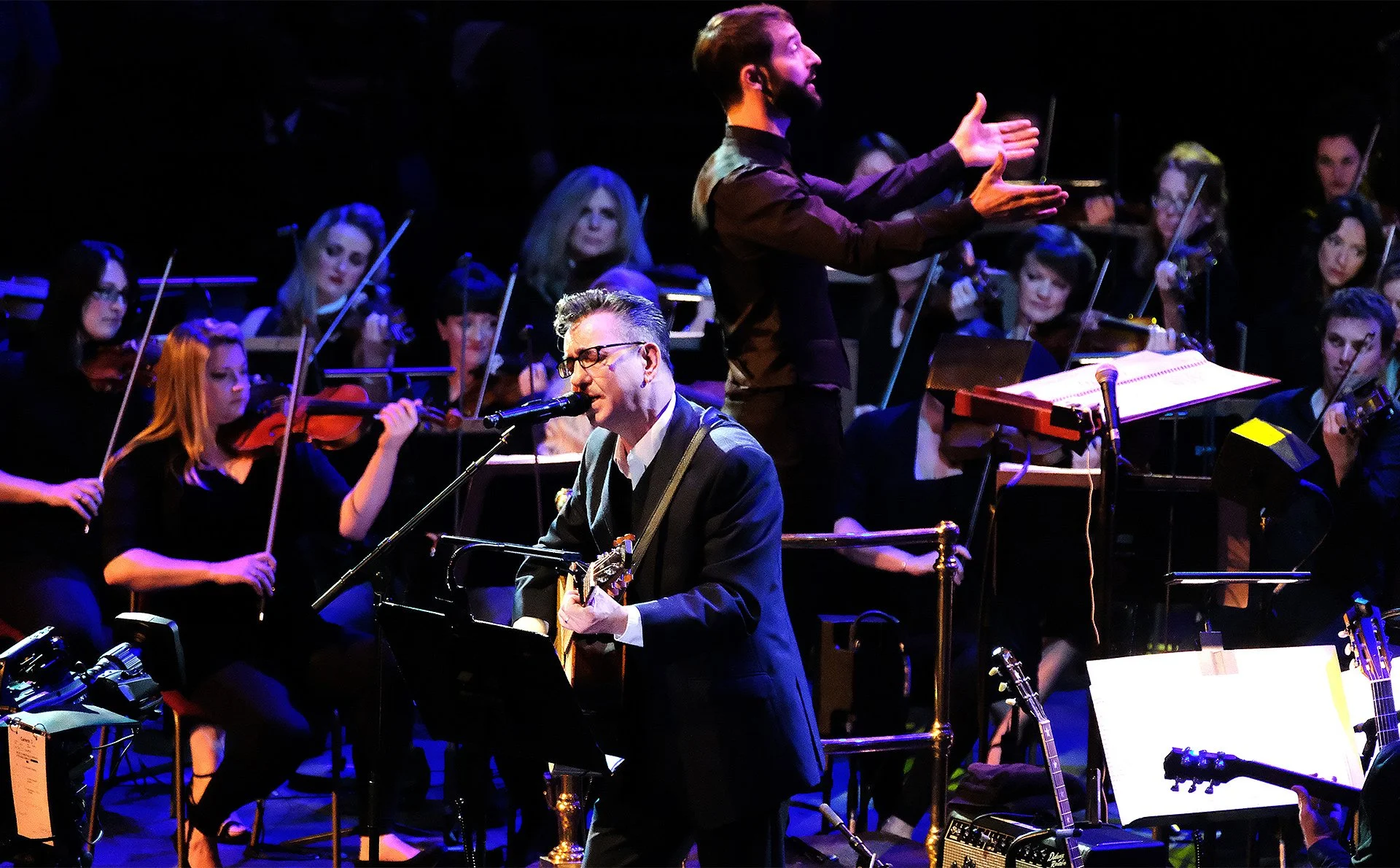
Conductor Jules Buckley and The Heritage Orchestra performed tracks from the four self-titled albums with vocals delivered by special guests Jarvis Cocker, John Grant, Richard Hawley and Susanne Sundfør.
The event saw some of these tracks performed in full for the very first time and the event was broadcast live on BBC Radio 3 and recorded for TV.
“It was an unusual project because a lot of it has not been performed before,” says senior studio manager Marvin Ware, who headed up the engineering duties behind a Stage Tec Aurus in the BBC’s OB truck Sound Three, which was present at the Royal Albert Hall for the entire Proms season. “The albums Scott to Scott 4 was the period post the Walker Brothers and many regard it as his wilderness years, but it was the orchestrations of the music that were absolutely crucial to the sound that he was creating on those albums,” he continues.
“A lot of care and attention had gone into the mixes and into the arrangements of that. That had to be reflected in the mixes that you could hear on air. There was also an affinity with Scott Walker for all four solo artists and it was an important project for the BBC to get right. It’s one of those things that will end up in an archive somewhere. It’s a one-off event.”
First steps
Getting the broadcast element of an event of this scale and significance right obviously involves a lot of planning and requires an expert level of skill, which operations manager Huw Robinson says is “characteristic” of BBC engineers.
“If you look at the Proms scenario dealing with a full classical orchestra, you might sometimes get a 30 minute rehearsal,” he explains. “It’s experience that means you’re still getting it right so that it sounds great on air. BBC engineers are known for getting stuff down in a few minutes really, because that’s the job.”
Robinson emphasises that the Proms are not like any standard date on a tour “when a group is coming into a broadcast infrastructure,” and what they are able to achieve “in the Royal Albert Hall has taken several years to turn into a well-oiled machine”.
Ware tells AMI that the first step in the process was meeting with the Heritage Orchestra, Jules Buckley and PA company Delta Live.
“From that point we start to plan it and piece it together,” he continues. “It’s basically about trying to understand the orchestrations and what the pitfalls are along the way. Then I’ll produce an extensive mic list.”
Once the initial mic list has been drawn up, the team went away to work out how to patch that all together. This event required about 170 mics to be patched up in about an hour.
“There were a lot of AKGs, DPAs and various other dynamics,” says Ware. “There were also an awful lot of condenser mics out there, which is possibly unusual,” he says.
“I do have the luxury of being able to use a lot of mics that are quite expensive, which wouldn’t necessarily fit if you were a touring band in a rock and roll world. There would be a lot of dynamics out there and an awful lot of DIs just to cut down on that spill.
“Sometimes, I do think about how many thousands of pounds worth of mics there are on that stage and often engineers will say to me, Wow, this is incredible – we never get this opportunity to use this calibre of mic on a show.”
House rules
One of the biggest complexities of this project was the way in which Ware and his team in the OB truck had to work with the FOH engineer to get the mixes right.
The PA company appointed for the Proms is Delta Live (who has been the preferred audio supplier to the Royal Albert Hall for around 20 years) with FOH duties handled by Stephen Hughes and monitors handled by Elaine Duffy.
“We’ve worked with them for several years and have a close working relationship and understanding,” says Ware. “It’s a broadcast festival, so it’s crucial to have that understanding between the two parties.”
He adds that one of the biggest issues with this particular show is that with 170 mics on the stage, he needed to work out the acceptable level of colouration and how much colouration could be removed from his personal mix.
“There is inevitable colouration from monitor speakers, the PA and the cavernous size of the Albert Hall which has quite a lot of reverb of it’s own in there,” he says.
The key to achieving the correct balance here was the choice of microphones. “The choices of microphones are absolutely crucial and Delta Live were quite happy for me to lead that,” says Ware. “I guess that’s just my 30 years of experience working in that hall with a limited amount of time.”
In preparation for the show, the broadcast team, orchestra and solo artists had pre rehearsals in Maida Vale. “The PA company turned up and did a full mic up,” continues Ware. “Then we took the whole thing into the Royal Albert Hall, rehearsed it and then took it all down. Because it was a Late Night Prom, we had a rehearsal in the morning.
“We’ll have taken everything out, hidden it in every nook and cranny backstage in the Albert Hall and then at the end of the evening concert at 9:15pm, everything came back on and it would have been re-rigged. About 170 mics had to be patched up in about an hour. It’s quite a complex project.”