
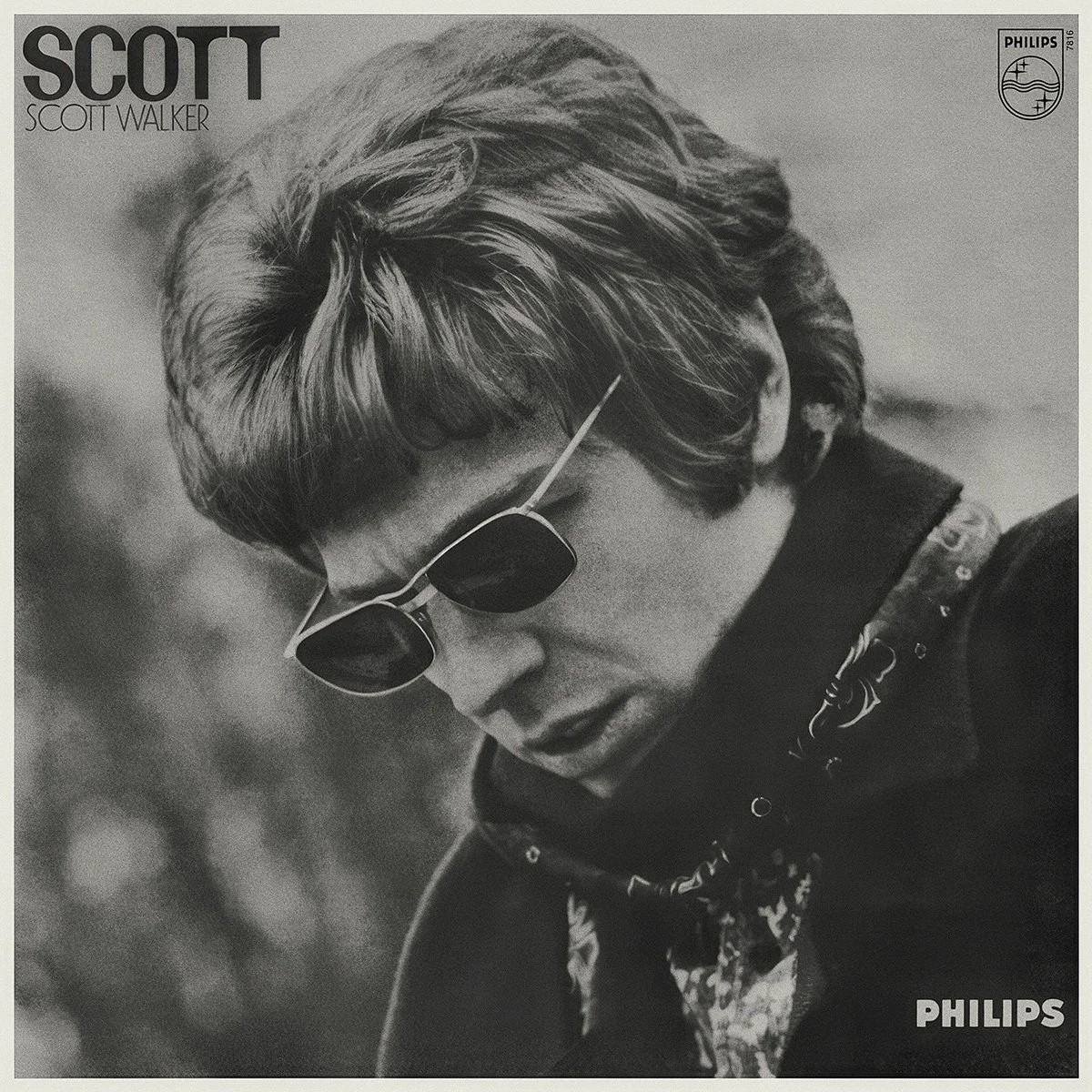
Scott
Scott Walker
Released: September, 1967. Label: Philips
Scott is the debut solo album by Scott Walker. In the US and Canada, it was given the title Aloner, distinguishing Walker as a solo artist from The Walker Brothers, whose third album, Images, had been released in March. “This is the album which Scott called ‘my obsession’”, writes Keith Altham in the liner notes. “[It] is an album for which you must open not only your ears but also your heart and your mind”.
Scott features three original Walker compositions: Montague Terrace (In Blue), Such a Small Love, and Always Coming Back to You. “I’m writing my own odd abstract stuff,” Walker told the Melody Maker’s Nick Jones in advance of the album’s release. “Like surrealistic songs done in orchestral movement.”
Walker also covers Tim Hardin’s The Lady Came from Baltimore, Wayne Shanklin’s The Big Hurt, a 1959 US hit for pop singer Toni Fisher, Angelica by Brill Building songwriters Cynthia Weil and Barry Mann, and Jack Segal and Robert Wells’ When Joanna Loved Me, recorded by Tony Bennett for his 1964 album, Many Moods Of Tony.
Two songs from film soundtracks also feature: André and Dory Previn’s You’re Gonna Hear From Me from the 1965 drama Inside Daisy Clover, and Through a Long and Sleepless Night, by Alfred Newman and Mack Gordon from the 1949 comedy drama Come To The Stable.
Scott also includes Walker’s first three recordings of songs by Jacques Brel. The album opens with Mathilde, its first side closes with My Death, and its second side closes with Amsterdam. All Brel songs were translated into English by American singer-songwriter Mort Shuman. The album was produced by John Franz and engineered by Peter Olliff, with orchestral arrangements conducted by Angela Morley, credited before 1972 as Wally Stott, Peter Knight and Reg Guest.
Scott reached No. 3 on the UK Albums Chart in its third week of release, behind The Beatles’ Sergeant Pepper’s Lonely Hearts Club Band and The Sound of Music soundtrack. It remained in the top 40 for seventeen weeks.
Track Listing
Mathilde 2:39
Montague Terrace (In Blue) 3:31
Angelica 4:02
The Lady Came from Baltimore 1:59
When Joanna Loved Me 3:08
My Death 4:57
The Big Hurt 2:26
Such a Small Love 4:55
You're Gonna Hear From Me 2:53
Through a Long and Sleepless Night 4:12
Always Coming Back to You 2:41
Amsterdam 3:04
-
Arranged and conducted by Wally Stott (tracks: 1, 2, 5, 7 & 8)
Arranged and conducted by Reg Guest (tracks: 3, 4, 6 & 11)
Arranged and conducted by Peter Knight (tracks: 9 & 10)
Production: John Franz
Engineer: Peter J. Olliff
Sleeve Notes – John Keats, Keith Altham
Written By - Jacques Brel, Gérard Jouannest, Mort Shuman (track: 1)
Written By - Noel Scott Engel (tracks: 2, 8 & 11)
Written By - Cynthia Weil, Barry Mann (track: 3)
Written By - Tim Hardin (track: 4)
Written By - Jack Segal, Robert Wells (track: 5)
Written By - Jacques Brel, Mort Shuman (tracks: 6 & 12)
Written By - Wayne Shanklin (track: 7)
Written By - André Previn, Dory Previn (track: 9)
Written By - Mack Gordon, Alfred Newman (track: 10)
Sleeve notes
by Keith Altham
This is the album which Scott called “my obsession”, and it is an LP for which you must open not only your ears but also your heart and your mind. There is great honesty of purpose in the selection of these songs by Scott for his first solo showcase, and the result is a fine example of original expression and unique interpretation.
“Solo” should have been this artist’s middle name, and if it were necessary to find any further proof that “loneliness is not just a cloak he wears” but a state of mind, it is here in his own compositions—“Montague Terrace (in blue)”, “Always coming back to you”, and the cold ethereal beauty of “Such a small love-such a little tear”.
These three songs are almost an intrusion of privacy, and the points are barbed–but so superbly made that you must realise that like “The bullfight” this is no idle “sport” but a matter of life and death, and the hope is that you too will be aware. There are some artistic people who perform through a sense of urgency which is almost a despair, so acute is their anxiety to communicate. Often they are the young. The late James Dean and Montgomery Clift seem to burn themselves up from within on the Screen. Bob Dylan’s early songs and the tortured voice of Ray Charles have this emotional quality, and occasionally the voice of experience breaks the same barrier–Sinatra has it, and Piaf had it.
There is an indefinable element within the work of these people which is an expression of their own being. Scott Engel has this same gift of communication and the intensity with which he interprets the three introspective works of Jacques Brel approaches musical genius. Scott’s version of Brel’s “Amsterdam” is a raw magnificently honest one, and superbly orchestrated. “Mathilde” is a shattering piece of vocal dramatics guaranteed to stop the show, and for a moment almost the World. “My death” is the hurt of a voice crying in a wilderness; but what a splendid lust for life as well.
You cannot explain pain, either physical or mental, to someone who has never experienced either, but mental anguish can become so solid and tangible a thing that it can become “The big hurt, and the success of this track relies on the interpretation and timbre of Engel’s voice. “There are some songs that you hear famous and gifted vocalists perform and you think, ‘My God, I would like to get my hands on that song’, and when you have been lucky enough to do this, as I have now, there is great satisfaction,” says Scott. Such a song is Tony Bennett’s “When Joanna loved me” and to follow Bennett you have to be good. One other track which must be mentioned was written by that broken singer of broken songs, Tim Hardin. “The lady came from Baltimore” is a sad, cracked little tune which Scott sings with the gentle touch of one who knows the package is fragile. And while we applaud the result of this musical journey through Scott’s mind we must not forget those sensitive arrangements by Wally Stott, Reg Guest and Peter Knight who have conjured “musical spirits from the vasty deep” for these inspired orchestral settings. When Scott Engel (I use the surname because it is his real name and I know few more real people) sang with The Walker Brothers, he had a little-boy-lost image, but this album is a man’s work, and the portent of greater things to come. Should some of the truth on this album offend, should the light be too bright for some, we might be permitted the device of using the words of another young man who wrote with the fire of burning youth:
“Beauty is truth, truth beauty - that is all. “That is all ye know on earth, and all ye need to know.”
– John Keats.
Live Review
Melody Maker, 12 August 1967
by Chris Welch
Scott sheds his pop wings in Stockton…
SCOTT WALKER’S cabaret debut with the Ronnie Scott band at Stockton’s fabulous Fiesta Club on Sunday, marked the emergence of Scott as an important new quality singing star, and the shedding of his pop wings.
The young, good-looking American took to the opulent and demanding audience with a surprising stage confidence that swept away his old introvert image. His casual chat in rich, musical, cultural tones was almost as impressive as his singing.
Slim, in a black mohair suit, with hair brushed high, Scott stepped into spotlight and warm applause laced with girlish squeals, and opened with a tearaway version of ‘Gonna Travel On’. He sounded a little shaky on the first couple of numbers but as his confidence grew he got into his stride and conveyed sadness, sensitivity and occasional bursts of strength.
The powerhouse band, when blowing at its brassiest, tended to overpower the vocals, but for the most part they played sympathetically and the Walker diction was impeccable.
Some of the more aesthetic and poetically frank lyrics by composers like Jacques Brel made some of the audience feel uneasy. But while Scott’s use of interesting and unusual material may have disturbed those expecting Walker Brothers hits, it showed his determination to stick to his musical ideals. He is in the tricky position of trying to gain a whole new audience and retain his young fans.
“He’ll be another Billy Daniels, that kid,” a blunt voice was heard to comment from behind a cloud of cigar smoke.
Ronnie Scott’s band included Ronnie (tenor), Bunny Cauld (baritone), Ray Warleigh (alto and flute), Norman St Pierre (trumpet), Stu Harvey (trumpet), Tony Gilbert (trombone), Johnny Patrick (piano), Terry Smith (guitar), Kenny Baldock (bass) and Tony Crombie (drums).
Ronnie explained how the teaming of Scott and Scott happened.
“I spoke to Scott in my club one night when I knew he was going solo and suggested getting something together. I knew he was not just a pop singer and had very good taste. I was getting fed up with just playing with a quartet in the club and wanted a change of scenery.” Who did the arranging? “Well, I couldn’t arrange a vase of flowers.”
“Some of the scores were by Jimmy Deuchar, some by Stan Tracey and Wally Stott. We had about three days rehearsal. There’s nothing way out in the music — just some nice arrangements and a little bit of jazz.”
Said Scott Walker:
“The band is the best you’ll ever hear. Ignore me — just listen to the band!”
Audio Recording
“Billy Cotton Band Show” TV BBC Studios, Shepherds Bush
More & My Death. 8th August 1967
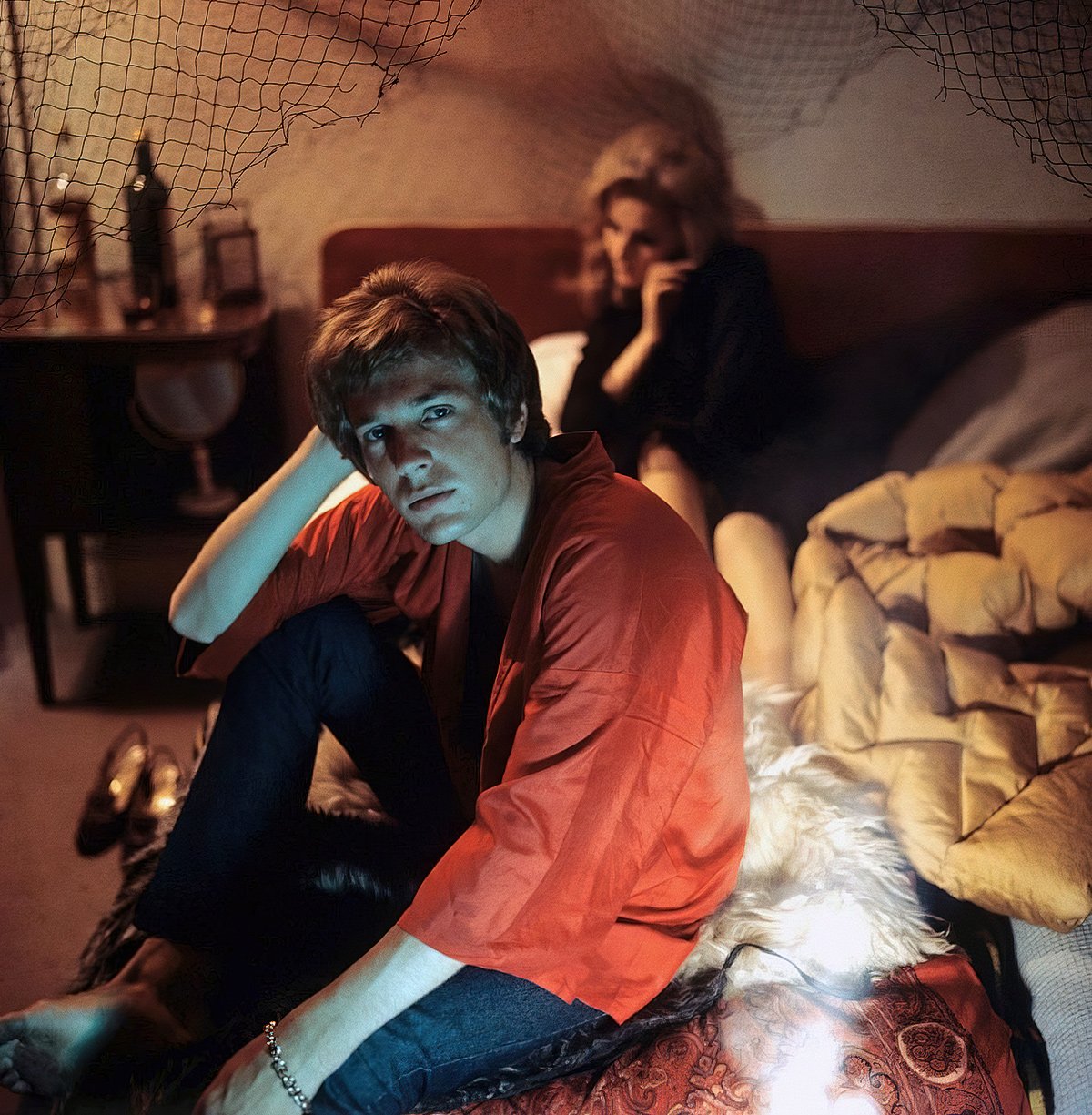
Photo by Dezo Hoffman
Interview
New Musical Express - 24 July 1967
by Keith Altham
Scott Walker: Scott Keeps One Step Ahead
AND SO THE moving singer, having moved — moves on. Scott Walker is still one jump ahead of the fans in his pursuit of privacy. Having completed his new LP Scott (released mid-August) pop’s most famous recluse invited me round to his latest London retreat to hear the album for which I was pleased to write the sleeve notes.
“Don’t ring the bell,” Scott warned me over the phone. “It’s been disconnected — knock four times on the window.”
And so on a beautiful summer’s day, with the temperature in the eighties, I found myself in the gloom of Scott’s new apartment where the curtains are drawn permanently, and a huge veteran of several fan uprisings guards the door and brings the tea. Scott sat huddled up in an armchair clasping a guitar. “The fans have found me again,” he sighed. “It’s become a sort of a game now — they climb over my back garden wall, so I hide in here all day and go out for walks only at night.”
Loneliness is a condition of mind with Scott and further evidence is to be found on this first fine solo LP. The album is essentially a collection of sad love songs but with some majestic orchestrations by arrangers Wally Stott, Reg Guest and Peter Knight which lift the songs off the wax and into the living moment.
“This album is more than just my first solo work,” said Scott. “It is an obsession. I’ve been living with it day and night for the past four months. It was produced like an epic movie. I’ve put everything I believe in into this LP.”
“I’m not issuing a single first because it would not be possible to convince people of the things I’m striving for. It is possible that if one particular track gets a strong reaction we may issue that as a single.
“’Mathilde’, which is a Jacques Brel composition, is my personal favourite. It is just that everything went right on that number, the atmosphere was right, the musicians were all feeling the song and I felt the same.
“The album is not intended to be a particularly swinging one — it is meant to make people think and, more important, to make them feel.”
“I’m trying to do something which has never been accomplished in this country before and has only been done previously by a few top continental artists. I believe in it and I hope others will.”
There are three of Scott’s compositions on the album ‘Such A Small Love — Such A Little Tear’, ‘Always Coming Back To You’ and ‘Montague Terrace In Blue’.
“All my songs are written from personal experience,” admitted Scott, “it’s the only way I can write. ’Montague Terrace’ was written about two young friends of mine who have not long been married — they live in quite small rooms and are always dreaming of a place in Montague Terrace — their dream house. Sometimes when I’m very down I go to visit them because they are very much in love and they make me feel good to be with them.”
“’Such A Small Love — Such A Little Tear’ is a song about the way a man feels about his best friend, who has just been killed.
“He is at the funeral and he sees a girl who was with his friend the previous night and he knows that her feelings for this man she knew so fleetingly are nothing compared to what the man was really worth.
“The musical effects on this were the result of some of my research into religious music.”
Three of the tracks on the album are Jacques Brel numbers translated by American Mort Shuman — ‘Mathilde’, ‘My Death’ and ‘Amsterdam’ which is likely to cause a storm of controversy due to the basic language.
“’Amsterdam’ is no tea party,” said Scott. “The lyric concerns the sailors of that port and it is a story told in their language. It is real and it is honest. The translations are as close to the original as Shuman could get and I stand by them.”
Other songs on the album include Tony Bennett’s ‘When Joanna Loved Me’ and Tim Hardin’s composition, ‘The Lady Came From Baltimore’. Does the possibility that much of this material may go over the heads of some of Scott’s younger fans concern him, or is he deliberately aiming at an older market?
“You don’t really believe the Mums and Dads who sit down to watch Coronation Street will bother to listen to this album do you?” asked Scott.
“It has to be said that I am a primitive singer and I’m glad. I would not want to be a perfectly well oiled machine.
“This album is for young marrieds, young single people, and those still sensitive enough to remember what youth was all about.”
Scott is also worried — he would not be himself if he were not worried — about the cabaret he begins shortly in the North. He calls it “my getting myself together period” and hopes not too much is expected of him.
“It’s a prelude to doing concert appearances,” says Scott, “a kind of paid rehearsal.”
AND WHAT if all Scott Walker’s dreams come to nothing and there is no recognition?
“I’d give the whole business up,” says Scott. “I could never compromise on something which is as important to me as this.
“I believe in it and I believe the British public will accept something artistically new.
“I don’t believe that I would have any better luck in America — the British charts are musically much more aesthetic. If I can’t make it here I won’t make it there.”
Scott has enough faith to be applying for British citizenship in a few months and enough to be already working on the next album.
Interview
Rave - October 1967
by Maureen O'Grady
“I suppose I am scared. I want to get the right message across right now, without falling into black or white, like Sinatra or pop. That is very important to me, to establish myself as myself.
“I just want to sing honest songs in a primitive way. After all, I think I am primitive. I don’t want an image. That’s what I’m breaking away from.”
Scott has started off his solo career by playing weekly stints in north of England clubs. With him he has taken ten men, all true jazz musicians, such as Ronnie Scott and Tony Crombie. These club dates, says Scott, are just rehearsals, preparations for his real debut. Routine is unusual for these jazz men — to play seven nights a week at the same place at the same time every night isn’t them, but with Scott they don’t feel it’s routine.
“These dates are just a warm up, to get me on my feet. I’ll learn the tricks, learn how to feel an audience. I’m still learning for the stuff I eventually want to do, like concerts at the Royal Festival Hall and Royal Albert Hall, with a thirty piece band.”
Scott decided, for his recording debut, to release an album, not a single.
“Well, I want to be known as an album artist, that’s all there is to it. I worked very hard on my first album. It was important, an obsession with me. I wanted to create something a little different from anything else I’ve ever done. I spent a lot of time and money on it. I’m rather like Dusty Springfield in that I will give whatever time or money is necessary to achieve perfection. I want to sing about experiences of human life.
I can’t be really happy, so I’m methodically sad. People nowadays are lying like crazy about everything, even about love, especially in this business. I feel it’s important to feel something, happy or sad, and I know it’s my vocation to make people feel sad.
I want to make people feel something. I want them to walk away after hearing me sing, and feel as though they’ve experienced an emotion. The whole point is that I’m trying to be honest with the songs I write and sing.
“I’ve already started on my second album. I wrote six songs for the first one, but threw three of them away. I sang four by Jacques Brel, my idol. I’ve been a fan of his for so long now, but have never heard him sing in person. I never will now,” he said quite sadly. “He retired last year.”
When he writes his songs, he’s not inspired by love or anything so romantic. He’s more interested in human failings, which he himself admits to having.
“I’m inspired by what I know, people and situations around me. Maybe a book, a line. People interest me, what they say and do — or rather what they tell you and then do, which is usually quite different. I’m interested in hypocrites, liars, debauchers, cowardice, drink, prostitution.”
I’ve had to move twice already since I’ve been on my own,” he grinned. “Fans are wonderful, but those that respect my privacy are even more wonderful. They’ve stuck by me. I miss nothing about the Walkers. I still won’t put up with the hangers-on that always flocked around us. I’ve had all that bit and all the luxuries that went with being a pop star. The girls and all that. I’ve done the big star bit and I’ve had enough. Really though, I suppose I do miss Gary. How many are there in the Hollies? Five? He’ll probably become the sixth Hollie and be very happy,” he said fondly.
In another room, Scott’s road manager Ralph, who lives with him, was facing up to life. “Forty to fifty fans we have outside the flat every day,” he said.
“Scott wants to move again, but I won’t! I have to lug around 5,000 LPs and all his hi-fi equipment every time we move. We’re not moving again, are we Scott?”
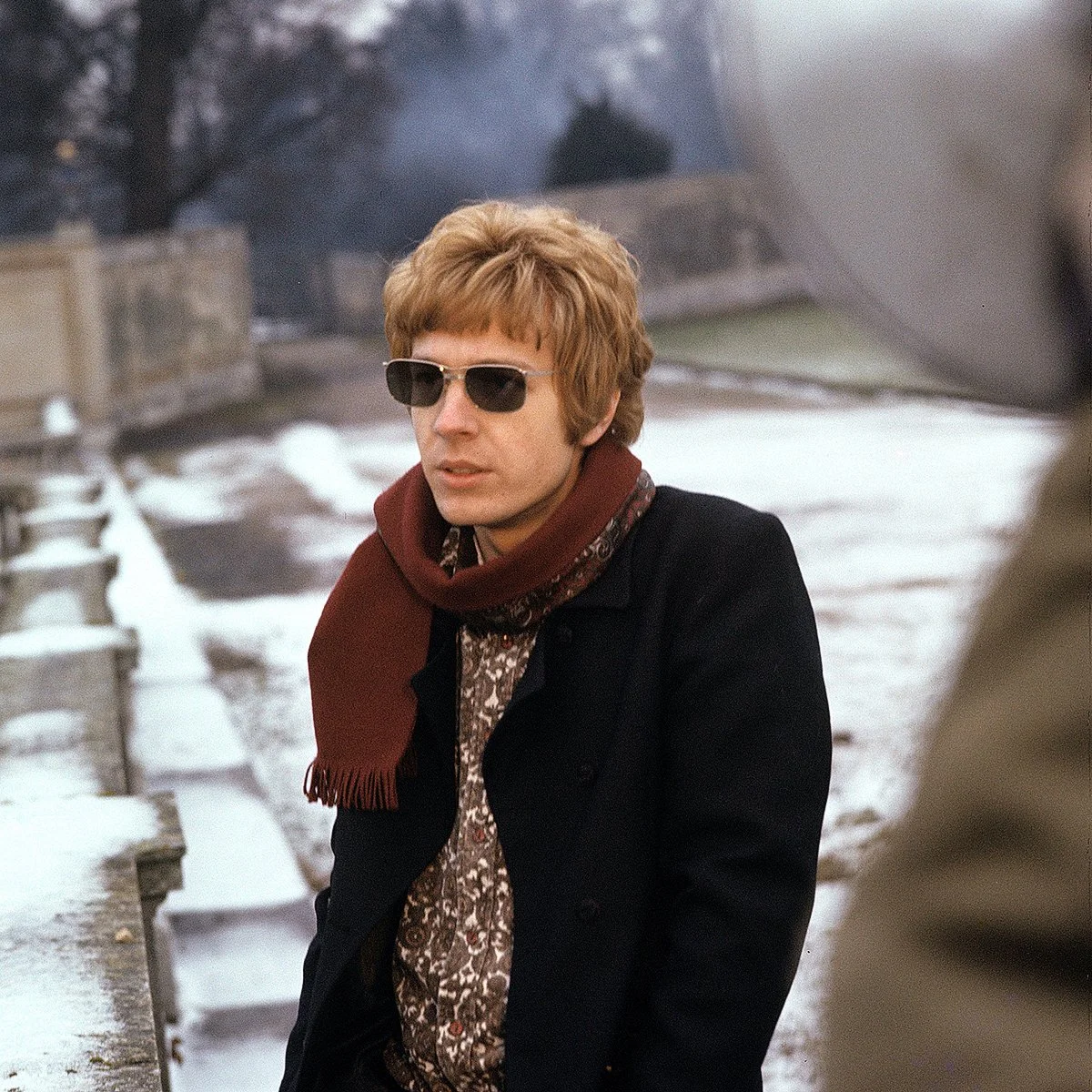
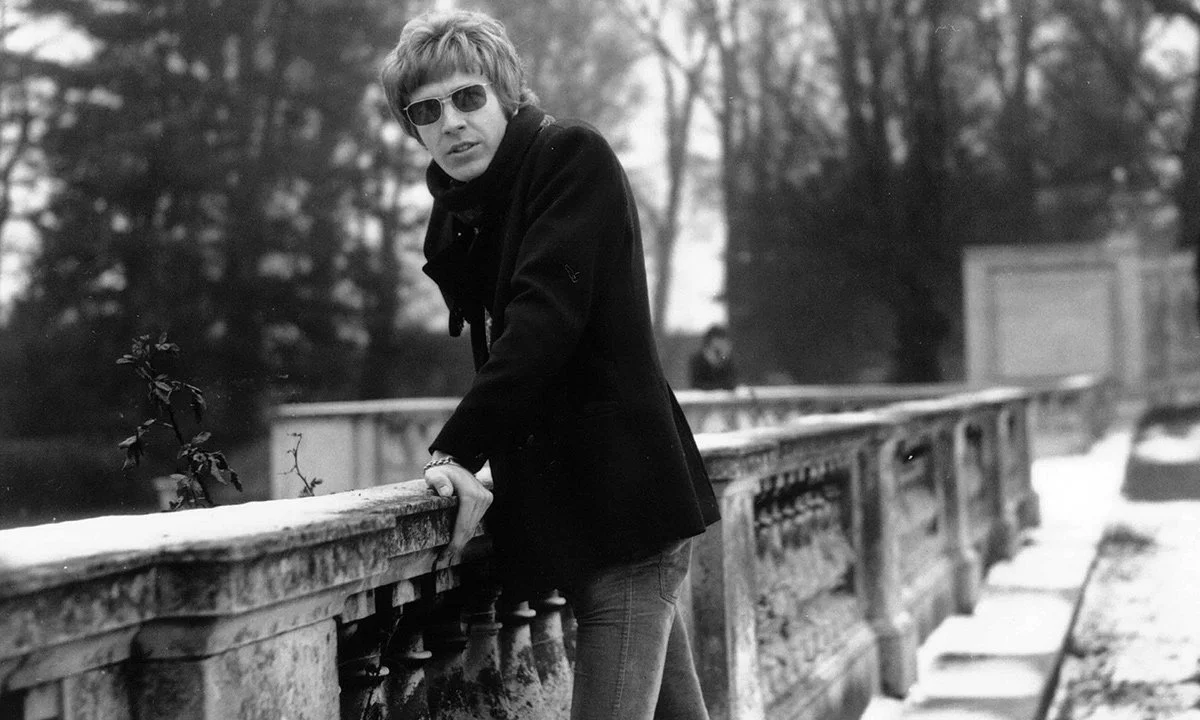
Photos by Dezo Hoffman