Take It Easy with the Walker Brothers
The Walker Brothers
Released: November 26, 1965. Label: Philips
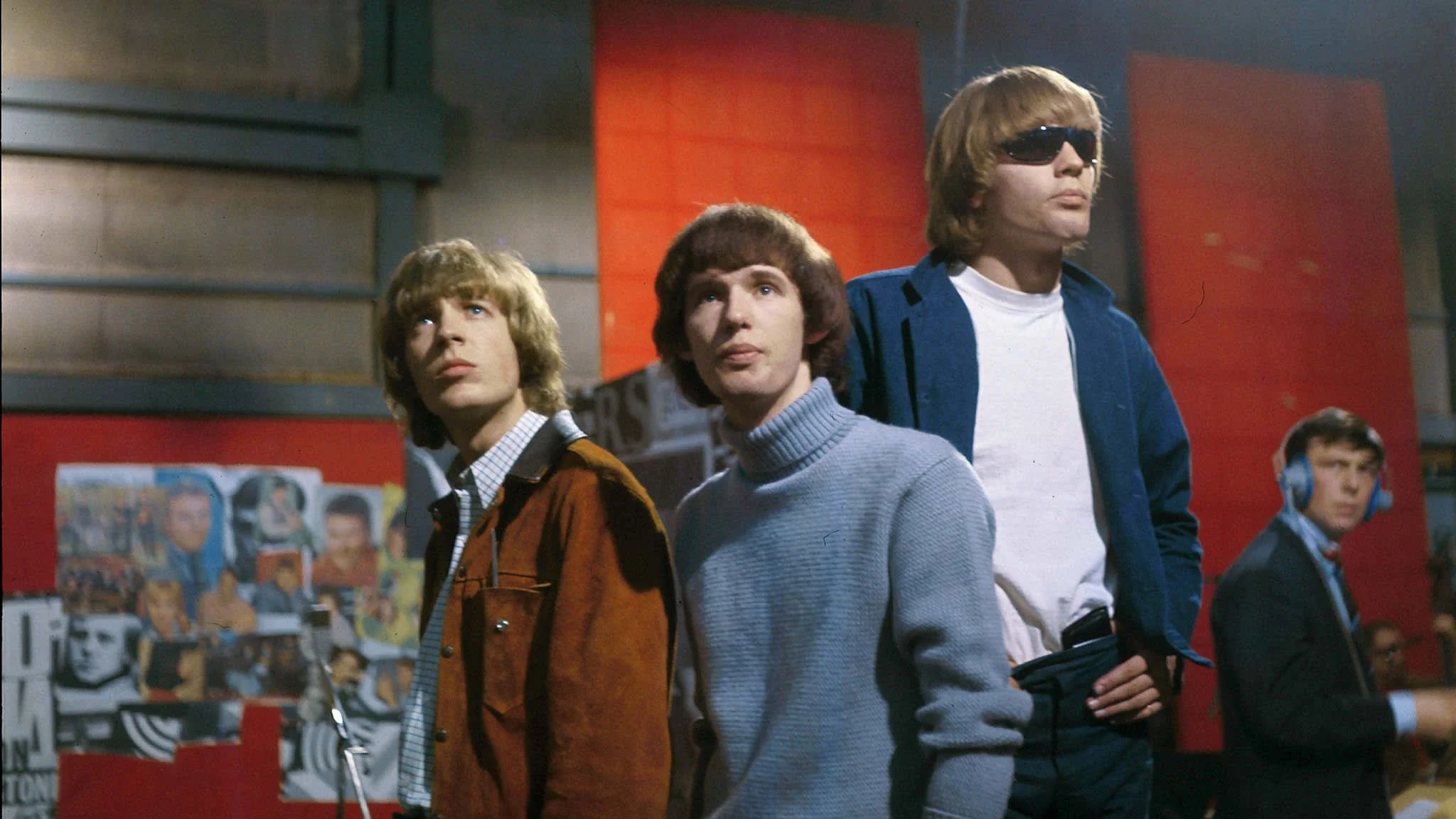
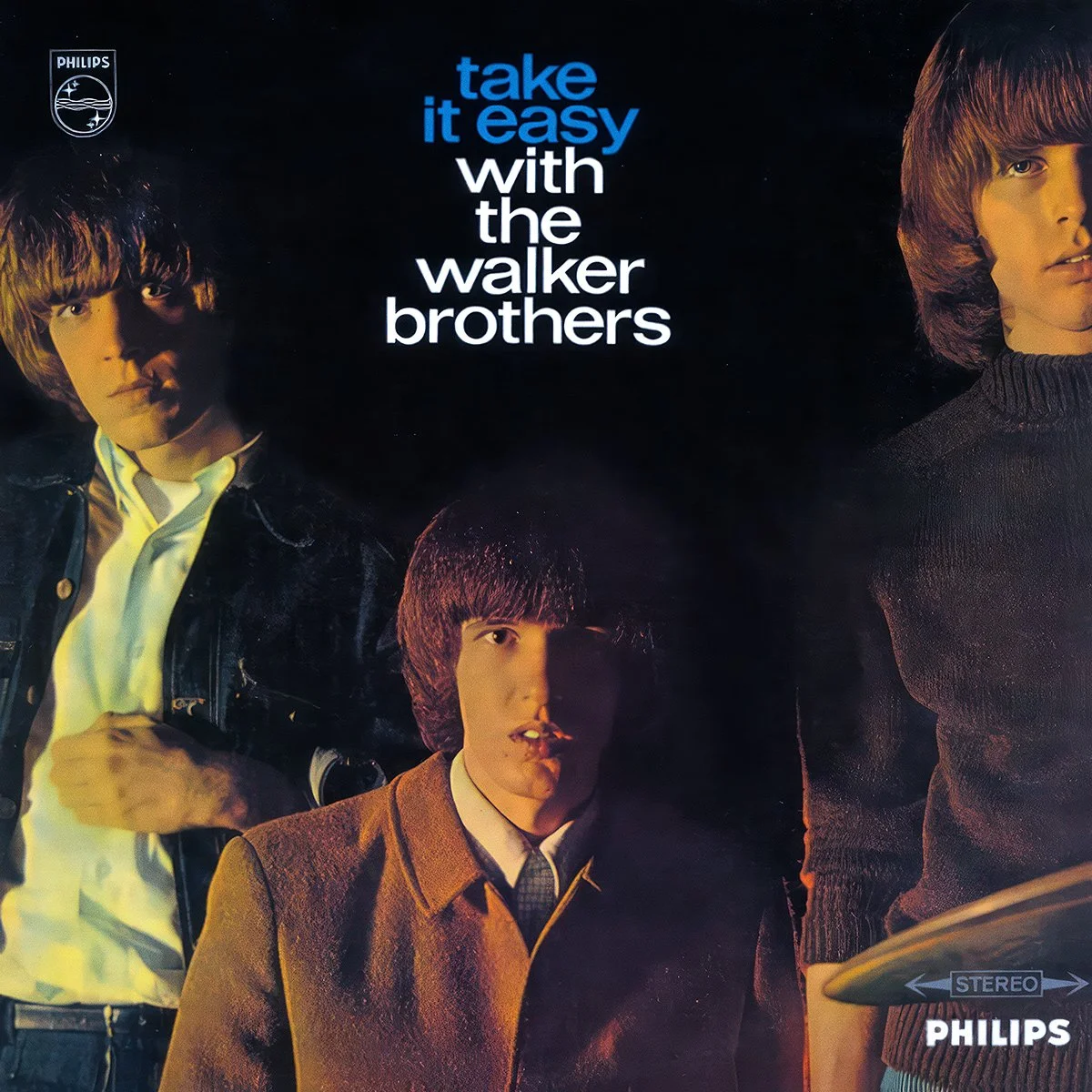
Take It Easy with the Walker Brothers, also known as Take It Easy, is the Walker Brothers’ debut album in the UK. It comprises cover versions of contemporary songs, and one original, You’re All Around Me, co-written by Scott Engel and British singer-songwriter Lesley Duncan.
Opening with Burt Bacharach and Hal David’s Make It Easy On Yourself, a number one single for the group in September, Take It Easy includes songs by other popular singer-songwriters like Ben E. King’s There Goes My Baby, a 1958 hit for The Drifters, written with George Treadwell and Lover Patterson, and Marvin Gaye, Ivy Hunter and William Stevenson’s Dancing In The Street, a hit for Martha Reeves and the Vandellas.
R&B songs by Lowman Pauling and Chris Kenner also feature alongside Bob Dylan’s Love Minus Zero/No Limit and Randy Newman’s I Don’t Want To Hear It Anymore. Ivor Raymonde directed the musical accompaniment, and the album was produced by John Franz and Nick Venet.
The sleeve notes, written by Brian Mulligan, press officer for Philips Records, include quotes from British DJs. “So we lost the American War of Independence,” says Tony Blackburn. “So what! We’ve got the Walker Brothers and that’s more than equalled the score.” Mulligan also describes the “phenomenon” of the Walker Brothers’ success in 1965, highlighting their silver disc for sales of 250,000 copies of Make It Easy On Yourself and Most Promising International Act award in that year’s Melody Maker Poll. The cover photography is by Terence Donovan.
Take It Easy With The Walker Brothers spent five weeks at number 3 in the UK charts and 36 weeks in the UK top 40.
Track listing
Make It Easy on Yourself
(Burt Bacharach, Hal David) 3:14There Goes My Baby
(George Treadwell, Lover Patterson, Benjamin Nelson) 3:08First Love Never Dies
(Bob Morris, Jim Seals) 3:37Dancing in the Street
(Marvin Gaye, Ivy Hunter, William "Mickey" Stevenson) 3:50Lonely Winds
(Mort Shuman, Doc Pomus) 2:37Girl I Lost in the Rain
(David Gates) 2:48Land of a 1,000 Dances
(Chris Kenner ) 2:35You're All Around Me
(Scott Engel, Lesley Duncan) 2:39Love Minus Zero/No Limit
(Bob Dylan) 3:05I Don't Want to Hear It Anymore
(Mort Shuman, Doc Pomus) 3:48Here Comes the Night
(Randy Newman) 2:27Tell the Truth
(Lowman Pauling) 1:51
Credits
Music Director - Ivor Raymonde, Reg Guest
Producer - John Franz, Nick Venet
Arranger And Conductor - Jack Nitzsche
Drums, Vocals - Gary Walker
Guitar, Vocals - John Walker
Vocals, Guitar, Keyboards - Scott Walker
Accompaniment - The Quotations
Photography - Terence Donovan
“This was a great opportunity for me to make music. And I kind of sensed it back then. I just knew that this was good stuff. We could just sense the talent in each other - him to use me for his backings and me to be one of the few who could see just how good he really was. When he heard some of the sounds in the studio for the first time he used to be thrilled to bits. I thought 'good, I've got it right”.
Reg Guest on getting the job as Scott's arranger
Interview
New Musical Express, 17 December 1965
by Keith Altham
Walker Brothers get flat smelling ‘funky’ then they’re thrown out!
ON THE large green door of their flat, a fan has scraped P.J. Proby’s name in large letters. The door knocker disappeared along with the bell some months ago, prey of ardent souvenir hunters. Inside the flat I found — temporarily — Scott and Gary.
“They’re throwing us out!” sighed Gary. “A little man came around the other day with a big petition signed by about 100 people who claimed to have heard our last party about three blocks away. Then he began to take an inventory of the fixtures in the flat. He just kept noting down things and repeating ‘Wal, that’s been destroyed’ and now we gotta go.”
He ushered me into the living room, which looked rather like Gamage’s Toyland after a cavalry charge. On the wall hung a six-foot purple scarf which was embroidered with names of Scott, Gary and John. A large Union Jack was spread across the opposite wall and a full-length picture of Francoise Hardy (property of Scott) pinned up in one corner. The mantelpiece, floor and odd corners were completely buried with toy animals and gonks of every description that have been given to them by the fans.
Philosophic
Scott was philosophical about their eviction: “We’d just got the place smelling nice and ‘funky.’ You like the smell in here, Keith? We put a kipper in the hot air machine to get that just right about three days ago!”
I was introduced to the new inmate — John Stewart — who is one of Scott’s close friends and has just flown over from California to join him in his newly formed Super Records company.
Scott talked to me about some of the problems he hopes to overcome while producing his independent recordings. “It’s not like Andrew Oldham says, that you have bad studios here,” said Scott. “It’s the approach and attitude to recording which is bad.
“What I object to at Philips is that just as we are getting a nice feel on the disc and the atmosphere is right, suddenly everyone gets up as one man and off they go for a tea-break. The feeling is completely lost. Also we are expected to record three tracks at every session.
“When I record at the Pye studios next week with an 18-piece band we’ll do one number until it is right — even if it takes eight hours to do it.
Gary solo
“We are also going to record Gary as a solo vocalist next week. He is the only one of us who is not contracted to Mercury Records as a vocalist and so I can record him independently and we’ll sell to the highest bidder.”
I asked him if he was happy about their newly released, first LP Take It Easy With The Walker Brothers.
“No, I’m not,” said Scott, who is his own severest critic. “I don’t know why, because everyone else is happy. But I feel that on some of the tracks, like ‘Land Of A Thousand Dances’ and ‘Dancing In The Street’, we should have taken more time. Several of the tracks were rushed and are unbelievably bad.”
“But some things on it are really beautiful. I think you’d dig tracks like ‘The Girl I Lost In The Rain’ and ‘First Love Never Dies’.”
Interview
Rave 1966
by Dawn James
“The sort of things I care about are hard to explain,” he said, slowly and with careful thought. “General things that might be expected to count with me, don’t. I’m not impressed that I am a Walker Brother and have many fans. I like being me for the reason that I have done at least one thing I set out to do in my life. I’ve made a hit record, and the fans have appreciated it. That is great because it is achievement, and achievement is progress.
“If I had to give up something that mattered to me, it wouldn’t be my singing career, but the way I feel about music in general.”
He likes to paint, and his make up is such that he would probably return to art school in America, if it were not for the other two Brothers.
“I have them to consider,” he said.
“Even if I am an isolationist, life is such that it demands I think of others. No one is free to think entirely for themselves.”
The emotion I get from good music, and my own music, is beautiful. I can be depressed by it, and feel certain anxieties because of it, but I like all emotions. Emotions, after all, is what life is all about. Sadness can be a good feeling, I don’t run away from it, and I don’t dislike it.
There should be more emotion involved. The most beautiful paintings aren’t always those you appreciate immediately. It’s the same with sound.
“I use all sorts of weird techniques in recording. For instance I’ll use five pianos playing one figure. And the result is beautiful and bursting with emotion. I use sound like a performance.”
Ivor Raymonde on Scott
Ivor Raymonde was a well respected professional who was best known for some exquisite work with Dusty Springfield. He loved ‘Make it…’ and established an instant rapport with Scott and co.
“Ah! What a joy to record a song like that!” he told London radio 25 years later, “I mean the song itself is beautiful. Putting an arrangement to it is absolutely magic.
“Between Scott and myself, we devised an orchestra that would be The Walker Brother’s band - if you know what I mean. So we had three pianos, four guitars, umpteen Latin American instruments, percussion... a sound that we hoped would be the ‘Walker Brothers’ - and of course, it worked.”
Arranger Reg Guest on Scott
Melody Maker, 3 September 1966
by Chris Welch
Arrangers are not common household names, but Guest’s work is known by all due to his arrangements for hits such as ‘You Don’t Have To Say You Love Me’, ‘Shout’ and ‘As Tears Go By’.
Walker on Guest: “It’s the fault of so many arrangers today that they profess to hate what they do in pop, but he believes in what he’s doing”.
Over the years Reg Guest was dismissive of his work in the 1960s as house arranger for Philips and Decca, but of his work with Scott Walker he said:
“This was special. I knew that Scott was a really creative artist but I also knew that he wasn’t a chart performer. He was also to most people a bit weird, I suppose reclusive. There was something very private about him but we were very friendly.”