
Guy Barker on Walker’s Duet For One Voice, Lullaby, Bull, Brando and Epizootics!
Audio Transcript
Peter Walsh in conversation with Guy Barker
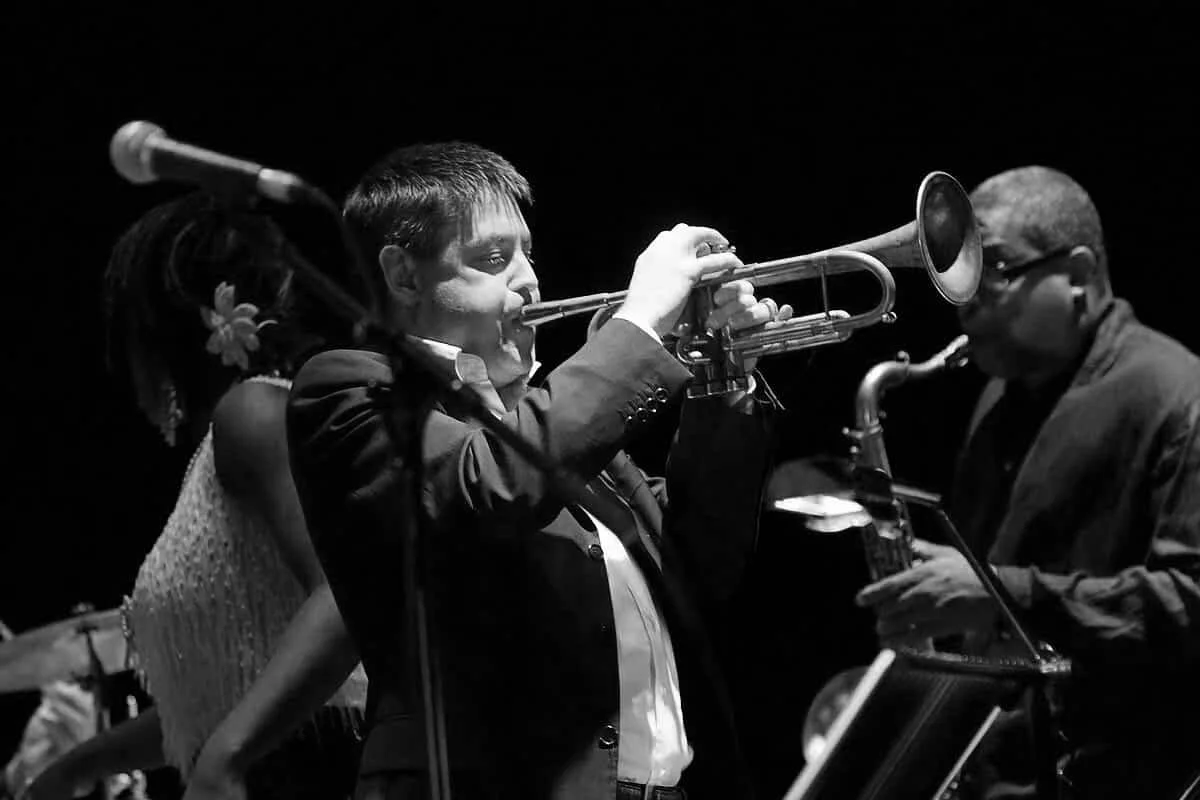
Peter Walsh I’m talking to Guy Barker: British composer, band leader, and trumpet player. He’s worked with a diverse selection of artists, from Frank Sinatra, ABC to the Moody Blues. And on Scott Walker’s Duet for One Voice, a soundtrack commissioned by the Royal Opera House. You can also hear him on Bish Bosch, and on Scott’s collaborative album with Sunn O))), Soused.
Guy, we go back a long way – even actually further than when we worked on Scott’s records.
Guy Barker Oh, absolutely! I’ll tell you how far we go back: I was working with you and Greg when the storm happened in 1987, remember that? Because there was a tree in Greg’s garden, that fell down …
PW Okay, for those listening, Greg’s my brother. It was very much the 80s pop scene, wasn’t it, and we were doing all these kind of brass section sessions, with usually two trumpets, a sax and a trombone, I think.
GB Yeah.
PW And I know you’d played on loads of stuff, like ABC, and Erasure, and Style Council. And I remember we even got you out to Berlin to play on some Alphaville sessions that I was working on.
GB I remember that very well, because the studio was right next door to the Wall. And there was a step, so you could go and look over.
PW That’s right. At Hansa. Hansa Studios.
GB Yeah! Yeah I remember working in that studio.
PW I’d always wanted to introduce you to Scott, because I knew he would love the sound that you produced. The lovely sort of warm tone. And especially on a project that we were working on at the time, called Duet for One Voice. Which was actually performed at the Linbury Theatre. So we got you down to Kore Studios in Acton for a session. What was it like, meeting Scott for the first time? Any recollections?
GB I loved it, because I didn’t know what to expect. When I got the call, you said, Oh, come down, we’re doing this recording with Scott. And then you said, Oh it’s for a ballet, I think.
PW That’s right.
GB For a ballet. And I said, What do you want me to do? And you said, Well, we’ll tell you what we want you to do but we want you to improvise, but we’ve got specific ideas. And the wonderful thing was, when I heard it start, and I really realised that this music was totally different from what I was expecting. I’d no idea that it was going to have this incredible sound-world. And I loved it! I loved the adventure of it all. Because it wasn’t like going to a normal session, you know, this was something incredibly creative. And quite beautiful, and quite menacing. And the wonderful thing was that, you know, in the middle of all this, I was asked to do things and Scott knew exactly what he wanted me to do. And he would just describe it, and then I played along. And it was just – what I remember about it is sitting there on my own in the studio, overdubbing, and kind of getting lost in it.
PW Right, right, yeah.
GB Which I think was the whole point, you know?
PW Totally.
GB And then when I got the call from you to say, do you want to go and see it? And I - of course I heard what was on the recording so far, and I heard what I did on it. But I never heard the final result, until I went to the Linbury Theatre and sat there and listened to it. And I just remember – because it was the first half – the second half was Poulenc’s one-woman opera called La Voix Humaine, which is a wonderful piece, I loved it. And it was with the South Bank Sinfonia. And subsequently, I got to work with the South Bank Sinfonia, nothing as a result of that, but just years later. And I remember the whole evening being really – it was one of those things where you thought, that’s a really clever way of programming something, you know. You’ve got Scott’s piece, which is inspired by Jean Cocteau. But hearing it in that room, and hearing the volume of it, and then hearing myself and where I’d subtly been placed, it was amazing to hear it.
PW It actually turned into a surround sound mix.
GB Yes!
PW A 5.1.
GB That was it.
PW And we had speakers all around the theatre, and actually a centre speaker behind the stage which was actually dedicated to your trumpet. And it was beautiful, because it was as if it came off the stage, and the rest was all swirling around the audience, you know.
GB The sound world was just amazing.
PW Thank you.
GB I’d never quite heard anything quite like it.
05:59 – Listening to Duet for One Voice, “Sunny” part 2
PW Absolutely beautiful.
GB The thing I can’t remember, in there, because … listening to it, it sounds like phrases I would play. And I can’t remember whether I was improvising it, or whether I played a few phrases and then Scott said, That’s the one.
PW Yeah, yeah. I can’t remember exactly, Guy, but our usual workflow would be that Mark Warman, our musical director, would have written out a part for you from Scott’s demo - and sometimes it was a complete part, sometimes it was just different phrases, but that would have been the starting point.
GB Yeah. Now I remember, yeah.
PW And then I think you would probably have done a few takes of it, and then I probably later would have made a composite, and…
GB What I think I seem to remember, would be: Here’s the part, play that. And then: Play it more freely; play it more, you know, regimented; play it like this … we’d do another couple, and then it would be: Now just look away from the part, and do your own version. And so we’d end up – well, you’d end up – with all these different versions, and you’d have to try and piece together what you felt was best.
PW Mm. It’s wonderful, because it’s got that very smoky dark, jazzy type sound and feel to it. And your background was in jazz, I think, wasn’t it, early on.
GB Yeah but it’s placed in this amazing … sound.
PW Abstract sort of world, yeah.
GB And the thing is, I remember like when I was a kid, first hearing jazz, I remember my listening went through the history of the music. You know, so I was crazy about Louis Armstrong and Rex Stewart and Bix Beiderbecke. And then I discovered Dizzy Gillespie later, because up to that point I thought, Oh that sounds a bit weird to me, you know. But then, when I left college - left school - at the age of 16, I went to a place before I went to the Royal College of Music, for two years, there was a place called the Chiswick Music Centre. And it was run by a group of passionate teachers who made up their own rules. Sort of thing you wouldn’t be allowed to do today, but it was better. You know. It was fantastic. And there was one guy called George Brown, who took us for 20th Century Music course. And he introduced us to the world of Schönberg, and Stravinsky, and Webern, and beyond, and … you know, and I became quite obsessed with the avant-garde.
PW Incredible.
GB At the age of 16. I was crazy about it. And that kind of thing has stuck with me. And that’s why I always remember going into those sessions the first time, like I said, and not being quite sure what we were going to do, and when I heard it I got that kind of excitement like I was 16 again, you know. Just discovering something.
PW I mean, it obviously prepared you well, because on the Scott session you never quite knew where things were going to go. The theme is the theme, but I think you were also asked to play the part of wounded animals, and make it scream, and …
GB Yeah! Well, the interesting thing about that, is that when I was 13 or 14, I was learning the cornet, in the school brass band. And my dad came home and bought me two records which kind of started me on the way. One was a record called Louis Armstrong in the 30s & 40s. And the other one was an album called The Golden Era of Dixieland Jazz, which I had – I had both those albums, I still have them and I cherish them. And it featured a trumpet player called Rex Stewart. Now Rex Stewart was a soloist in the Duke Ellington band and stuff like that, and he went along, but the thing about Rex Stewart was he made incredible vocal sounds on the trumpet.
PW Ahh, okay.
GB And he would choke the sound, he would like push the valves …
PW Half in.
GB … just half way down, and get this crank… and I remember sitting there as a child on the sofa at home, listening to that record, listening to the sounds he made, and looking at the cornet next to me there, from my school, you know, and thinking: How is he making that sound?! So that became a thing. I got so into it. And of course, I end up on a Scott Walker session, and I’m asked to do exactly that! But not in mainstream, swinging jazz, but we’re now in this avant-garde area.
PW Experimental area, yeah.
GB But, all of that stuff I experienced and had knowledge of, but now it was … they really did want me to sound like a wounded animal!
PW Absolutely, yeah. Let me just play you a little bit of that … and you can wallow in the beautiful atmosphere of this.
12:20 – Listening to Duet For One Voice – clip 2
There it is.
GB Yeah, that’s actually me! Ha ha!
PW I mean.
GB Love it!
PW It must be amazing, as a musician, to have that sort of backdrop. I mean, if you listen to what’s going on behind you, and then the artist just says, you know, Just do your thing. Just … I want to hear, I want to feel the pain, I want to feel this, I want to feel that …
GB Yes! I mean – like I say, incredibly creative sessions. I mean, they weren’t like: Here’s some examples, and we can listen to it and in a matter of two or three minutes it’s all done. We spent a long time in the studio doing that. You know, it was like, I’d go in, and you’d say, Okay, could you come in tomorrow afternoon from 2 till 5. And you’d do that, you’d do the whole thing, but we might only just … there might be a minute’s, or two minutes’ worth of music, and everything was like, No let’s do this… Until, Scott knew: I’ve got it. I’ve got it now. It’s in there. And then it was a matter of you guys to try and sort it out, you know.
PW Exactly.
GB But it was – yeah. I loved it.
PW It’s funny, when you’re recording something like that, and you have a few takes at it, a few different passes, and you’ll hear – you know, when we’re in the control room – you’ll hear maybe just one phrase. And you think: Oh! I love that. Make a note of that. So you’d make a note of that, you know, a couple of bars. And then there’d be another one. And so by the time we’d finished the session, you could safely say that you had all the bits and pieces. And that was one way of doing it. And then, sometimes, you’d ask for something similar to that, and then it would be a one-take. So you would have to have everything – you know, make sure you had all the mic gains, everything set, just in case it was the one, the first one, you know.
So that was one of the more relaxed sessions, if you like, or certainly relaxed musically, for us. There was nothing too abrasive on the trumpet side. But the next time you came in was a year later, when we were doing Bisch Bosh. And the centrepiece of this album was a track called Epizootics. Which actually had – it went through so many different colours and moods, this song. And I spoke to BJ Cole about it, and I spoke to Hughie Burns about the fact that Scott had wanted to paint this picture of a sort of “Hawaiian nightmare”. And the first couple of minutes of this song is just the chaos and confusion of this Hawaiian nightmare - in his head, probably. And then, suddenly, it just breaks out into this incredibly rich trumpet fanfare.
GB Right.
PW Which Scott had demo’d, but he’d played it in a certain way, and we had to try and recreate it in the studio. And I know that you came in with Tom …
GB Tom Rees-Roberts! ‘Cause I remember … I had some kind of pre-warning from you about what it was going to be, I don’t know if you played me anything? But I know that I’d said, Let’s have two of us, and I know exactly the guy, let me get Tom Reese-Roberts, ‘cause he’s got chops of steel and he can play really high notes if I fail, you know! Ha ha!
PW Yeah, yeah. He was a sq – yeah, what did they call him in the business?
GB He was a squealer! Ha ha! But he does all sorts of stuff, he was amazing. But I remember going into the session, and we got the result, you’ve got the end result, but to get there, we had to go over and over it in different ways, it was a real punch in the face. I remember leaving the studio feeling my mouth was completely swollen. The next morning, you know, you got up to have a shave …
PW Oh my God …
GB …and I couldn’t see my face for the swollen lips, you know!
PW Phone your agent and say, Cancel all the sessions tomorrow! There’s no way I can play tomorrow! Well, I’m sorry about that.
GB Well it’s just because when you hear it, you say Oh yeah that’s great, and let’s go, but we played it, over and over again, and different versions, and ways of making it, until we got where it needed to be.
PW Exactly. Well, let me just play it to you, just so I can remind you of it. This is the fanfare from Epizootics with Guy Barker and Tom Rees-Roberts. Busting their guts.
17:36 – Listening to Epizootics fanfare trumpets
GB Heh, heh.
I mean, when I hear it now it wasn’t particularly high but it’s just that we were playing really hard, over and over and over again. You hear that section, but imagine it ten times longer!
PW Yeah, I understand, yeah! And also, it does get higher.
GB Oh, does it.
PW I mean, the normal way would be, with something like this, we would have normally said, Look, let’s get the highest bits out of the way first, so you’re not struggling at the end of the session. I’m not sure, this was a very long song, so … I’m hoping we did it that way. But this is where it ends up:
18:36 – Listening to Epizootics fanfare trumpets clip 2
GB Phew. Hectic.
PW I mean those stabs always reminded me of Batman, which is ridiculous. I expected, you know, the sort of cartoon “POW!”, “WHAM!” …
GB Yeah, exactly!
PW …“BAM!” … But yeah, I mean: exploring all the frequencies that were available, so you have the low end and then these crystal-clear trumpets. It was one of the things that excited him very much, sort of going to all the extremes, you know. It wasn’t just: Okay, can you play this stab? Obviously, you’re going to play it punchy, but he really wanted to actually see that you were giving it a real blast.
GB Oh, yeah.
PW So every one had to be – you were probably giving it your all with every one.
GB Yeah, so that was all around the time that my career was changing. ‘Cause I had been studying - re-studying composition, studying with a wonderful guy called Jeffery Wilson. And I had started doing the opening night of the London Jazz Festival, in 2008, where my job was to write all the arrangements, and conduct. And then, a year later, I was asked to do the Cheltenham Jazz Festival with the BBC Concert Orchestra. And then, by the time I was getting to this, 2014 particularly, I was writing all the time, and I was trying to … as I was so busy, I was turning down trumpet jobs, just because I was thinking, my stamina’s not going to be there, because I haven’t been able to play for a couple of weeks. Which I would have never done.
PW Of course. You have got to keep your lip in, don’t you.
GB But it was interesting, that this time, I must have really been putting some extra practice in to try and keep everything together, because I obviously really wanted to do it. Because I loved working with you …
PW Thank you.
GB … and the experience of that first time of working with Scott, I just absolutely loved. So anything that came along, so … Yeah. It was a great time, actually. It was such an interesting part, in my - for me, my life changing, and yet I still had the opportunity to do sessions like this. I mean, mind you, when I say sessions like this, I mean who else would have a session like that! It was so individual.
PW Well, I think it’s a recurring theme for a lot of musicians that came in, you know, they loved the challenge and it was a little bit out of the ordinary – they always knew they were going to be asked to do things in a slightly different way, you know.
So, 2014 was actually the last time we got you in to play. And without knowing it, it was actually his last album recording, or, Scott Walker recording. It was a collaboration with the American band Sunn O))). Once again, quite a different genre, even for him. But, you know, he would have been listening to all kinds of music and this was just one of them. And he was quite into this drone metal, the threatening sound. I’ll play you the track Brando, and I know that Scott was kind of feeding off this idea that … you know, he loved film, watching films, and he didn’t tell me a lot about the lyrics in the studio, where he was getting it from. But this one was quite interesting because he’d watched a lot of Marlon Brando films and it seemed like he would get beaten up in every film he was in.
GB Yes!
PW So films like On the Waterfront, and what was the other one?
GB The Wild One?
PW The Wild One, exactly. So there’s this kind of masochistic element in there, you know. And even, maybe he had it written into his contract that he would have to get in a fight, you know. But anyway, that’s why the whips are there… so let me play you this track. See if you remember what you played on it.
23:35 – Listening to Brando
GB Hmph.
PW Yes, so – I took it for so and so, and I took it for so and so, and you were doing the sort of pain movement around it, you know …
GB Yes, squealing away in the background!
PW Exactly, this:
GB I can feel it! Ha ha! I can remember how much that hurt!
PW Yeah, absolutely! I can remember we’d spent quite a long time working on those kind of effects for this. Do you have any memories of when you came down to work with us on that?
GB For me, I was doing another session for Scott, you know. And I’d say, by that time, we’d done some stuff before and I just loved the way he worked. And I loved the collaborative things that would go on in the booth, I would watch you and Mark and him together, creating things. And then saying, Right, Guy, try this. Here’s a piece of music. Take that. Right, let’s take the music away. Let’s try that. But again, it was always… I think for me, the sessions were all about emotion, more than anything else. It was breathing some kind of emotion into something, that would take you to a place that you hadn’t been before.
PW Yeah, yeah, that’s true. Hughie was saying the same thing. I mean, he’s known for being unconventional. How do you think his, sort of, unusual methods influenced your performance?
GB Well, I see it as not so much unconventional – I think the way to look at it is, they were his methods.
PW Right.
GB It was how he did things. And if you step in and you’ve never had the opportunity to do something his way, it was another learning experience. I remember now, it’s all coming back. Because by 2014, I’d definitely been a full-time composer and arranger for between seven and eight years. And the trumpet really had been taking a back seat. But, I know when you called and said, there’s a session for Scott… whereas sometimes I would say, I can’t really do this because I haven’t been playing, you know I’m writing and I have all this stuff to do… but when you said, It’s one of Scott’s, I said, Right, I’m going to practise! Because I just wanted to do it! You know – because it was totally different. You never knew what was going to happen. But like I said, I would listen to it - the music in the headphones when I was playing - and you just get lost in it.
PW Yeah, absolutely.
GB Yeah, it was great fun. And also, you know, he’s producing another band – in the end, his influence is all over it. Everything. I mean, when I went in and did it I didn’t think I was doing a session for anybody else other than Scott.
PW Yeah. I mean, they were his compositions, and, he’d written the vocals, and all the words and everything. And so, obviously, it was the sound and the energy and it had to sound like a Sunn O))) record, but it was really interesting, once again, trying to make those two worlds work. Because, normally, in a Sunn O))) record, the vocal’s quite buried in reverb and it’s got loads of effects on it… and suddenly you’ve got - your vocal is in the centre of the sound and everything is kind of quite well arranged around it.
So, let’s have a listen to a track called Bull. Just see if you can remember playing on this?
28:35 – Listening to Bull
Sounds like the cavalry coming in.
GB Yeah! Ha ha! … Well.
PW What were you thinking?! Ha ha ha!
GB No, it’s just, you know, I was just following orders! Ha ha! You know it!
PW And some of these parts – it would be quite difficult to notate that in a way, wouldn’t it. That “mrrp, mrrp” – that touch, you get that feel, so I guess we had some sort of guide parts from Mark, but there would be a lot of interpretation from you…
GB Yeah. And sometimes, I would just get some things sang at me, sung to me, you know.
PW The last track I’ll play you is a track called Lullaby, which we actually had recorded with Ute Lemper. And this was the additional song that we recorded for Sunn O))).
GB Wow.
PW And yes, it’s basically a lullaby. Scott’s take on a lullaby. And we got you in to play some quite dissonant trumpets on the end.
GB Of course! Ha ha.
PW Maybe they’re not that dissonant, depending on what world you’re living in! But have a listen to this.
30:32 – Listening to Lullaby
It sounds like everyone is playing in a different key. But it’s very effective.
GB Yeah, certainly is.
PW And another take on a lullaby. I’ll just remind you of your trumpet part, because it sounds great on its own.
GB And you can hear that it’s not just one take and repeating, because there’s little things and the intonation and stuff, that change.
PW Absolutely, yeah. We didn’t like using loops. Or having it in any way repeating phrases. I mean, sometimes we layered a lot of stuff on top of each other, but it had to feel like it was performed, and had to feel real.
GB Yeah.
PW So, that’s it, Guy. Feel real! It’s a long way from Frank Sinatra…!
GB Ha ha ha!
PW But maybe we’ll save that story for another day. Well, thank you, Guy.
GB Thank you!
PW Brilliant. For all your insights, and it’s brilliant to hear how it was from your side of the glass, as it were. And I hope we didn’t put you in too much pain!
GB No, not at all, ha, ha!
PW I think it was worth it.
GB Yeah, definitely, definitely. Thank you.
PW Thank you, mate.