Hearing History: kudu horn player Michael Laird on working with Scott Walker
Wednesday 13th August 2025
Mark Warman How nice to see you after all these years, Michael. My goodness, 14 have flown by since we worked together on Scott Walker’s album Bish Bosch.
Michael Laird Good to see you too.
MW Scott would spend much time exploring on YouTube, listening to music and going to concerts, plays and films. He was widely read and very well informed.
ML He was an intellectual, in other words.
MW Exactly. He was always researching, always looking for subjects of his often quite lengthy songs. When he started work on Bish Bosch, he had an idea for an epic track which in the end runs almost 23 minutes.
ML Good heavens!
MW It’s called Zercon. Scott wanted quiet, lonely, empty sections to be violently interrupted by blasts of ram's horns, rather Battle of Jericho-like. He wanted that raw elemental sound and so of course his mind turned to those ancient trumpets, rather than seeking to use more modern brass instruments.
But - Scott being Scott - he also needed very precise pitches to create particular semitone-laden dissonances. So, one of the first things we had to discover from you was how many pitches a shofar could produce and what options there were. Can a note be lipped up or down, for instance? How many notes of the harmonic series are available?
ML I remember being asked if I had a shofar when I was booked and I said “Yes, I have”. I was then asked, “How many have you got?” I said, “Well only one, but I’ve got other things that might possibly be useful, such as post horns”. I was instructed to bring what I’d got and we'd go through them and see what Scott would appreciate most. And then I think it was at that point that the word kudu horn came up.
Now I’d never heard of a kudu before, but I did a little research and found out it's an African antelope. It produces two horns on its head and they are often used in Africa for signalling, but also the rabbis in some parts of the Jewish faith use the kudu horn instead of a shofar. Does that make sense?
MW That absolutely chimes with my memory of it. Now I knew of you at that point as an esteemed classical trumpeter, so was delighted that you agreed to join us on this madcap adventure!
ML I was a classical trumpeter, but being very materialistic I would undertake any project that I thought I could do! I had a family and wanted to make a living and this struck me as a very interesting project.
MW It was! Prior to that, had you done sessions on the shofar or would Scott have seen YouTube videos of you playing it?
ML No. The shofar I actually borrowed from a friend of mine. There's a piece by Elgar that requires a shofar (The Apostles) and I had to play it for that, but when the word kudu came up I did a bit of research. I got in touch with Jeremy Montague. Jeremy was an extraordinary character; he died 10 years or so ago. He was the curator of the Bate Collection at Oxford, a famous collection of musical instruments. So I called him up and said, “Got any news on kudu horns?”. “Oh yes,” he said. “I’ve got five or six here. What pitch do you want them in?” I said, “Well, I don't know”. He said, “Well come down and visit me in Oxford and we'll have a look at my instruments”.
So I went down and there were five or six of them: some of them in a poor state of repair, some of them which didn't really play. When you have a cow's horn or an antelope's horn you have to cut off the pointed bit, then you drill it out in order to get air through (because it's solid at the tip) and then later on as it flares out, it becomes hollow. He had cut off the end and drilled a hole and fashioned a kind of mouthpiece on the end so I was able to get I think two notes or maybe three out of it.
MW Did it take a regular trumpet mouthpiece?
ML No I don't think it did. I think he carved it so that the flat end had a little indentation which went down into the hole. If I pursed my lips and blew rather cautiously I could produce a few notes. I took my instruments along to the studio. You, Peter Walsh and Scott of course were there and he encouraged me to give him a demonstration of each one.
He more or less immediately dismissed the post horns as sounding too much like orchestral trumpets. He wanted something - and I’ve made a couple of notes here - he wanted something mysterious, I felt something “not a trumpet”, possibly with a jungle kind of sound and so he fell in love more or less immediately with the kudu horn. They circle around two and a half times in a coil. They're long - the one that I borrowed from Jeremy was about 70 centimeters long.
It made a lovely sound but the two notes that he was interested in were a tritone apart: something like a C and an F sharp above and that tritone at the pitch he needed was not in the natural harmonic series of that instrument. The tritone in Bach’s time was known as the interval of the devil!
MW Indeed.
ML Not available on the natural trumpet, it very rarely crops up in Bach’s writing. But there's a wonderful phrase at the end of the Christmas Oratorio that goes down and then it goes C to F sharp and then we go back to D major. Experts have told me it was a reminder that while we're in the presence of God, the devil is lurking very close by. It's the final phrase, within a bar or two of the very end of the piece. Just a little coda: “the devil is down there, lurking”!
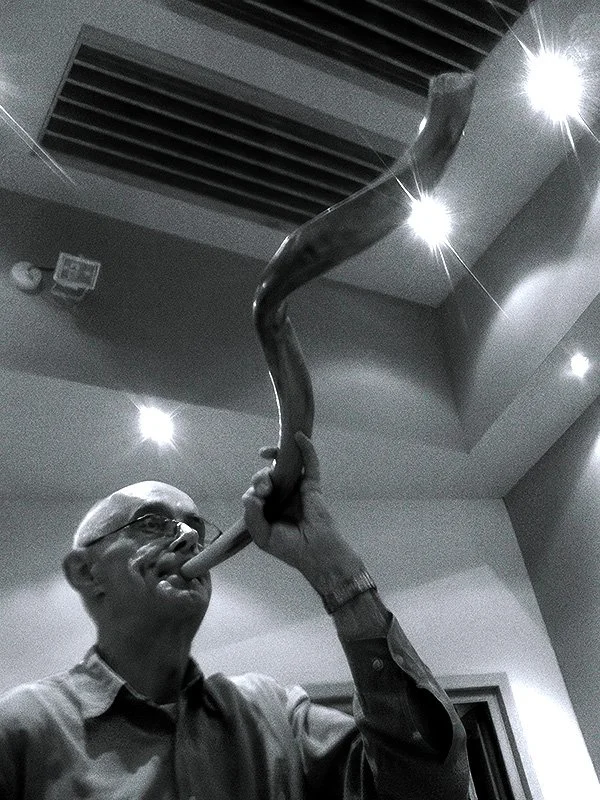
MW Fascinating. I actually have a photo I took of you playing that day.
ML What we're seeing there is not a shofar, that's a kudu horn.
MW Do you think we probably didn't use the shofar in the end?
ML I don't think we did. I think we only used the kudu.
MW On the album sleeve, you're credited as shofar and kudu uh so perhaps we did add it.
ML The shofar might have been a lower note or a higher note. It's a very short instrument - only about 12 inches long - and very basic. It's not a musical instrument as such, it's a religious instrument and it's almost impossible to hit a note accurately on it.
MW Right.
ML It just makes noises!
MW The glorious thing of course about making an album in the 21st century is the way that we can manipulate the pitch of recordings after the event. We would have taken your original recordings and made sure they sat absolutely in pitch with the moment they were designed to work with. Scott will have enjoyed the rawness of the initial onset of a shofar note to add some roughness to the beginning of those “ram’s horn moments”.
ML I don't remember playing to any kind of backing track. I think I would have just played and demonstrated notes.
MW Yes.
ML Scott might have said “Show us what you can do. Play long notes on this instrument. Can you play them with a crescendo? Can you play them very loud?”
MW That sounds like Scott!
ML And whatever notes were recorded, you did what you needed to do with them.
MW But he never wanted to, I don't know, record one kudu note and play a tune on it. That absolutely wasn't part of his approach. He was aware of all the wonderful new sounds that electronic instruments could make. Nevertheless, an essential part of his ethos, part of his way of thinking about sound was to work with the genuine, the acoustic as far as possible for moments where that was his vision. When he used an electronically created sound, he wanted it to sound electronic.
ML Yes, he wanted - I made a note here - in my opinion he was looking for something raw and something unusual, something a little bit earthy, something with a different quality so that as the listener you would say (if you were to try to analyse it) you say “I’ve got no idea what that is. I can tell that's meant to be a violin, or that's a flute, but I’ve got no idea what that is.” I think he wanted something mysterious.
MW What was lovely about Scott is he wanted to work with the player, he wanted to hear the history, he wanted to absorb the heritage and experience that each instrument and musician brought into the room and use it because it fitted his lyric, it fitted the idea he had for a song at a particular moment. He would have absolutely loved both the research you had done and also the knowledge that you brought into the room with it.
ML So, in other words he was a very sincere and involved musician.
MW Totally. His search was to explore new stories, to deal with difficult subjects and difficult issues and tell them in a way that celebrated both unusual sounds and also real musicians. I hear that with every musician I talk to about their experiences of working with Scott. I think it's interesting that in their desire for sensationalism, many journalists and other commentators on Scott's work will seize on comments from participants who remember a “basically I wanted them to play until their fingers bled or until they passed out” moment. Yes I did experience an element of pushing them (and me) harder. Could we go one step beyond what was comfortable, what was “musically safe”, but it was never out of some sadistic desire to make anybody suffer!
ML Peter Maxwell Davis I worked for…
MW Yes.
ML …and he liked the sound of a musician under strain. I once said to him “You've written a part, a trumpet part here. There are so many notes and some of those notes are so high.” He said, “No, don't worry about the notes. I just want it to sound like you're under a lot of stress!” Is it possible that Scott wanted that element of tension in the sound?
MW Yes. Absolutely. That single-minded focus on delivering something and concentrating on it with every fibre of your being. I was recently reading that a contemporary of Richard Straus, an orchestral player, once asked him about a particularly fiendish run of notes in one of his tone poems. He’d said something along the lines of “This is jolly hard to play. Are you really sure about what you’ve written?” and had received a very similar Maxwell Davis sort of reply “I don't care about the actual notes, it's the effect of that scurry that I need”!
ML That's what Peter Maxwell Davis wanted and I guess that's what Scott wanted as well.