
Listening to Everything: film composer, arranger and pianist Brian Gascoigne on working with Walker
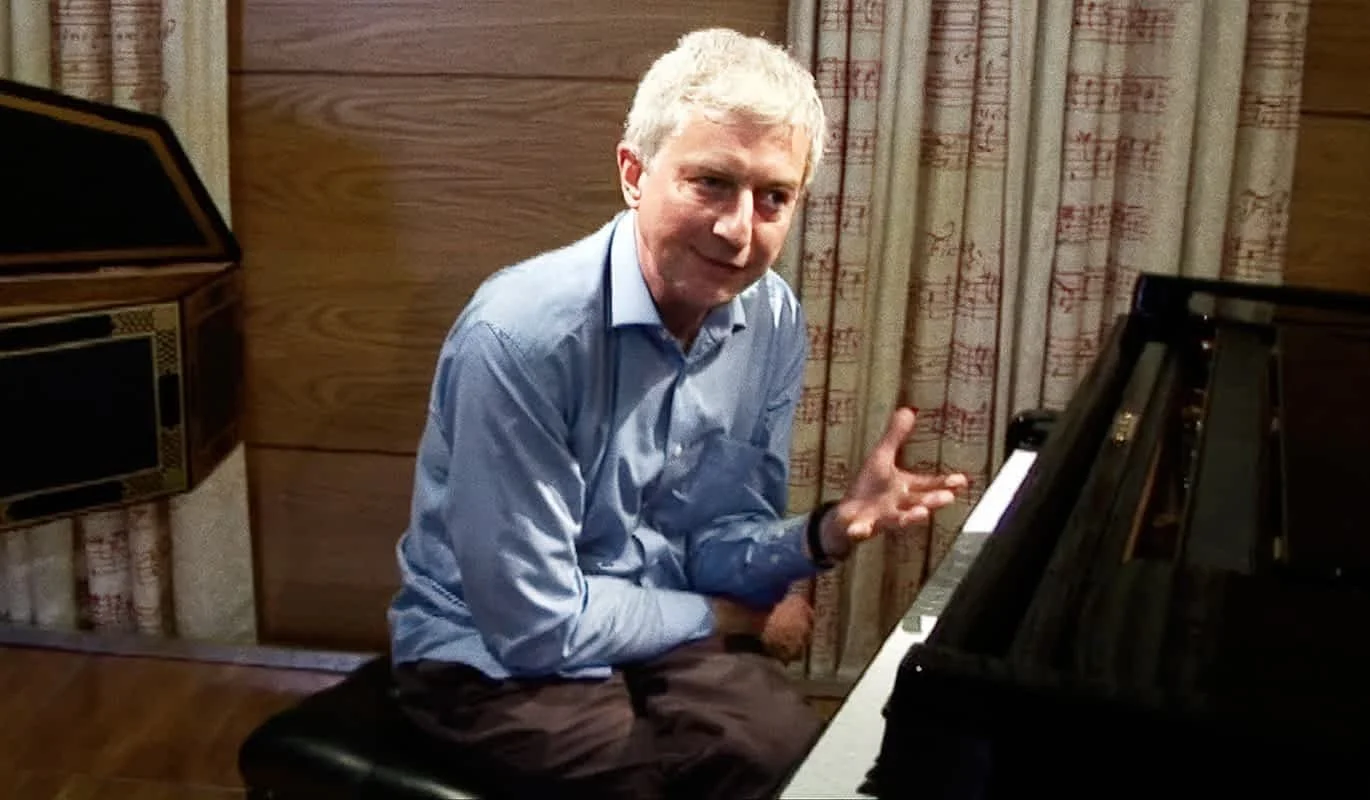
Brian Gascoigne interviewed by Stephen Kijak
Brian Gascoigne is an acclaimed and prolific British musician, composer, and arranger. He established himself as a film composer in the early 1970s, earning credits for original scores on feature films including Under Milk Wood (1972) and Blue Blood (1973.) Superman, Star Wars,Rambo and Outland are just a few of the other major feature films that he has worked on. Climate of Hunter, Tilt, and The Drift are the three Scott Walker albums he has worked on. Brian was interviewed for Scott Walker: 30 Century Man, seated at a grand piano...
STEPHEN KIJAK: You first work with Scott on the Climate of Hunter album...?
BRIAN GASCOIGNE:Yes, someone rung and said he wants to come round and prepare some tracks and he arrived with his little pieces of paper - in those days, before he had a keyboard, and he had printed sheets with a keyboard on it with little bar marks for the chords, and we worked it out and I played it back to him and we made a demo.
And in those days he was very insecure because he didn’t have a chance to hear it and he likes to live with stuff before he records it, so it went through a lot of changes. On this one (the recording of The Drift) he’s had a keyboard work station and he’s made quite good demos so it’s actually much closer to the finished product to what he started with than it was in the old days.
SK: What was the experience of working with him like? Was there any expectation going into it?
BG: I’d been warned that this was very different and it was obvious that it wasn’t going to be pop. And I found it very exciting actually. I mean because it was very different. And also, most of the avantgarde doesn’t have a budget of months in the studio and 48 track analogue and all that stuff, so it was interesting from that point of view. And I immediately took to him, he’s an incredibly attractive person, he’s clever and funny and well informed and he listens to everything so I found it very interesting to do.
SK: Do you recall his frames of reference for the album?
BG: This is what’s so wonderful, because he listens to everything, I mean, Bruchner, Mahler, Bartoch on one side, Evan Parker and the Free Jazzers on the other, guitar albums by people you’ve never heard of, so you know kind of the direction you were going in, but what we’re after is a feeling.
SK: Then you come to TILT a decade later what did you understand about him at that point and how you were to approach the arrangements? He has said he never wanted things to get “too musical.” What does he mean?
BG: “What he’s about is the contrast of opposites. That’s what he’s aiming for, mainly light and dark, joy and pain, consonants and dissidence. So, he’ll have long, low clusters, murmuring and roaring, followed by luminous, diaphanous, beautiful chords, transcendent beauty. And the strategy is to get this great seesaw going back and forth and the pivot for it is to get the musicians interested in the no-man’s land between melody and harmony, conventionally, and the squeaks and grunts of the avantgarde.”
BG: So, when he says ‘no it’s too musical’ it means that it’s heading too far towards a conventional chord. And other times he’ll say it’s too dark which is a word he uses a lot or it’s not doing it for him.
And what he’s after is the boundary between chords and discords. I mean, anybody can play a chord (PLAYS) and anyone can play a discord (PLAYS) but he will take a chord like (PLAYS) for example . . . and hold it for 16 bars on might be Philip Shepherd’s cello or it might be electric guitar, and it’s halfway between a chord and a discord, I mean it contains four actual chords but when you play (PLAYS), it’s neither a chord nor a discord, and if you fill in the only remaining note . . . . it’s completely different and so he’s operating very much in the area where that makes a difference.
Or if you take another one (PLAYS) that’s a completely stable chord. And (PLAYS) that’s a completely unstable one, and if you play them together and hold it for long enough it starts to contain all the chords that are in it, which in that case was half a dozen, and it will be its own thing. So that’s the horrible bit. And the nice bit is open fifth (PLAYS) lovely, loveliness. And they’re all usually open sort of chords and they’re very often on the major scale. But the thing about them all, and I only realised this thinking about this before I came here, is that they all imply (PLAYS) so although they may be very stark . . . there’s a sort of unspoken warmth behind them. And when he’s got that kind of right, the whole thing seems to hang together and that, as far as I can gather, is where he’s heading.
SK: From where you’re operating, what are the significant differences between the albums, emerging decades apart...?
BG: Oh, I can’t tell the difference between them. As far as I’m concerned, they’re the same album just continued. I mean it’s always been like that. The sounds change, and he gets more and more adventurous and then he finds a musician like Alasdair Malloy (percussionist), who understands completely what he’s after and knows how to make it and then that leads in another direction, but he’s always on the same thing. Joy and pain and more pain and joy.
SK: He mentioned a French journalist who, in speaking of The Drift said, “they’re not songs anymore.” What are they if not songs?
BG: Well, the melodies are tonal, they are, but they’re more like chants than songs aren’t they, because they’re repetitive. And I mean you can see a cult two generations hence, meeting in a room to chant along with these things and regard the lyrics as holy rites. I can imagine that happening quite easily. But you can’t imagine anybody covering them. I mean you’ve never heard anybody covering any of these songs since Climate of Hunter.
The other extraordinary thing about Scott is that who else has ever issued two albums of fully produced stuff that’s sold to the public and nobody, probably not even Pete, has ever heard him sing them full voice with the lyrics in the same room. I mean that’s very unusual.
SK: He’s said he withholds the lyric and top-line from the musicians during the sessions to prevent “grooving”...
BG: He also doesn’t want the musicians to have a stereotypical reaction to the lyrics so that’s why nobody’s told what they are and they’re not written on the scores. He wants the musicians to bring their own narrative. Once they’ve got the general idea of what the thing is, they’re going to produce their own narrative in this no-man’s land zone. And that’ll just add to the richness and complexity of the lyrics. That’s what he’s after.
SK: Tell me about recording the string sections.
BG: They’re agony.
BG: “He believes, and I take issue with him on this, that in order to convey the strong emotions in the music you have to be feeling it while you’re making it. Well, I mean, that couldn’t be true or the people who are playing Bruchner and Mahler every night would be basket cases by the time they were 30. And indeed, after 3 or 4 hours in the studio, he is a basket case because he lives the thing with such intensity of emotion.”
BG: One of the musicians described the sessions as like having your teeth drawn slowly. He does put the musicians through the ringer because he really wants that intensity. So, the days are very short with Scott!
I always find writing for the strings for Scott very irritating because they’re mostly holding one note for 16 bars you know, fortissimo or pianissimo. But there’s only so much you can do, you can only have so much bow and so much pressure, and yet, he will make them go on and on and on doing it again and again and again until he gets the emotion. But in fact, in the case of the string players, it’s when he hears a difference, it’s irritation because they’ve been made to play the same thing so many times and they can’t believe it’s any different. So, I never like mediating that. But with the rhythm players it’s fine because they’re always sort of working towards something and that’s what they do.