
Scott Walker’s collaborations with Artangel, by Michael Morris
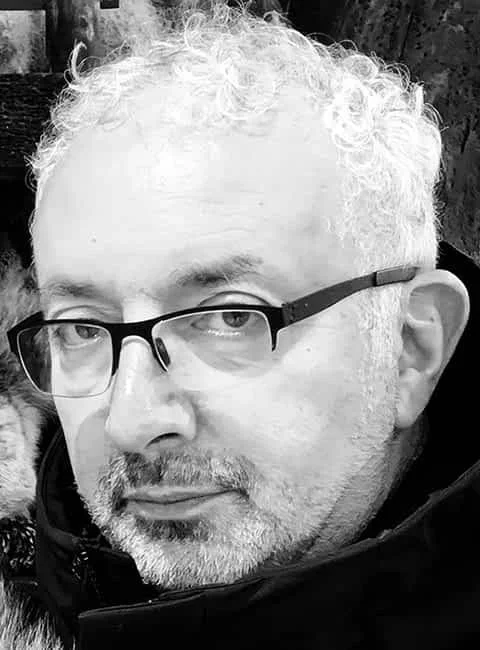
Michael Morris interviewed by Stephen Kijak
As Co-Directors of Artangel from 1991 - 2023, Michael Morris and James Lingwood commissioned and produced ambitious artworks for a range of distinctive and unexpected sites and situations throughout the UK and beyond. Moving across disciplines and genres, Artangel became a byword for originality and integrity through landmark works developed slowly over time by Jeremy Deller, Jonathan Glazer, PJ Harvey, Roni Horn, Roger Hiorns, Miranda July, Mike Kelley, Michael Landy, Steve McQueen, Rachel Whiteread, Taryn Simon and Sarah Sze, amongst many others, including, of course, Scott Walker. Michael was interviewed in “Scott Walker: 30 Century Man”, just as he was collaborating with Scott on the Margate Exodus project – a large-scale retelling of Exodus set in the seaside town of Margate, written and directed by Penny Woolcock. Scott contributed an original song based on the Plague of Darkness...
Stephen Kijak: I believe when we interviewed you for the documentary, you were in the early stages of planning the Margate Exodus project. How did you first come into contact with Scott?
Michael Morris: I was told that he had visited quite a few Artangel projects by people who knew him. So I arranged to meet him in 1995 when he came to see Robert Wilson's H.G. in the Clink Street Vaults. Close to where Tate Modern is now, it was a wasteland of cavernous warehouses when we discovered it. I plucked up the courage to ask Scott whether he might be interested in getting involved in something.
We were planning a version of Exodus in the seaside town of Margate involving hundreds of local people as performers and local bands performing songs inspired by the biblical plagues. Scott took on Darkness - a hugely skilful distillation of different associations: from slavery and cotton picking to light bulb filaments, and a sense of the Earth as “threadbare”. So it was both a very complex, and yet a simple and spare reading of the Plague of Darkness with a truly wonderful choir, providing call and response to Scott’s rich baritone.
SK: What was your purview on his creative process? Did he involve you much or did the song just appear one day?
MM: He sent me a rough mix. He sent me some lyrics. He assembled it in a way that was unlike any other writer I'd come across because it was difficult to know what came first, the lyrical content or the music. It was so integrated that you couldn't take one element away from another. It was like a kind of miniature opera. Perfectly formed and completely surprising.
SK: I remember hearing it, I can't remember who played it for me or if you had it in the office, and I had already been immersed in The Drift, but I jumped out of my seat when the screaming choir comes in. It’s shocking but so simple. He's working with such spare elements.
MM: The darkness is really between the lines. It works on so many levels,
“like most of Scott's late work. It’s like a great novel. You must reread it. You go back to it. You understand more about it every time you listen to it. The songs are like mini operas.”
Certainly, when we came to talk about how to stage the songs from Tilt and The Drift, it was an operatic challenge really. It felt like making little operas. And we began to talk about the event that became known as Drifting and Tilting in 2006, very soon after Darkness. I remember saying to Scott, it would be so great to perform Darkness live, and of course he said, “I'll never do that!” And so, for Drifting and Tilting we talked about getting other artists to sing the songs, which was the beginning of something which I think he very much enjoyed doing.
[Drifting & Tilting: The Songs of Scott Walker was performed over three nights in November of 2008 at the Barbican Centre in London. A stunning cast of vocalists, musicians and dancers bring music from Scott Walker’s seminal albums The Drift and Tilt to life. A 42-piece string orchestra played alongside Walker’s band and featured vocalists Damon Albarn, Dot Allison, Jarvis Cocker, Philip Sheppard, Gavin Friday, Michael Henry, Owen Gilhooly, and Nigel Richards. Scott did not appear on stage, preferring to sit at the mixing desk, overseeing the sonic experience.]
SK: Do you think it was the experience of seeing Darkness performed at Margate that may have made him comfortable with the idea of giving the songs to other people?
MM: Yes, I think so. He was no longer responsible for it. He was responsible for staging it and being the musical director, but he wasn't responsible for performing it. And I'm not really sure why he didn't want to perform anymore. And it doesn't really bother me because I think his songs were perfect worlds that could be interpreted in many different ways. He found revisiting them much more interesting through other people's voices. I don't think he would've wanted to work on this under any other circumstances.
SK: He was deeply involved in every aspect of the show, right? Down to drawings for sets and staging...
MM: He sent reams of fax paper with his thoughts, sketches and storyboards from which we actually made the show. Every song had its own clear world, both visually and musically. Each song was rendered from the ground up. And there were eight songs, two from Tilt and the rest from The Drift. It was an ambitious undertaking and really, it came together surprisingly quickly. At Artangel, we tended to spend several years on projects, and this was developed over 18 months.
SK: That's incredible. Well, given how he works as well.
MM: We had a slot at the Barbican, and if we missed that slot, it would’ve been a year later. And we just felt it was timely. So out of these faxed images, we created a more coherent storyboard. The director was Ann-Christin Rommen, who'd worked for many years on projects with Robert Wilson. So I knew her well. Sam Collins was the designer, someone I'd worked with for many years, and Aletta Collins was the choreographer. Patriot, I think, was probably the most extraordinary piece of choreography performed by Philip Herbert.
SK: Yes, yes. I remember it. I got there late and immediately went to the wrong theatre and missed the first song, and then we were hustled into the correct venue.
MM: You went to the concert hall, I imagine; we had to use the theatre because we needed to fly a pig in and out!
SK: That’s right!
MM: We needed the controlled conditions of a theatre. We needed the depth of a theatre. It wasn't really a concert; it was a series of moving images and mise-en-scène.
SK: The orchestra and band, everything was off-stage. It was very much about the theatrical tableau and the performer.
MM: We put the orchestra in the pit so your focus was on the performer - the subject really - whether it was Clara or Jesse or Jolson & Jones – these songs are all portraits actually, of people but also of time and place. We did it for three sold-out nights and it was very well received. At that time, only the Barbican had the resources and the courage to do something like this. It was a lot to do with Chris Sharp who, of course, had been very involved in The Drift at 4 A.D. and had just begun to work at the Barbican.
It needed the technical precision of the Barbican Theatre and the Barbican team. Scott, after all, was very precise and he wanted everything to be perfect in its imperfection, and he loved it. But there was no question that he would take a curtain call or anything like that. I do remember a moving moment where the entire audience turned around to the sound desk and applauded him, something I’ll never forget. I was lucky to have worked with him.