
Must Go Lower: Mark Warman speaks to Pete Long about pushing deeper sounds on the tubax on Tilt and Bisch Bosch
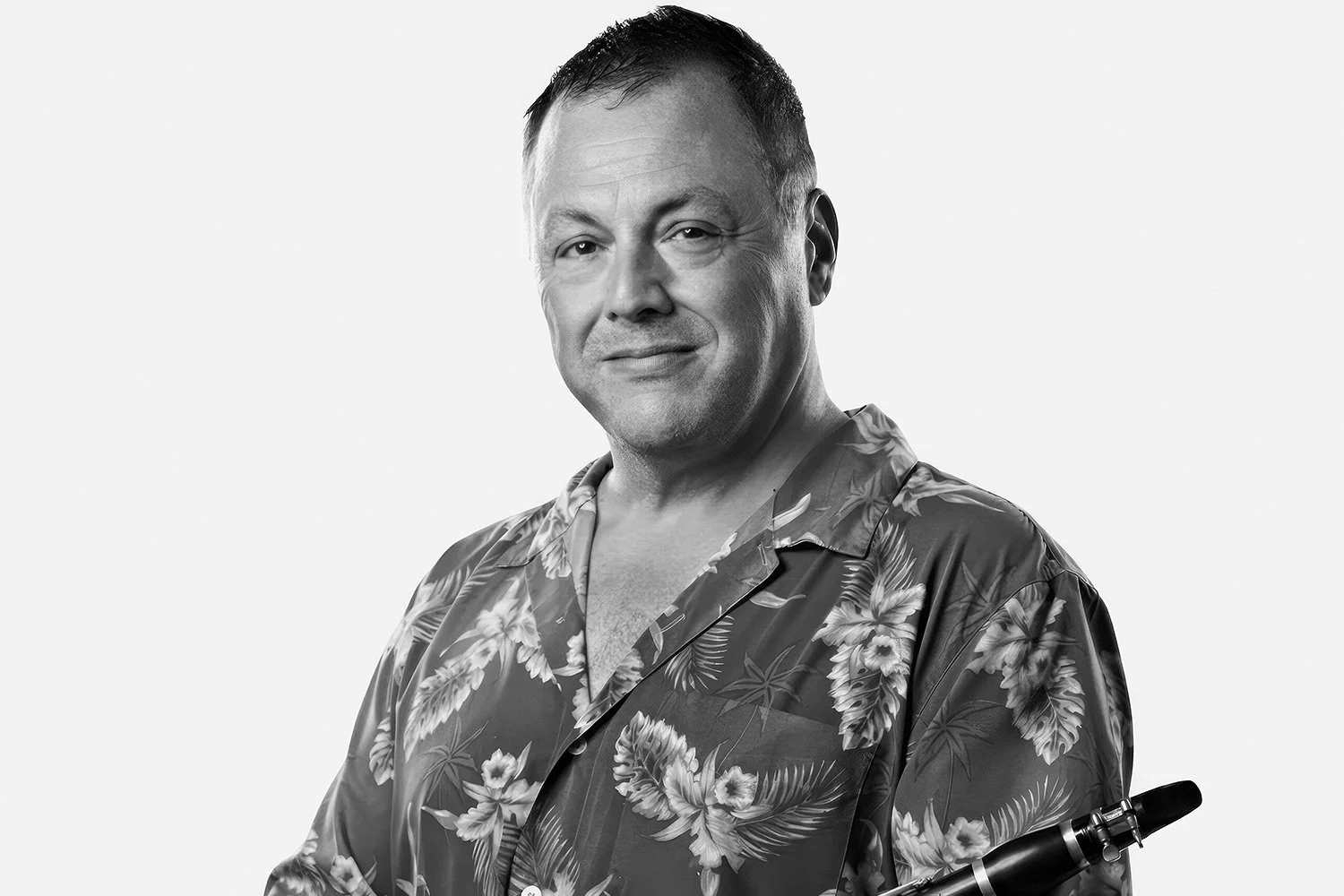
Thursday 14th August 2025
Mark Warman Hi Pete - To set the scene, let me take you back to autumn 2004. I got a call from Brian Gascoigne (Scott Walker’s MD at the time) to see whether I'd be interested in taking over the role from him.I was walking into Metropolis Studios to have my first meeting with Scott and Pete Walsh (his long-time engineer, friend and co-producer). They were preparing for the first recording days of the album “The Drift”. Both were immediately welcoming and I very quickly became the third member of the team.
In those early days with him, I was very much feeling my way and not really sure what my purpose was, because he was always so clear in his own mind about the sounds, the musical ideas - he knew exactly what he wanted. My various roles became clearer once his trusted team of regular musical collaborators began to arrive one by one.
The first sessions were with Ianto [Ian Thomas] on drums, and then Huey [Hugh] Burns on guitar. Very soon it became obvious that basically my role was to fill in any gaps. If Ianto was being asked to hit too many drums at the same time, then I might be lying prostrate on the floor with a beater in my hand, hitting his bass drum from the front while he was on his side of the kit striking it as well, or whatever the required weirdness was.
With Huey, I'd sometimes be leaning over his shoulder during a take, pressing down extra strings that his fingers couldn't physically stretch. Scott knew what he wanted to hear, but he left it to the two of us to figure out how best to create the textures on guitar that he’d originally played in on a keyboard.
But then came the next challenge. There was a brutal sound on his synth demos, this low collection of semitones, raw, buzzy…
Pete Long I remember the low collection of semitones!
MW …and vibrant, and I don't remember how I'd heard of the tubax. Perhaps you'd come into a show that I was on. Did you used to dep on “Thoroughly Modern Millie” at the Shaftesbury Theatre?
PL Yeah, a little bit.
MW Because I was conducting that at the time.
PL Yes, we probably had a chat about it then.
MW You'd told me about this rare gem you owned: a contrabass instrument sounding an octave lower than a baritone sax, using the same mouthpiece but with twice as much tubing. It had only been invented a couple years earlier. Scott’s score needed low notes that certainly a bari sax wouldn't hit. I knew of the existence of a bass sax - not sure I'd ever encountered one “in the wild” - but even that wouldn’t go low enough.
And then I suddenly recalled our conversation and thought, let's give Pete a call. A few days later, you rocked up at the studio with your tubax. Scott loved it at first sight! Had it been in your possession a long time?
PL A couple of years by then, I'd have thought.
MW And the rough value of the instrument?
PL Oh, about £15000 - £17000 now.
MW Wow!
PL Yeah, probably more actually. I bought it at the time for £12000.
MW I knew it wasn’t cheap, and that you were one of the very few who had one. So, you arrived at Metropolis with this beast. I don’t think you’d met Scott previously, had you?
PL No.
MW What are your recollections of the session?
PL Well, I mean, I mainly dealt with you. So Scott was sort of a large, strange, I seem to remember blondish man, big, tall, in the corner of the room, and you were interpreting his whims. As I remember it - and it says a lot for his idea of orchestration - that the first session I did, where I recorded six tracks of low notes, I was in after Ian Thomas playing thrash metal drums. And then as we were getting to the end of it, you said “We’ve got to get you out, because we’ve got the Screaming Child booked in at half past five”. And I thought, they've got a screaming child?!!
MW Yes!
PL So, it's going to be some “different” orchestration! And I remember playing very very long notes. I can circular breathe, which facilitated this. So I was circular breathing, and he wanted the bottom six notes on the instrument in semitones. So it was a D flat and the next 5 semitones up. It was the most impenetrable noise I've ever heard, because once we got to about the third semitone, each one was knocking into the harmonics of the one before. Because as you know, in those rich, low sounds there's lots of harmonics, aren't there?
MW Yes.
PL And so it, yeah, it got to be quite a noise. I mean, it did blur what is sound and what is music, that experience!
MW Absolutely. And it came at quite a considerable physical cost to you. I remember we had to stop at one point because it looked like you were either thinking you might pass out, or it looked from the outside like you should be passing out from that amount of effort.
PL Well, yeah, ‘cos when you're blowing that instrument right at the bottom, it might be 35 Hertz or something like that. It's that lowest D flat at the bottom of the piano. So you’re going at that speed, in your mouth and it shakes your eyeballs. You can't keep doing this! [laughter] No, it just got very hard to cope with because of the harmonics building up, and I couldn't tell in my cans what note I was adding. I mean, what we should have done, in hindsight, is not played back the other tubaxes through the cans.
MW For sure.
PL But that didn't occur to us at the time. Next time we need to track up that sort of chord, we’ll know what to do! But no, the sound of it was really extraordinary. I couldn't tell what was going on. I couldn't tell what note I was playing and what I was listening to, couldn't tell anything down there, because it was just all these harmonics banging into each other.
MW It was a monstrous sound, and just right for the album, just right for the track and Scott absolutely adored it, as you know. It’s what he was needing out of the music at that point, extreme lows and extreme highs. He carefully filed your sound away.
So when about six years later, we started work on “Bish Bosch” you got the call again. I remember a flurry of anxious emails, because I seem to think that you’d either put the tubax on the market or you'd sold it but hadn't delivered it yet…
PL I did sell it in the end. Yeah, I mean, it was a huge great bit of capital investment, and I thought I'll get all the film sessions. I didn't get any!
MW Oh well, I suppose you have to speculate to accumulate.
PL Anyway, I did play it notably on Scott Walker's…I don’t know what you call it. It's kind of the opposite of the Glenn Miller sound in reeds, isn't it?
MW [laughter] So it heavily features on a track called Epizootics.
PL I seem to remember the job that day was rather more normal.
MW Yes, that was more of a little riffy figure, wasn't it? And there Scott was playing with a couple of very distant nods to Jazz. I mean, he had no intention of actually going all the way towards Jazz, but I remember at one point he had a group of us in the studio all playing a dotted ride cymbal rhythm on six ride cymbals simultaneously with the inevitable smearing and build up of harsh high frequency harmonics that it generated.
PL He did like a load of harmonics! I mean, what was hilarious: okay, so I've got the lowest woodwind instrument in the world. Well, not quite, but really one of the real low ones, and a little line to play. And as we just discussed, it stops at D flat. It's the lowest thing you can buy. It isn't anymore. They've made a lower one, but it wasn't out then. And he wanted a C!! He wanted it. So I played two consecutive D flats, and then you got on the computer and took the second note down a semitone, yes, because IT WASN’T LOW ENOUGH!
MW [laughter] I'd forgotten that moment, but you're absolutely right. I was talking to Michael Laird, the trumpeter, who plays shofars, rams horns and kudus on that same album. He reminded me about when Scott required a melodic tritone interval from those simple natural instruments that wasn’t available at the pitch he needed. Even though Pete Walsh and I knew that we could solve it electronically by re-pitching notes later, Scott would want to hear the real thing there and then. Michael was asked to try countless different animal horns, one after the other, until he found the one that could provide exactly the right pitch. We were probably allowed to get away with electronic fakery on your riff because it was just the one note and Scott knew there wasn’t an existing real instrument that could produce it.
PL Oh I didn’t realise. So was the idea that all this music, none of it was synthesised, it was all created by humans?
MW He always wanted it real if at all possible. He wanted to feel like it had cost the musicians something in terms of actually focusing in on just delivering what was needed at the time and he did have this penchant for sounds that nobody else had heard. But I think, well, you selling the tubax certainly suggests that, yes, the world was not ready for six note tubax clusters!
PL It was its finest hour. I'll give it that.
MW Oh, that's good to hear.
PL It's on those two things and a Ringo Starr single, of all things!
MW Any final thoughts about working with Scott that you’d like to add?
I think you could describe his music as a zone. It's a zone that you enter, and you just have to experience the zone. It doesn't rely on tonality, or anything. It is music, but it's, it's, it's a different zone of music.
Pete Long