
A Sharp Pair Of Ears: Andy Findon on stretching the flute and saxophone for Scott
Saturday 9th August 2025
Mark Warman Other musicians I’ve been talking with have made comments along the lines of “Scott always knew exactly what he wanted” but when we worked together on Scott’s music it was sometimes within a more elusive improvisatory world where the notes on the page only told half the story.
As a hugely experienced session player, you're obviously well used to trying to understand and deliver what the client wants. Did you feel that you always knew with Scott when you'd interpreted the instructions - or sometimes the poetic metaphor he’d use - in a way that matched what he was hearing in his head?
Andy Findon Well, he’d stop you when he’d got a “Yes”, when he was happy.
“There are definitely two kinds of sessions: those at which we’re buttons being pressed, but his sessions were different ones, where you felt you could give a little bit more. You know, you gave 100% on others but you gave 120% for him because you thought it might be appreciated!”
MW That's absolutely right. I was always very aware I was in the presence of a really sharp pair of ears.
AF Yeah. Sometimes we work in a vacuum: as session musicians you simply play what's written on the page. You obviously interpret it until you go too far, and find they don't want you to interpret it too much. Then you have to claw it back. With him, you knew where to go, kind of. You did give a little bit more, especially the odd things that looked a bit weird on paper – that was your fault [laughs] - but you think yeah, I can make that work.
MW I often hated the fact that we had to use written notation to communicate Scott’s ideas. So many times it would have been easier for me to sing something to you and you could play it just from having heard it.
AF That's something in parallel with other people. I mean, A. R. Rahman when he came over to England and Isobel [Griffiths, the fixer] said “Do you want a copyist?”, he said “Why do I want a copyist? I just sing it at the fiddle section”. [In India] he'd have a room full of 100 fiddles with no music stands and he'd sing his riffs at them! And that is the kind of thing I felt Scott wanted.
The other one is [Michael] Nyman who, since his band has been together for 40 years, never wrote expression marks on the music because we were the band playing, and what we played was like part of him.
MW The way you did it is what he wanted.
AF We didn’t get slurs and things like that!
MW So in Nyman rehearsals, would there be a lot of…
AF There weren't rehearsals! We did everything recorded. We'd turn up to the studio and they’d still be copying! It was a similar odd unusual circumstance with every record we mad. We would record a piece (sorry - we were meant to be talking about Scott Walker!) but we'd record the piece sight reading it. That would go out, but eight years later - having toured it for eight years - we'd do a [definitive] live recording of it where tempo, expression, everything was totally different because the piece had grown into how we were going to play it, without the pressures of recording.
You say that Scott [recordings] were up against financial [pressures], he didn't have time. If we could have sat in the studio for three days - like the old days of rock and roll - we'd have learned more, been able to interpret it. You having us there for only two or three hours and needing to get out of us what you needed at that time…
MW Yeah, everything had to be meticulously prepared, so that we could make maximum use of that time.
AF Yeah.
MW In trying to pin down in notation what Scott had created in his demos, I was running the risk of imperfectly translating what his idea was!
AF So you've got two sides to worry about - him breathing down your neck and you trying to get us to interpret [the music] correctly. You were the buffer - literally - between us.
MW The third thing is that with most of the people I’d worked with up to first encountering Scott, I would apply my own musical knowledge and taste to decisions about retakes. If I heard something was out of time or out of tune, of course it would need another take, to be improved and perfected, whereas…
AF I first met you in the studio recording [the 60’s pop composer] Ken Howard's stuff.
MW You’re right!
AF And you were in charge. He gave you some tunes and you were in charge.
MW Exactly.
AF That wasn't the case with Scott Walker.
MW [laughing] No! I was always wrestling internally with “I think I’ve understood what he wants”, but he was just as likely to say “No, that's not it at all” as “That's absolutely it”. It got slightly easier as time went on, of course. I realized I was working here with someone who worried that the bubble might burst, an idea might somehow lose its vibrancy if it was over-explained or over-examined. If I’d ask “What are the notes in that chord that you think are the most important ones, Scott?”, he absolutely wouldn't want to go down those sorts of roads. He didn't want to analyse what he'd written, he’d just say “Well, just listen to the demo. It's all there.” Which was mostly true, but not always!
As MD in the recording sessions, as the interface between composer and musician, I often felt on less certain ground with Scott than with other writers. After a take that I presumed was clearly unusable - perhaps there'd been an inadvertent reed squeak or some such in the middle of a note - Scott would turn around and say “I love it - that's the one!” and I'd think “Surely not!”, but there'd be something about the moment, maybe the effort that he saw the musician putting into blowing such an impossibly high note, or whatever it was.
AF I do remember him asking for some unfeasibly high notes on a tenor [sax].
MW And you probably said “I’ve got the alto in the boot. Would you like me to bring that in instead?” but that wouldn't have been right at all. He actually wanted the strained sound!
AF That is an odd parallel with Nyman. He liked the slightly uncomfortable.
MW Well, like Scott, Michael’s music celebrates the energy and power of the extremes down at the bottom, the low frequencies and right up at the top. Your Nyman gig, was that always on piccolo and bari sax?
AF I was either baritone working with the bass trombone or piccolo working with the violins. I’d either boost the bass trombone or boost the strings, or give the bass trombone a rest and I would be the bass.
MW That was absolutely Scott's world, you know. Violas would never get a look in, because he was either interested in the low stuff or the high.
AF I don't think I ever really used a lot of piccolo with Scott.
MW No. There was one occasion where I think you and Bradley [Grant] were both going to be on piccolos possibly, and then you both ended up on flutes instead.
AF I was surprised it never got to piccolos.
MW Yes. It's partly I think because a lot of the time he was getting that ear-piercing high frequency pain from other sources: screaming children, synths, sometimes percussion. And whistles, of course. He loved whistles, factory whistles and samples of anything that was ear-piercing. He loved piercing ears!
AF Did you ever have session musicians in when you didn't use their stuff and they went home, they just didn't fit? Or did the selection process - through you - get the right people at the right time?
MW We were always very lucky. He stayed very loyal to people. He loved working with people who brought with them into the studio a history, a story and a sound. Like you!
Thanks so much for taking the time to reminisce, Andy
AF Brilliant - I really enjoyed that! Cheers.
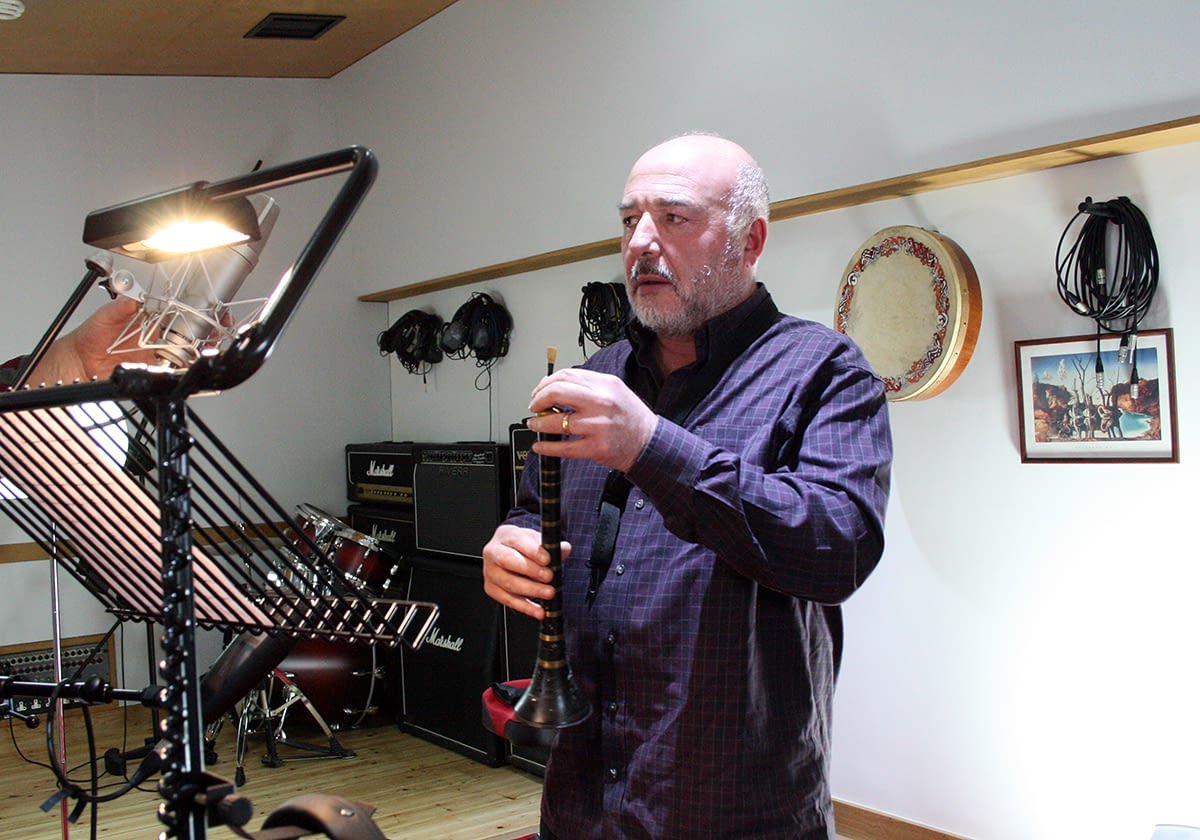
Recording Soused, Andy Findon at Westpoint Studio 2014. Photo by Philip Laslett