

Pulp
We Love Life
Released: October 22, 2001. Label: Universal Island Records
We Love Life is the seventh studio album by English rock band Pulp, released on 22 October 2001 by Island Records. It is the band's final studio album to feature bass guitarist Steve Mackey, who died in 2023.
Written and recorded after the tumultuous sessions for This Is Hardcore, We Love Life saw the band move toward a more relaxed and natural sound, shepherded by producer and singer-songwriter Scott Walker. Walker had replaced original producer Chris Thomas, whom the band had worked with on the band's two previous albums. It was the band's last album for over two decades until More (2025).
The album reached number six on the UK Albums Chart, with a total chart stay of three weeks.
Track Listing
Weeds 3:42
Weeds II (The Origin of the Species) 3:58
The Night That Minnie Timperley Died 4:38
The Trees 4:49
Wickerman 8:17
I Love Life 5:31
The Birds in Your Garden 4:11
Bob Lind (The Only Way Is Down) 4:16
Bad Cover Version 4:16
Roadkill 4:16
Sunrise 6:02
Credits
Written by: Jarvis Cocker, Nick Banks, Candida Doyle, Steve Mackey and Mark Webber. Also, Peter Mansell (Sunrise).
Producer: Scott Walker
Co-producer and engineer: Peter Walsh
Assistant engineer: Matt Lawrence
Mixed by: Scott Walker and Peter Walsh
Mastered by: Chris Blair
Sleeve credits:
Design: Howard Wakefield and Marcus Werner Hed
Art direction: Peter Saville and Jarvis Cocker

Photo by © Rankin
Interview Excerpts
2Rock, VIVA Zwei channel, Germany
Jarvis Cocker and Steve Mackey interviewed about Walker producing We Love Life
Jarvis Cocker: “I’d say we were a bit nervous about it because, you know, maybe if you work with somebody who you admire a lot, you’re going to kind of feel a bit awkward and maybe you won't speak your mind because you've got too much respect for this person or something. And I didn't want it to be like that, I wanted it to be a proper collaboration, you know.
There’s [sic] a lot of rumours about him as well, [that] he doesn't really go out, and he hides away from the media’s attention. Then obviously people have theories about him, and you hear strange stories about him, I guess, because the records that he's made in recent years have been quite extreme. People who you know want to know why that is, and they all have their own theory – but we just found him quite easy to get on with.
He’s quite a shy person, but he's not a strange person. He seemed to be happiest when we were actually just recording something, when he could really get into doing some work. I think he was very good for us because I think he was quite keen to do a good job.
You know, it’s not his job to be a producer – it's the first time he's ever produced anybody else. I think it was probably quite important to him to get it right as well, so that was a good feeling, you know? That he wasn't just doing it as a career move or something.
And he was very encouraging to us in the studio because we decided to do it this way, of just playing, and obviously the trick to making it work was to get good performances of the songs, and he really helped us to do that. He was good at giving you little pointers on how to hold back on one bit and really go for it on another bit or whatever, you know? So it was really good.
Steve Mackey: You come up with some producers who live their lives a bit like pop stars are portrayed…in that, you know, maybe they're wealthy, or they can be quite decadent or sociable characters. He’s not really like that. Like Jarvis said, he was happiest when he was actually recording and making and trying to get the best out of the song, Which was kind of how we felt when we wanted to make this album. So it's a bit of a lucky accident in a way. His attitude was something I think we wanted to adopt whilst we were making this record.
Esquire, 2001
Jarvis Cocker interviewed by Amy Raphael
Jarvis was initially nervous about working with Walker, a childhood hero. “He’s never produced a record for anyone else before, but we had appeared at the Meltdown festival he curated a few years ago, and when our manager approached him, he seemed interested. He really understood what the atmosphere of each song should be.” Jarvis empties the last of the mineral water into his mouth. He smiles. “The daftest thing happened. On the album, there’s a song called “Bad Cover Version” which includes a list of substandard records, one of which is the second side of Scott Walker’s fifth solo album, Till the Band Comes In. I kept on thinking that I had to say something to him about it, but I just couldn’t bring myself to. So one morning, I went into the studio thinking, ‘I can’t pussyfoot around any longer. I’ll go straight and tell him.’ He must have thought I was a nutter. He seemed bemused by it all.”
Mojo, 2001
Jarvis Cocker interviewed by Jim Irvin
How did you feel singing in front of Scott Walker?
“I was terribly nervous. I'm not the biggest fan of my own voice. But he was good.
He encouraged me to sing out. He didn't give me any specific tips like, 'Drink camomile tea and take lots of deep breaths,' but he made me face up to my singing.
My basic method in the past was to get semi-pissed, go into the vocal booth, do five or six takes – while still drinking –- and then leave it to the producer to composite the final version from the best bits. But Scott didn't like me to sing too late in the day, certainly didn't like me being pissed and [made me focus] on getting the performance right. So I was more involved in it, rather than leaving it to somebody else to sort out, and I realised I didn't have to be hammered to sing.
The Independent, 2001
We Love Life, explored by Ben Thompson
The turning point was engaging the legendary pop maverick and longtime inspiration Scott Walker as producer. “He would say to our drummer, “Hey Nick, put some lead in your ass.” Jarvis smiles with pleasure at the memory, “That was to make him slow down… And it worked,” he marvels. “There really was a lot of lead in that ass.”
We Love Life has turned out to be Pulp’s finest and most complete recording to date: the band’s music is more supple and more engaging than ever before, and Cocker’s lyrics are as good as any he’s written: at once effortlessly contemporary and occupying a world all of their own.
The Strange Brew podcast, 2019
Mark Webber on Walker coming in as producer of We Love Life
We thought it was time to try something else out. So we tried with various folks…we basically recorded the album twice, recorded it once, and just thought it wasn’t interesting enough.
It wasn’t sonically doing what we wanted it to do, so we started casting around and seeing if there’d be someone else. I can’t remember who else had been in the frame, but then you get another one of these life-changing phone calls of [Rough Trade label boss and artist manager] Geoff Travis saying, “I just had a call from Scott Walker’s manager. Yeah, Scott’s really into doing more of a pop than an experimental album. What do you think if Scott Walker did it?” Obviously, me and Jarvis were huge Scott Walker fans. It was kind of like, this is an opportunity not to be missed, to work with someone like Scott Walker. So off we toddled back into the studio with Scott Walker to do it. That was quite amazing, really, working with the great man.
The Guardian, 2011
Jarvis Cocker on the influence of Scott Walker’s approach to his work, from his selected lyrics book, Mother, Brother, Lover
There is a quote from Albert Camus on the back cover of Scott Walker's album Scott 4: "A man's work is nothing but this slow trek to discover, through the detours of art, those two or three great and simple images in whose presence his heart first opened." That kind of nails it: those images get embedded when you're too young to know much about it and then you spend the rest of your life trying to excavate them. If you're lucky, they're worth the effort.
Scott Walker on his collaborator and friend, Jarvis Cocker
The South Bank Show, 10 June 2007
Jarvis Cocker: Running the World
Jarvis Meets Scott
Q Magazine, June 2006
By Miranda Sawyer
One is a legendary recluse. The other is a national treasure. Scott Walker and Jarvis Cocker met exclusively for Q to discuss breakdowns and bicycles.
In the west London home of Scott Walker’s manager, Jarvis Cocker is perched on the back of a chair. Angle-poised, affable, resplendent in beige suit and Kickers, Jarvis is so familiar, so much part of the British furniture, it’s a shock to remember that he’s left us. Our Sheffield-born, London-battered national treasure is an expat now, living in Paris with his wife, Camille, and three-year-old son, Albert.
He kisses me on the cheek (“twice, like in France”) and chats about the Arctic Monkeys. “I met the singer at this awards ceremony last night,” he drawls. “He had a bit of attitude. He said, I didn’t know this do were fancy-dress.” Jarvis likes the Monkeys - “it’s nice to hear a broad Sheffield accent” - but thinks that there’s a bit too much fuss about them, when what they do - “writing about what you know rather than what you aspire to” - seems obvious to him.
Anyway, soon he’ll be able to show them how to do it: after a few years off dabbling with DJing, the Harry Potter soundtrack and his side project with ex-Fat Trucker Jason Buckle, Relaxed Muscle, he’s about to start recording his first solo record. “I don’t really like my second name, so I’m thinking of just calling myself Jarvis,” he says. “Like Kylie.”
Jarvis is looking forward to seeing Scott Walker. He’s written out his questions for him in a scrawly long-hand. A long-term fan (Jarvis chose Walker’s The War Is Over, from 1970’s ’Til The Band Comes In, as one of his Desert Island Discs), he was honoured when his hero asked Pulp to perform at Meltdown in 2000. The band refused - “Contractual obligations? We probably weren’t speaking to each other” - but Jarvis sang solo, and then asked Walker to produce Pulp’s final LP, 2001’s We Love Life.
Gently, gently, over the past few years, Scott Walker has enjoyed a minor renaissance. He’s always had hardcore fans, such as Jarvis, Marc Almond or Julian Cope, but the release, in 2000, of Boy Child: ’67-70 - highlights from his first post-Walker Brothers solo LPs, Scott 1 to Scott 4 - brought Walker to the attention of what we might politely call a younger audience. Whether they moved with him to his later work, through Climate Of Hunter and Tilt, is another matter: even at 63, Scott Walker is an uncompromising artist. His latest album, The Drift, is a difficult initial listen. Tracks such as Cue would scare a rabid Rottweiler, never mind the cat. Still, it’s intelligent, complicated, with atmosphere in spades. “I like this album better than Tilt,” muses Jarvis. “To me, it’s like a radio drama.”
When its dramatist arrives, youthful yet anonymous in Ralph Lauren denim, Gant baseball hat pulled low over his eyes, Jarvis is pulling poses for the photographer. A raised eyebrow, a languid hand. It’s soon clear that Walker doesn’t even do this; after 15 minutes of standing in front of the camera, ignoring it, he remarks pleasantly, in his quiet American accent, “Well, I’ve gone past the end of my rope now,” and walks off.
The pair, though very different - Walker elusive, Jarvis a showbiz natural - have aspects in common. Both, at one point, were hair-grabbingly, pant-wettingly famous (Walker even had his own TV show); and both retreated. Both live in countries other than their own. Both look alarmingly young for their age. And as you watch them chatting, you realise that what really connects them is their uniqueness. When Jarvis Cocker and Scott Walker are not around, no one else fills their place.
Scott, your last few records have all had more than 10 years between them - are you making music all that time?
Scott Walker: I have been. I’ve done soundtracks, I’ve done vocals for soundtracks, I curated the Meltdown festival, I did the Pulp record…
But everyone thinks, “Oh, that Scott Walker lies on the sofa for 10 years and then gets up and makes a record.”
SW: Yeah, it’s crazy. I’m sure I take longer than most people, but I was reading a review in a paper this morning of a Donald Fagen [formerly of Steely Dan] record and he’s taken 13 years and I thought, “Well, I’m OK.”
Jarvis Cocker: A few years ago, I read a quote of yours that said that you wanted to purge your voice of emotion… that kind of foxed me a bit, because if you have got a voice which is emotional, why would you neuter it?
SW: I wanted to get it more neutral, because a lot of my earlier records are very heart-on-the-sleeve. As I’ve gone on, I want everything to be clear and heard without any emotional distraction. A lot of emotion can be absolute bullshit, you know, lying to yourself too. I’m trying to just be a person singing, without my personality or anything else particularly. I’m going to sound pretentious now, but it’s not the first time, so, have you ever seen any Robert Bresson films?
JC: No. Say some films - I might know them.
SW: He’s a famous French director; he’s dead now. There’s Mouchette and A Man Escaped… I showed quite a few of them at Meltdown. When I see his films, it’s a visual version of what I want to get. He never uses real actors. If a person is laying down their hand, he just wants you to know a human being is laying down their hand. It’s the phenomenon of being human… So you were talking about your album earlier, Jarvis - when are you starting it?
JC: Hopefully quite soon, I’m still over-emoting on that one there.
Is it true that one song’s called The Cunts Are Still Running The World?
JC: Yeah, that’s the radio-friendly single. It’s difficult to talk about because it’s going to be quite a time before it exists. When I moved to Paris, I thought I was going to retire from music. But I’ve been in a group since I was 16, and never really known anything other than that, so of course I realised I didn’t really have any other skills.
That’s why everyone takes the mickey out The Rolling Stones, but what else are they qualified to do?
JC: But the trouble with The Rolling Stones is that they’re really bad now. Musically, they’re not doing anything and that’s what I was worried about. But as soon as I said I wouldn’t write any songs, then I started to come up with ideas, and so I thought it must be important to me. I also wondered what impact having a kid would have, you know, that famous cliché, the pram in the hall is the death of creativity But it was the opposite. On a very practical level, Albert helped me, because I bought him a kid’s guitar when he was only about six months old. I tuned it for him and then he broke my guitar - which I could have seen as a very symbolic act and I had to start using this kid’s guitar. And then he detuned the G string to F-sharp and that became the tuning to which I wrote about five songs. It became known as the Albert tuning.
SW: It matters when you have children as well. If you have them when you did [Jarvis was 39 when Albert was born], you’re prepared for them. If you have them too young when you’re in the rock music business, then it can be bad for the child. There are casualties all over the place.
JC: It’s weird, because there’s a missing generation. When I go to playgroups, there’s me with a three-year-old kid, but 20 or 30 years ago I would have been the grandparent and it would be my kid who had a three-year-old kid. It’s quite funny seeing the clapped-out parents.
Both of you at one point were incredibly famous: how do you feel about the fall-out from that?
JC: It’s an interesting thing to have experienced. I mean, it’s a big celebrity culture, our culture, so it’s like you’ve grappled with the beast. But you don’t want to keep grappling. You realise that you’re not cut out to live that. I did, anyway. I felt a bit stupid because I’d strived to become famous for years, you know 13 years in indie obscurity - so I felt a bit of a dick, saying, “Oh, I hate this now.” But it’s good to find out. It kind of tests you, you know.
SW: You can’t buy fame. You can buy it more today, but, essentially, you can’t buy a genuine thing like that. So people who have a lot of money are really envious of that one factor, because that’s an experience they will never have and can’t buy. It’s a huge experience and it’s hard to explain too, because when you’re touring, when you’re in that fever-pitch thing, you’re out of it anyway. So it’s a double-huge nightmare, or dream sequence, or however you want to accept it. But, I’m like you, I’m glad I had it because then you know.
Isn’t that what Pulp’s This Is Hardcore was about? The fall-out from fame, coming through the other side?
JC: Well, no, that was in the midst of it, a personality disintegration. I was really fucked up, so that was the sound of it. It tries to be poppy but then it dissolves into this… it’s like a bottle of curdled milk.
SW: And when you come out of an experience like that… Well, everyone is so many people, all of us have multiple personalities and you don’t know which person is going to come out the other end. Sometimes you get a bad one coming out at the other end and it can change into the one you can live with.
JC: It changes you, but you can find out which parts of your personality are fixed, because there are certain traits that do survive intact. I thought, at the time, that it was a kind of abrasive thing. That’s why the album was called This Is Hardcore, because it was the bit that’s left after the scouring effect of fame. I guess that bit is you, the bit that will never change. Talking about excessive fame, there’s a song on your new album about Elvis and his dead twin [Jesse]. And it struck me that maybe you could be the Anti-Presley. He is one of the great voices of America and so are you… and he took the cabaret circuit option and you could have done, but you decided not to.
SW: Well, actually it was cabaret stopped me [playing live]. I found myself age in a huge one up north; everyone did them because the money was phenomenal. Anyway, I was trying to do something very difficult with the songs, very knife-edge stuff and I’m really, really pernickety about stuff like that. And on this particular night, our trumpet player didn’t turn up and I was singing and I heard this kind of bugle - you know, like Spike Milligan on The Goon Show - this obviously drunken or deaf guy was playing the trumpet. This thing was going off behind me, and I was standing there delivering my stuff and I thought, “I’ve had enough.” I never returned.
After you both moved away from fame, did you miss it?
JC: Yeah, well, I went to an awards ceremony last night, and I was loving the attention. I don’t know about you, Scott, but I have got a slightly show-off aspect to myself.
SW: For me, the choice wasn’t there. What happened was, I’d signed to a label which wanted me to make a certain kind of record. [During the early ‘70s, Walker made five MOR albums before re-forming the Walker Brothers, which produced the single No Regrets and back-to-form album Nite Flights.] And I acted in bad faith for about five years and it haunted me so much that in the end I couldn’t do it any more. It literally almost destroyed me. I went through a bad period when I was into booze and stuff like that. I had to get back to where I was stopped, which was my fourth album [Scott 4] - where I had the experience which you had on … Hardcore. And now it’s regarded, for that period, as my best album.
What do you two talk about when you’re together: European art-house movies?
SW: Richard Hawley. [Ex-Longpigs and Pulp’s former live guitarist, now a solo artist]
JC: [Laughs] Yeah, we discuss Richard Hawley. We don’t see each other a lot. The last time was the Q Awards, more than two years ago. We don’t have dinner parties. [Suddenly] We could discuss bicycles, I suppose. Are you still riding?
SW: Yeah, I’ve still got mine.
JC: I haven’t ridden mine for quite a long time.
SW: It must be harder over there, because they’re really crazy.
JC: Well, there’s no cycle lanes.
Have you got a baby seat on your bike?
JC: Yeah, but that were a disaster. I took him out on the baby seat and he was all right going, but then we did something and he wouldn’t get back on the bike, he threw a hissy fit. I had to chain the bike up and take him back in a taxi and then go and get the bike.
What are the best myths you’ve heard about yourselves? Wasn’t there something about Scott getting into darts?
SW: I made a joke to some journalist. He said, “What have you been doing?” and I said, “I’ve been sitting in pubs and watching guys throw darts.” If there is a myth about me it comes from the drinking days, the early days. Now, I keep out of people’s way, I keep to myself. I’m just low-key. Though I did hear that if you are a recluse then you never admit it, it’s like people don’t admit they are insane.
What about you, Jarvis? Are you never coming back to the UK because you hate us?
JC: That’s not true at all. I miss London quite a lot, and I appreciate England. It was like when I moved to London, then I wrote more specifically about Sheffield, and I think it’s been the same when I moved to Paris. It points out things about the place you left. England’s a lot messier. France is culturally a bit more pleasant but it’s more regimented. And their culture is dying away. They’re very good at preserving the past, that’s why it’s such a great place to be and to visit. But it clogs everything up, it’s stultified the modern culture.
Is there any kind of modern culture that you like in France, like bands?
JC: The music’s awful. When you listen to French radio it’s pretty bad.
SW: Are they still playing Johnny Hallyday?
JC: That’s it, it’s all them people from that time, not just him. Imagine 50 Cliff Richards… it’s like they decided to have pop music but thought, “We don’t really agree with it”, and said, “Right, you’re the pop stars. End.”
Whereas in the UK we celebrate eccentric pop, out-there music; we’re proud to call Jarvis Cocker and Scott Walker pop stars, though Walker, in particular, is nothing of the sort. He’s more like a gentle professor. Sometimes, when he’s discussing his work, you feel a yawning gulf between what you hear and what he does: he makes wild and opaque music, but talks about it as though it’s as blatant as Britney, as though only an idiot wouldn’t understand. Still, despite his academic otherworldliness, Walker is engaged with contemporary culture. He’s cutting about stuff he dislikes (“the glut of Rick Rubin/Johnny Cash I-want-to-be-authentic records”), but enthusiastic about anything that catches his mind. He, too, likes the Arctic Monkeys: “You can hear they’re going to progress, they’re not going to stop at this. We are, though: Jarvis has to go now - childcare duties - but before he leaves, Walker has some advice on session musicians. “Be careful, some of them are really precious,” warns the elder statesman. “You have to surround yourself with people you like and who get it. That’s the most important thing.”
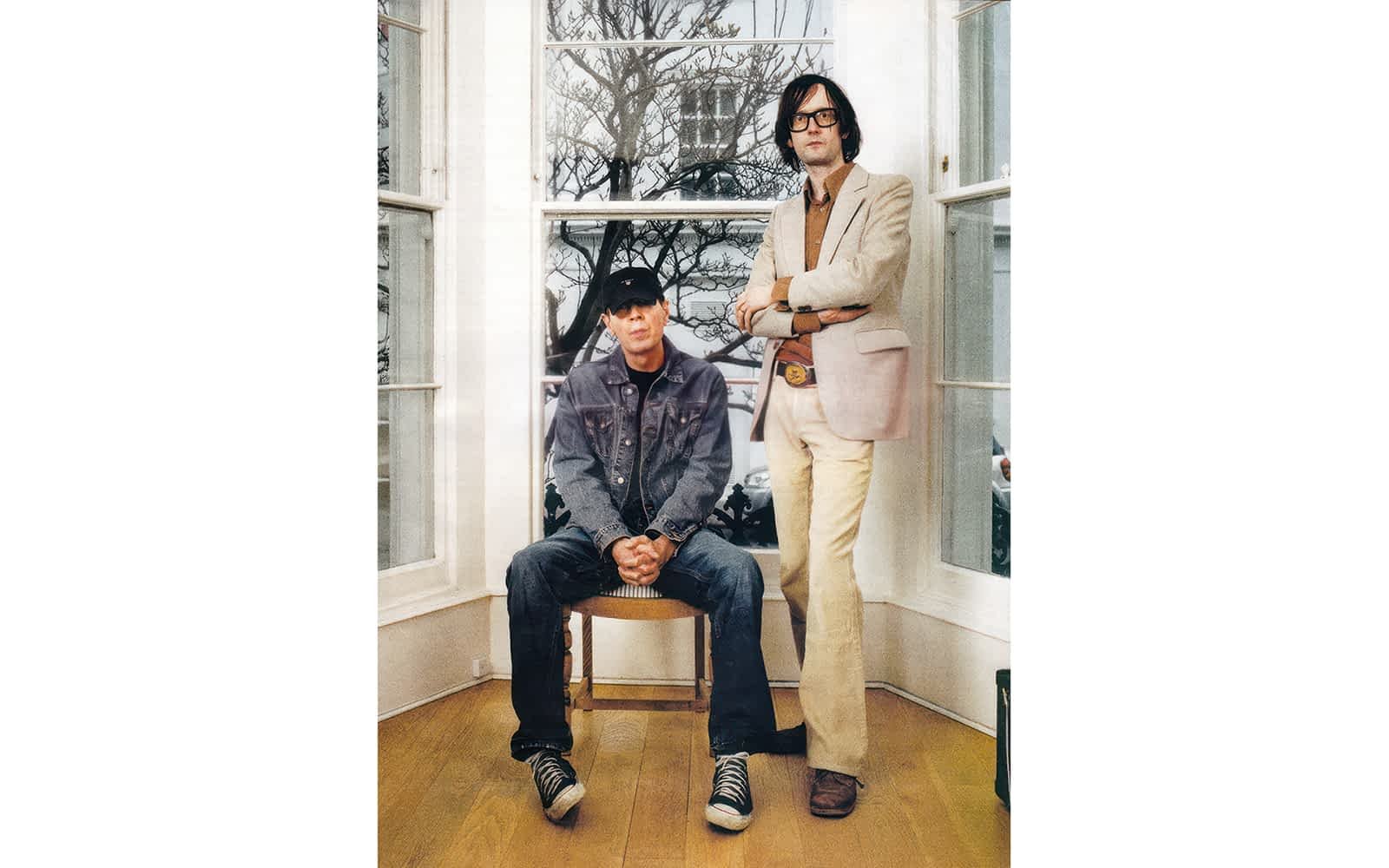
Photo © Polly Borland