
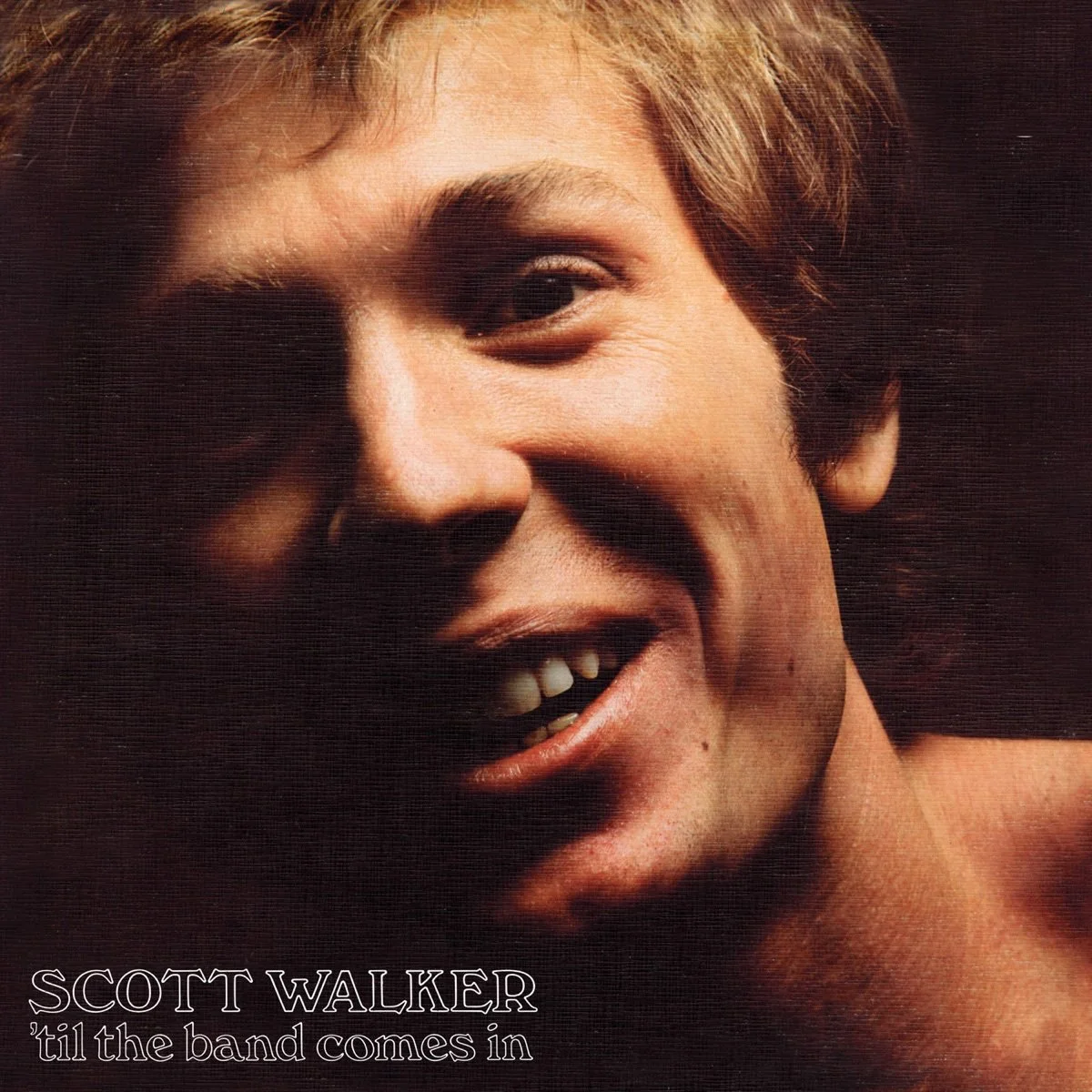
‘Til the Band Comes In
Scott Walker
Released: December 1970. Label: Philips
’Til the Band Comes In is Scott Walker’s sixth solo studio album. Walker returned to his recording name for this concept album exploring the lives of characters in a tenement building, after crediting himself as Scott Engel on his previous release, Scott 4.
Opening with Prologue, featuring the sounds of a dripping tap and a lone cello before the arrival of strings and the noise of playing children, ’Til the Band Comes In includes ten original songs co-written by Walker and his manager, Ady Semel, plus five cover versions. Semel lists the subjects of the original songs in the liner notes: “an old age pensioner, a kept cowboy, a resigned girl lover, a telephone crank, a landlady’s grasp of an unneighbourly stripper, an immigrant waiter”. Long About Now features Israeli singer, Esther Ofarim, another client of Semel’s, on vocals.
In the liner notes to the album’s 1996 reissue, Alan Clayson quoted Walker on his relationship with Semel: “I came back from Greece with the tunes and most of the lyrics done, and worked on them with Ady. He really stopped me going overboard on the songs which I have a tendency to do… striking out the words likely to offend old ladies.”
Walker also covers Michael Legrand and Alan and Marilyn Bergman’s What Are You Doing the Rest of Your Life from 1969 film Happy Endings, Henry Mancini’s The Hills Of Yesterday, written for 1970 historical drama, Molly Maguires, Reuben James by Kenny Rogers and The First Edition, Classic IV’s 1968 hit single, Stormy, and Jimmie Rodgers’ It’s Over.
Angela Morley and Peter Knight did the orchestral arrangements, the album was produced by John Franz and engineered by Peter Olliff, and the cover photograph was taken by Michael Joseph.
No singles were issued from ’Til The Band Come In. The album failed to chart in the UK.
Track Listing
Prologue 1:23
Little Things (That Keep Us Together) 2:18
Joe 3:42
Thanks for Chicago Mr. James 2:18
Long About Now 2:06
Time Operator 3:37
Jean the Machine 2:10
Cowbells Shakin' 1:06
'Til the Band Comes In 3:50
The War Is Over (Sleepers) 3:36
Stormy 3:09
The Hills of Yesterday 2:45
Reuben James 3:03
What Are You Doing the Rest of Your Life 3:36
It's Over 2:26
-
Producer John Franz
Composed by Scott Walker and Ady Semel (tracks: 1 to 10)
Accompaniment Directed by Wally Stott (tracks: 1 to 10)
Accompaniment Directed by Peter Knight (tracks: 11 to 15)
Engineer PeterJ. Olliff
Liner Notes Ady Semel
Sung by Esther Ofarim (track: 5)
Written By Buie, Cobb (track: 11)
Written By Mancini, Webster (track: 12)
Written By Harvey, Etris (track: 13)
Written By Bergman/Bergman, Legrand (track: 14)
Written By Rodgers (track: 15)
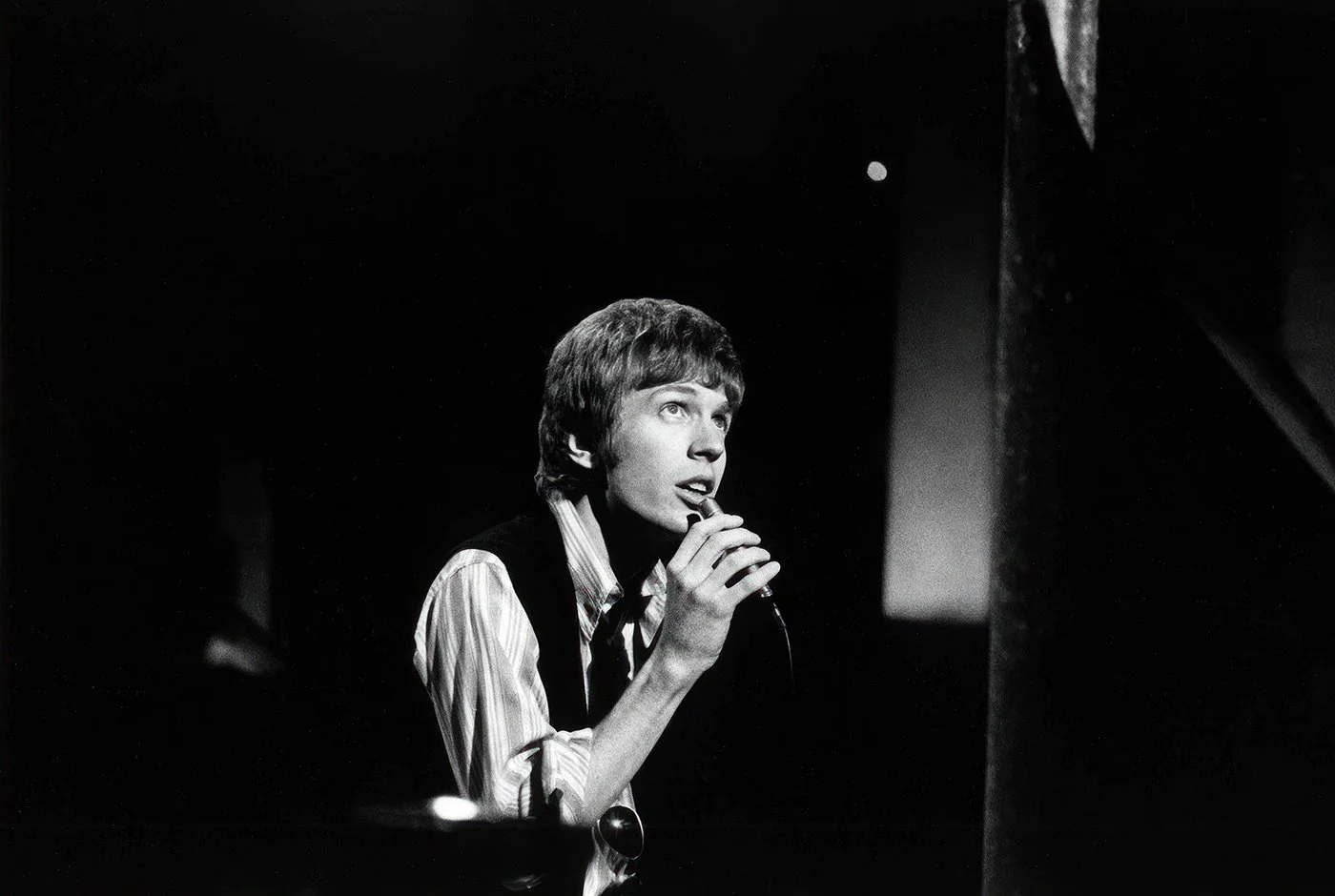
Scott Walker performing on the Nana Mouskouri' TV show, London, 1970. Photo by Michael Putland
Sleevenotes
by Ady Semel
We tend to exercise too often the right to say ‘We’. In passionate protests for integration, in heated discussions of the generation gap, it’s the crowd that roars, the gathering that shatters. We are stardust, we are golden, but the little things that keep us all together obscure a basic doubt.
I’ve known Scott for over a year now, but can’t really tell whether we think alike. We tend to respect, though, each other’s idea of solitude and suspect, each in his own way, that “it might be lonelier without the loneliness”.
This Is how we came to collaborate on this record, in an attempt to consider some solitary joys, some particular complaints (of an old age pensioner, a kept cowboy, a resigned girl lover, a telephone crank, a landlady’s grasp of an unneighbourly stripper, an immigrant waiter).
We owe much to some very singular contributions: to Esther Ofarim for her stunning Interpretation, to John Franz the Producer, to Wally Stott and Peter Knight for the musical arrangements, to Peter Olliff the sound engineer, and to Michael Joseph for the cover photograph.
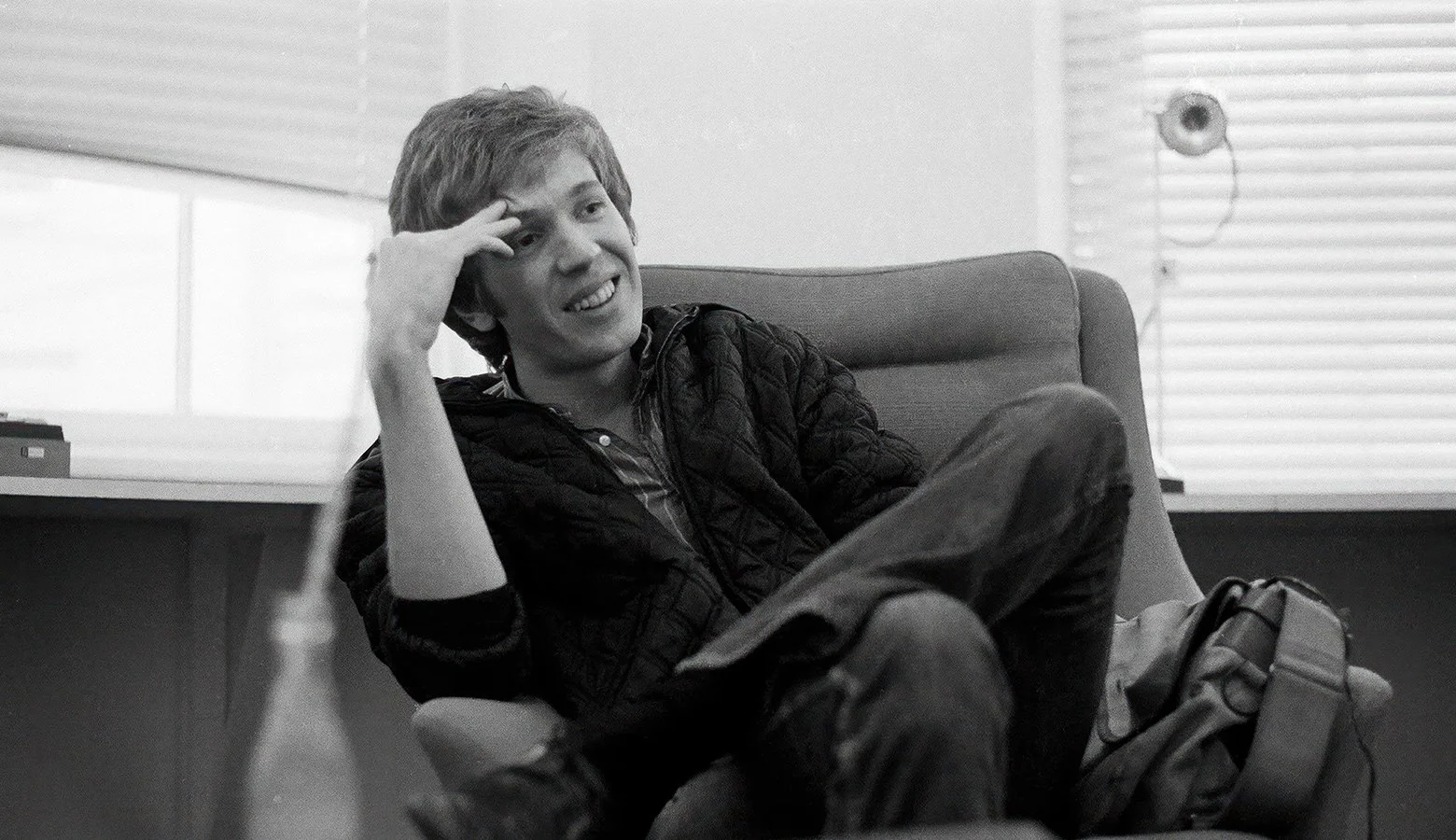
Scott Walker, 1970. Photo by Michael Putland
Interview
Melody Maker, 24 November 1970
by Chris Welch
In 1970 Scott Engel's career appeared to writing grind to a halt. He practically vanished from the scene. He seemed to be forgotten, discarded, after a few hectic years and a lot of beautiful music.
”Temperamental destructive,” that was the general opinion. Oddly Scott has always semed cheerful and enthusiastic whenever we have met after whatever recent uproars had transpired.
He used to get depressed, drink too much and vociferously express his opinions on the low standards of music and the business pop general.
”I had a bad image as moody monster, I broke from that ages ago. I put things in a quieter way - with less bravado.'
And Scott seemed subtly different, when we met for the first time in a year in London this week. He has a new LP called ”Till The Band Comes In,” which has guest singer Esther Ofarim on one track. So he was going through the routine of a cycle of interviews. It was bit mechanical but he was as charming as ever. In a cold white room at the Philips Records office he reclined in an armchair still wearing a quilted wind cheater to prove he wasn't stopping, and blue jeans. His manager Ady Semel, shot in and out of the office like a highly trained hare, checking that the interview was going according to schedule and liaising with the men o' Philips. When he was in the room, on Scott Scott glanced at him for approval for relatively mild statements. He smiled a lot and looked well, and might have been utilising a sun lamp. But it was more likely he had picked up his somewhat polished tan in Greece where he has been writing. ”What's been happening?” he asked himself. ”Well, I have a flat in Amsterdam, and I now have a flat in London. I've done a new album and I'm here for a TV show.”
That took care of the essentials what was the rest of the story?
”It took a month to record to the album - I work quickly. All originals? No but I wrote some songs with Ady Semel. The songs have a very definite idea. I didn't want to do what happened on the fourth album. I don't know what happened there it seemed to confuse a lot of people. I'm at my best writing about the human element - the human heart, it's as simple as that. The songs of the first side cover the lives of people living in a tenement. They are from - several places I have lived in, and some are not even particularly true stories. I did it all when I was in Greece. Then I sent a telegram asking them to set me up recording session.
”As Miles Davis always says, this album isn't a step backwards or forwards, it's a step in another direction. I want to go on to something else - quickly. But I'm supposed to promote, so I did the Derek Nimmo show. I sang a track from my album, which he announced as my latest record, which caused some confusion.
”Now I have to wait and see if anybody remembers me! I've had myself together for some time, and I've been having a beautiful time in Amsterdam. There nobody knew me and I was free to move around.
”Hey I can't tell you much else. Listen to the album, and when you hear it - don't hold it against Neil Young or the Band. I'm into the thing too y'know - it's just that I like to work with orchestras.”
Had Scott felt neglected in the last year, by his fans and the industry?
”No - I don't want to be a star, and never have. I have said always that, I love working in the studio.”
“It's just a question of a lot of things happening that weren't to do with me and me saying things that were misunderstood. And there were a lot of things reported that I didn't say. I had a bad image - but I broke from that ages ago.”
What is currently turning on Scott musically?
”I love The Band they are marvellous. They remind me of the America I love - Tom Sawyer and Huckleberry Finn. And Neil Young's new album is marvellous.”
“Some of the tracks don't appear to be written by the same man. He writes some dreadful prose - then he's written something nobody else could be into.” Scott is not contrite about the past. Nor has he lowered his sights or standards. But he is not intractable. ”There the is a possibility of putting out a single. I'm not so averse that. I need it!
There was a flash of the old Scott determination. ”I know what the voice of I have to contend with and I'm gong to be a tough contender.”
”I'm changed now. Now I can handle most things. I'm not like I was before. I got all that out of my system when I went away all those times and got out of it all for a while, and it's okay now. I don't think it's gonna affect me again, but nor do I think we'll get that same sort of hysteria again. That's what bugs you; that really gets on my tit.
”The times I was gonna give up I can't count, but now I've found my way through so many things in the last year. I'm a survivor man. I've gotta be there. I might go away and get out of it for a while but something draws me back. It's the worst kind of drug thing you can imagine. It's not stage glory either. 'I don't know what the hell it is. I guess it's just trying to explain yourself all the time.”
”I know I could do something else but the hustle it would take would be hard. I'd love to be able to be in a Howard Hughes position, to do things without appearing to do them. He just motivates everything around him and in comparison to everybody else's operations around the world, his operations are cleaner. I wouldn't want the sort of privacy he's got, though. Sure I'm a private person but I do like to rap. It's just that sometimes I don't want to talk as much as others, and people get the wrong ideas. I'm never an ass-hole intentionally. When I was very young I think I was an ass-hole. If somebody bugged me and it was a bad situation, I'd just turn around and hit him.”
Scott maintains that money doesn't matter to him. He still hasn't got any and if the Walker Brothers (who plan another album and a tour later in the year) are successful in this respect it will make an ideal situation for him to continue his own projects without outside pressures he certainly doesn't worry about his career though he does say he's a worrier on a grand scale. What sort of things do you worry about, Scott?
”I worry about politics. I worry about the elections. It really depresses me, you know, that whole thing with Nixon, because I went through all that. My family. all voted for him, you know. I called them and said 'You cretins, you're wrong. I worried about Solyzenitsyn and I'm terribly worried about the state of the writers America and which direction they're going to. I'm talking about novelists. I'm worried about Henry Miller because I love Henry Miller y'see, and it's because well he's gonna die sometime and it's gonna worry me. ”If I see something on television like the Cambodian thing or something I get terribly distressed about that. It's very distressing. I'm like every other little guy who sits and watches and wonders what exactly he can do. You can go and fight, sure, but you don't want to do that because that's exactly what you're p____ off about. And you don't have enough bread to do anything else. Unless you're Howard Hughes.
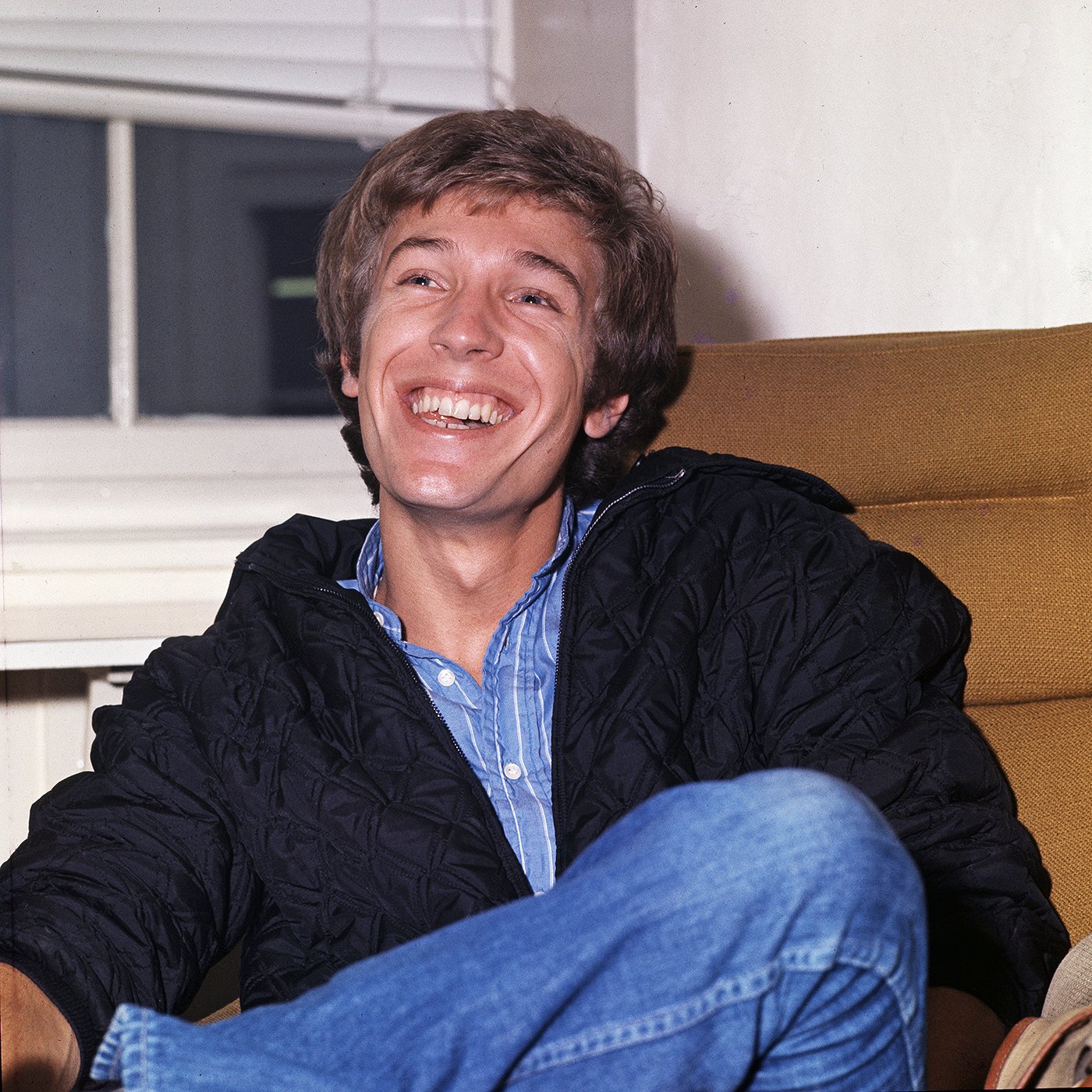
Scott Walker, 1970. Photo by Michael Putland
Interview
NME, November 1970
by Gordon Coxhill
Back from a self-imposed exile, back with a superb album and bags of confidence Is Scott Walker. Scott, the massive idol during his days with the Walker Brothers, who then had to watch his position as Britain's most polished and appreciated singer. vanish as his music became too abstract and lofty for the bulk of his fans, is about to claim what is rightfully his… success.
I count myself very privileged to know Scott quite well and I sense a change in him, a readiness to communicate to people on their level instead on his own demanding and usually unreachable terms.
It is almost four years since the Walker Brothers played their last concert together. In that time, Scott has won and lost just about everything he had in terms of fans and success. What he has kept is his undeniable talent as a singer, his insight into the joys and griefs of ordinary people, and his ability to transform those moods into beautiful and satisfying songs.
His solo career has seen several different phases, not all of them successful. Now with his new LP, 'Til The Band Comes In“, a glorious collection of songs moving round the basic theme of life in a block of flats, it seems as if he has found something approach- ing a permanent niche, rather than his previous musical resting places.
Talking to Scott in a cold, clinical office at Philips Records, I discovered just what has changed about Scott, the man and his music.
I'm not as terrified of live performances as I used to be," he told me. A tour of Japan last summer suddenly shook most of those fears out of me. Before, I had to feel an audience were on my side before, I could face them, and very seldom did I get that feeling."
Could he now say to himself, Hey, listen to me, you so-and-sos, I'm good and you'd better believe it?
No, I haven't quite got that much confidence," he laughed, "but I feel I'm more able to fight than I was last year.
Musically, Scott has become a lot nearer pop in its common sense, than his previous classical leanings. His melodies are simpler, his lyrics, while retaining depth and bite are more acceptable to people who can't or won't give his previous works the deeper concentration they required.
“It’s not a case of writing down to anybody," he said, but I want work to be heard and liked, so there's no point in turning out songs that are too complicated for people to accept.
“I been listening to a lot more pop music than before although I can't honestly claim to like much of what I hear. The new album isn't meant to be a follow on from Scott 4, it's just another direction, another avenue I've explored. The idea has been in my head for a long time now. It started just by watching people going up stairs where I was living, and never really getting to know them. I used to watch, and try and, guess where they came from, what job they had, whether they were happy or sad.”
Even from way back, Scott's music has never veered an inch towards the underground thing, head music, although he openly admits he can write that music as well as any of them. I remember him being very suspect of the flower-power scene three years ago because it sought an escape from reality.
“For me, dealing with reality is the only way,” Scott told me I write about normal people, people most of us can and do identify with.
He has always been thought of as the reluctant idol, and Scott is more convinced than ever that he will never be another Tom Jones. "I just can't see it," he said, referring to Jones’ success and added, “neither do I want it," referring to all that Tom Jones stands for.
"I really really don't know how people are thinking of me at the moment. I've had what amounts to a year away to keep my head together and sort out what I want. I'm pretty sure of that, now I must find out what the people want from me. I know they were pretty sick of me at one time, the problem was knowing the right time for me to come back.
Too soon and I wouldn't have been properly ready, too late and I would have been forgotten. The big star who should have been who never was, that's me. Who never will be? That's something I'll have to wait and see.”
Scott Walker will be big again. His talents as a singer are too rare to be overlooked. His compassion and understanding as writer make him almost the only one worth listening to in this country, and the magic of the man is such that you feel you must do all you can to make it happen for him.
What can you do? For a start listen and be pleasantly surprised by Til The Band Comes In. Notice the humour, the relaxed manner, the apparent case that almost hides the months of hard work that went into the making of the album.
There's a saying in boxing they never come back. It has been disproved several times in the music business. Scott Walker is about to prove it again.
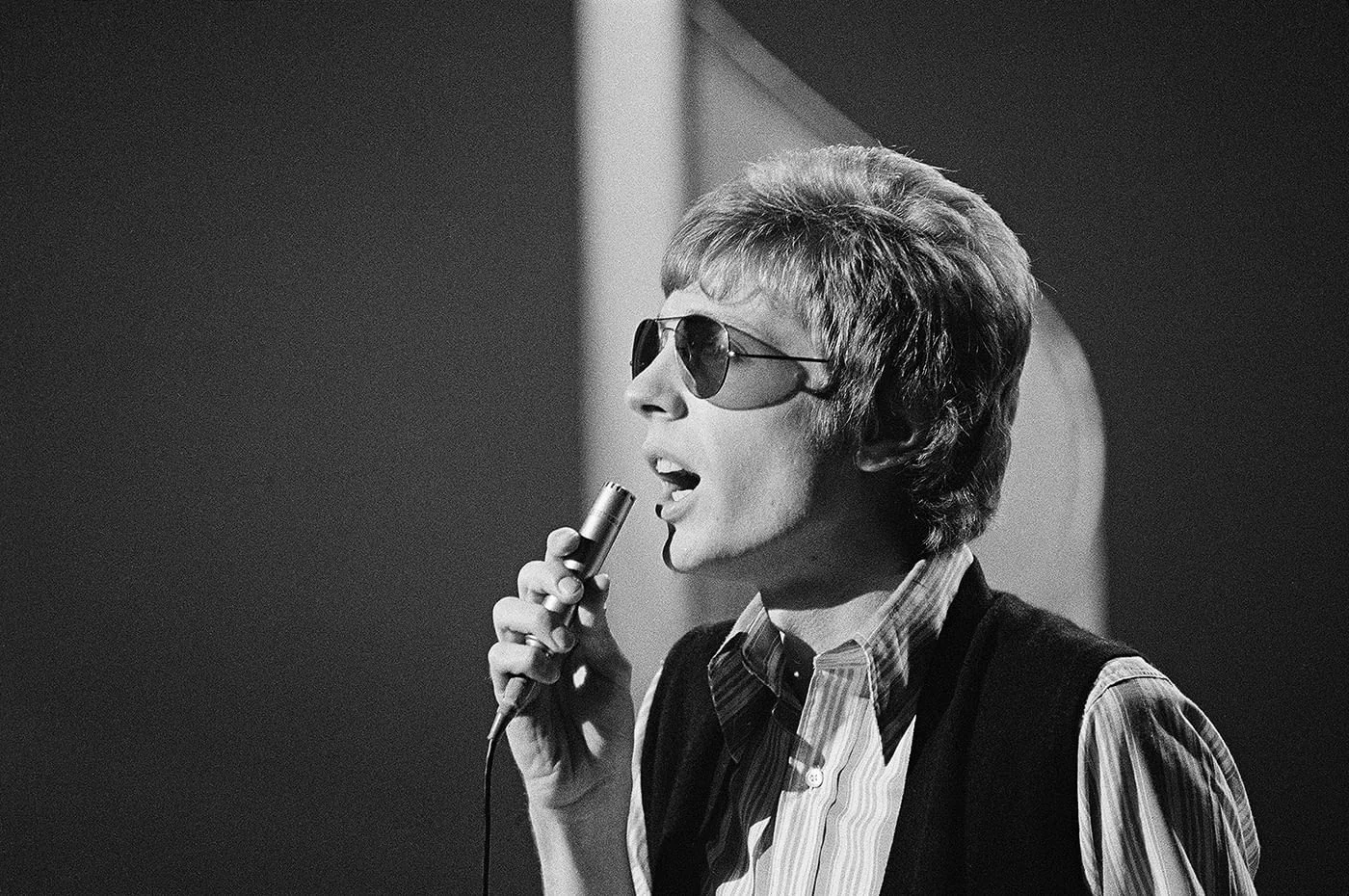
Scott Walker, 1970. Photo by Michael Putland