
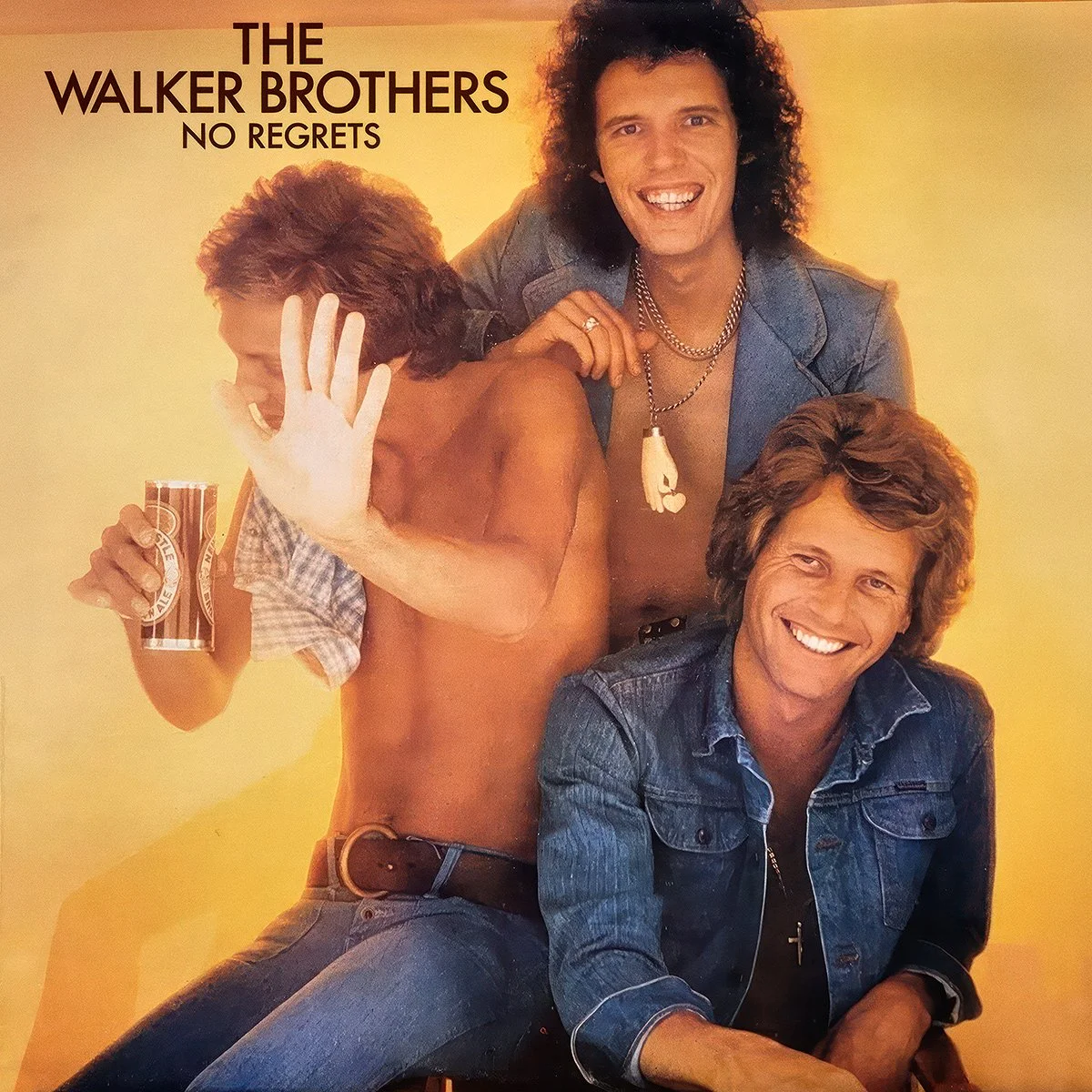
No Regrets
The Walker Brothers
Released: October, 1975. Label: GTO
No Regrets is the fourth UK album by The Walker Brothers. Their first album together in eight years, it comprises cover versions of contemporary country and pop songs. The tracks include Boulder To Birmingham, written by Emmylou Harris and Bill Danoff about the death of Harris’ late duet partner, Gram Parsons and Kris Kristofferson’s Got To Have You, originally a hit for Carly Simon.
The group also cover recent popular songs: Janis Ian’s Lover’s Lullaby, from her no. 1 US album Between The Lines, and He’ll Break Your Heart, a 1960 Curtis Mayfield co-composition, which had returned to the charts in 1975, sing by Tony Orlando and Dawn. There are also early songs by Donna Weiss, who won a Grammy in 1980, co-writing Bette Davis Eyes with Jackie DeShannon for the singer Kim Carnes, and Michael Kamen, an arranger for Pink Floyd, who would go on to write film scores for the Die Hard and Lethal Weapon franchises.
A month after the album’s release, Walker spoke about his hopes for No Regrets in an interview with the Melody Maker’s Ed Jones. “It’s set up for the next album, where we are going to have original material — and I keep stressing this. There is no original material on this album, which annoyed me because we had to get it together too quickly.” He added to the same paper’s Colin Irwin in February 1976. “It’s important to us the record’s a hit. It matters to us all because it buys you freedom.”
No Regrets’ title track, written and originally recorded by Tom Rush in 1968, was released by the group as a single in January 1976. It reached number 7 in the UK charts. The album was produced by Scott Walker and Geoff Calver and engineered by Phil Harding, with sleeve photography by Michael Joseph.
No Regrets reached number 49 on the UK Albums Chart and stayed in the UK top 60 for three weeks.
Track listing
No Regrets
(Tom Rush) 5:47Hold an Old Friend's Hand
(Donna Weiss) 3:47Boulder to Birmingham
(B Danoff, E Harris) 3:55Walking in the Sun
(Jeff Barry) 3:28Lover's Lullaby
(Janis Ian) 3:52Got to Have You
(Chris Kristofferson) 3:55He'll Break Your Heart
(C Mayfield, J Butler) 5:10Everything That Touches You
(Kamen) 4:08Lovers
(Micky Newbury) 3:01Burn Our Bridges
(J Ragavoy, L Laurie) 3:31
Credits
Producer – Scott Walker
Recorded By – Geoff Calver, The Walker Brothers
-
Producer – Scott Walker
Recorded By – Geoff Calver, The Walker Brothers
Acoustic Guitar – John Walker, Judd Procter, Len Walker, Scott Walker
Acoustic Guitar, Guitar [Electric] – Alan Parker
Arranged By, Piano [Acoustic] – Steve Grey
Bass [Electric] – Darryl Runswick
Conductor [David Katz Orchestra, The] – Steve Grey
Drums – Barry Morgan
Drums, Percussion – Dougie Wright
Electric Piano – Dave McRae
Guitar [Electric] – Ritchie Hitchcock
Guitar [Pedal Steel] – B.J. Cole
Orchestra – The David Katz Orchestra
Percussion – Chris Karan, Gary Walker
Backing Vocals – Bones, Suzanne Lynch
Recorded at - the Marquee Studios, Kingsway Recorders and Air London Studios.
Producer – Scott Walker
Recorded By [Assistant] – Ben Emrys-Roberts, Bob Broglia, Phil Harding
Sleeve – The Bloomsbury Group
Photography By – Michael Joseph
Interview
Melody Maker, 15 November 1975
by Edward Jones
Walk Right Back
EDWARD JONES talks to the reformed Walker Brothers
It’s been a hard day in the plush penthouse suite of this Mayfair hotel. The chandeliers in the mirrored hall have seen a succession of journalists pass in and out to talk to the reformed Walker Brothers. The air is thick with cigar smoke.
And it’s not over yet. Here comes another pressman with photographer and cassette machine in tow, ready to rake over the painful past and grill them on how many thousands they’ve been paid to get together again, ignoring their art in the search of a catch-penny headline. One can understand their welcome being polite rather than effusive.
Adding insult to injury. Scott Engel, in earlier years the heartthrob of a million pubescent girls, and at 31, still as tall, blonde and handsome as ever, is holding off a dose of ‘flu only by gobbling pills by the score. He is obviously feeling fragile. While drummer Gary Leeds hops from side to side of the coffee table around which the chairs are grouped, Scott uses the roomspace defensively, sitting well back in a deep velvet sofa, which he shares with the third Walker, John Maus. John is very much the Duke Wayne of the three. A strongly-built dude of six-foot-four, he talks slowly, punctuating his conversation with meaningful looks which convey from the outset that he is not to be trifled with.
The standard works of rock reference reveal that in spite of their immense impact on the female adolescents of the time, the Walker Brothers’ Top Twenty success was spread over a mere 16 months, from June 1969 to October 1966, though they did manage to cram six hit records into the period, with two hitting the top spot (“Make It Easy On Yourself” and “The Sun Ain’t Gonna Shine Anymore”) and one making number three (“My Ship Is Coming In”).
But success brought its own problems. The pressure of teen adulation and the attendant publicity took its toll, particularly of Scott, its main object, who was. Their record company, Philips, insisted they stick to the winning formula: Scott, who had pretensions to being more than a mere pop star, finally cracked, and in May 1967 the group split with mutual recriminations (usually misquoted, they say).
Scott had three Top Twenty hits on his own in 1968 and 1969, but had a progressively less happy time after moving from Philips to CBS, for whom he recorded several albums, often under protest at being prevented from including his Jacques Brel and Randy Newman-influenced songs. Later he went to live in Holland and then Copenhagen, where he is still based, living “modestly,” it’s said. Only occasionally has he forced himself to perform, and then only a couple of weeks cabaret each year.
John Maus’ career since the split is poorly documented, and he declines to talk about it.
Gary Leeds briefly led a group called Rain in 1968, then produced demos. Later he left the music business altogether and made jewelry. Recently he returned and has been rewarded with a number one hit in Italy.
Now they find themselves undergoing a batch of interviews to promote the album they have recently finished for GTO Records, an independent label founded by Dick Leahy, the man who ran the British end of Bell Records when it was breaking the likes of The Rubettes, and the Bay City Rollers. Entitled “No Regrets,” and released on November 7, the LP has been made Tony Blackburn’s first-ever Album of the Week, and according to Leahy, the title song, an old Tom Rush number, is generating enthusiastic feedback from radio stations around the country.
It becomes clear that the strongest factor in the reformation or revival (there is much semantic hairsplitting over the correct term) is the willingness of Scott Engel to try again as a public performer.
“Well, why hasn’t he been in the public eye?”
“I haven’t been able to do concerts, because, um, no guts,” he confesses, kneading his face. “No guts is the reason. I have done cabaret about two weeks a year; that’s about all I’ve been able to force myself to do.”
“What we’ve done now,” he says, “is make an album that is going to set it up for the next album. Really, that’s the truth. It’s a foundation. We’ve made a very good album, but it’s not going to offend anybody, you know what I mean?
“It’s set up for the next album, where we are going to have original material and I keep stressing this. There is original material on this album, which annoyed me because we had to get it together too quickly.
“We want to head for an album that’s better than just good, but when you’re into a new company and people are excited around you and you’re into a new thing, you’ve got to go with it.”
What about live dates? Is there a tour in the pipeline?
“We have to wait and see about this record,” says Scott. “Once again, we have to state that re-formation or revival, they are unfortunately the only words to use, are really the wrong ones; because if the thing doesn’t start to work in the first place, we’re not going to follow it through.”
This toe-in-the-water attitude is reinforced by considerations of the expense involved in setting up a tour whose profitability is so far not established.
Eventually, it can no longer be avoided: I suggest that in many minds there will be the suspicion that large sums of money played a big part in their reunion. There is a babble of denial.
“Why does everybody say that?” demands John.
“Unfortunately, this is the general way of judging success or value,” soothes Ady Semel, the group’s precisely-spoken manager, with a sad philosophical air. “But it is not a Las Vegas type of artist we are discussing here.”
Sounding suspiciously like the voice of frankness, Scott shatters the party unity:
“Look, if we turned around and said this didn’t matter, we’d be bulling.”
So money was not a motivation for getting together again?
“I’m telling you, forget it. OK?” says John. “We got into doing what we’re doing. We busted our backsides to do what we’ve done; but it got done because it was necessary. But the most important part is that, musically, what I’ve learned by myself, what we’ve all learned by being apart, we’re trying to apply to the Walker Brothers. We’re trying to bring knowledge into it, not take it out. OK?”
Scott insists on giving his version of the situation:
“I’ll tell you what it really amounts to is this: when we’re making an LP, we try to do the very best we can in choosing songs, too. So naturally there’s a financial consideration when you’re packaging this kind of an item.
“When we’re doing our own songs, we can talk about Art in a more serious way. But with this, if there weren’t a financial consideration, we wouldn’t be doing it at all.”