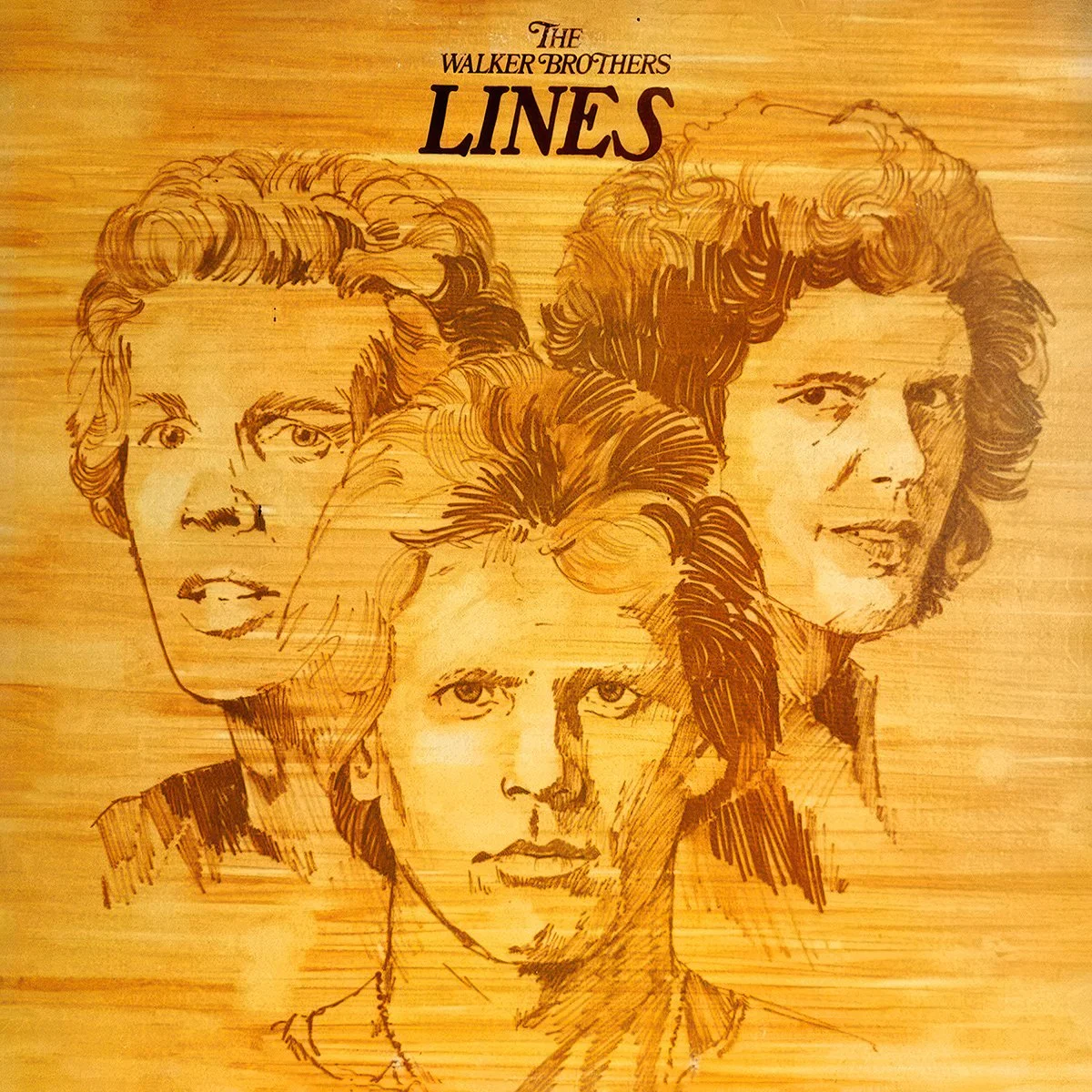
Lines
The Walker Brothers
Released: October, 1976. Label: GTO
Lines is the fifth studio album by The Walker Brothers, released in 1976, and their second album since reuniting in 1975. The album did not chart, and its singles, “Lines” and “We’re All Alone,” were not successful.
Stylistically, Lines is similar to their 1975 comeback album No Regrets, blending country and pop music with romantic orchestral arrangements. With the exception of “First Day,” which was written by John Walker under the pseudonym A. Dayam, the album features no original songs by the group. Scott Walker did not contribute any new songs until their next album, Nite Flights.
Track listing
Lines
(Jerry Fuller) 3:26Taking It All In Stride
(Tom Snow) 4:33Inside of You
(Tom Jarvis) 3:35Have You Seen My Baby
(Randy Newman) 3:31We're All Alone
(Boz Scaggs) 4:35Many Rivers to Cross
(Jimmy Cliff) 4:38First Day
(A. Dayan) 2:22Brand New Tennessee Waltz
(Jesse Winchester) 3:11Hard To Be Friends
(Larry Murray) 3:27Dreaming As One
(David Palmer, William Smith) 3:03
Credits
Producer, Mixed By, Recorded By – Geoff Calver, Scott Walker
-
Producer, Mixed By, Recorded By – Geoff Calver, Scott Walker
Acoustic Guitar – Paul Keough
Acoustic Guitar, Electric Guitar, Mandolin, Guitar [High Strung], Slide Guitar – Alan Parker
Backing Vocals – Bones, The Charles Young Choral
Bass – Alan Jones
Conductor, Arranged By [The David Katz Strings] – Steve Grey
Drums – Barry Morgan, Brian Bennett, Simon Phillips
Electric Piano – Dave McRae
Orchestra [Uncredited] – The David Katz Orchestra
Percussion – Tristan Fry
Percussion [Uncredited] – Gary Walker
Piano [Acoustic] – John Mealing, Steve Grey
Saxophone [Sax Section] – Alan Skidmore, Dave Wilus, Jeff Daley
Strings – The David Katz Strings
Violin [Blue Grass] – Roger Churchyard
Vocals, Acoustic Guitar – John Walker, Scott Walker
Recorded at - Air London Studios
Design, Illustration [Front Illustration] – A.P. Creative Services
Illustration [Front Illustration] – Geoff Crook
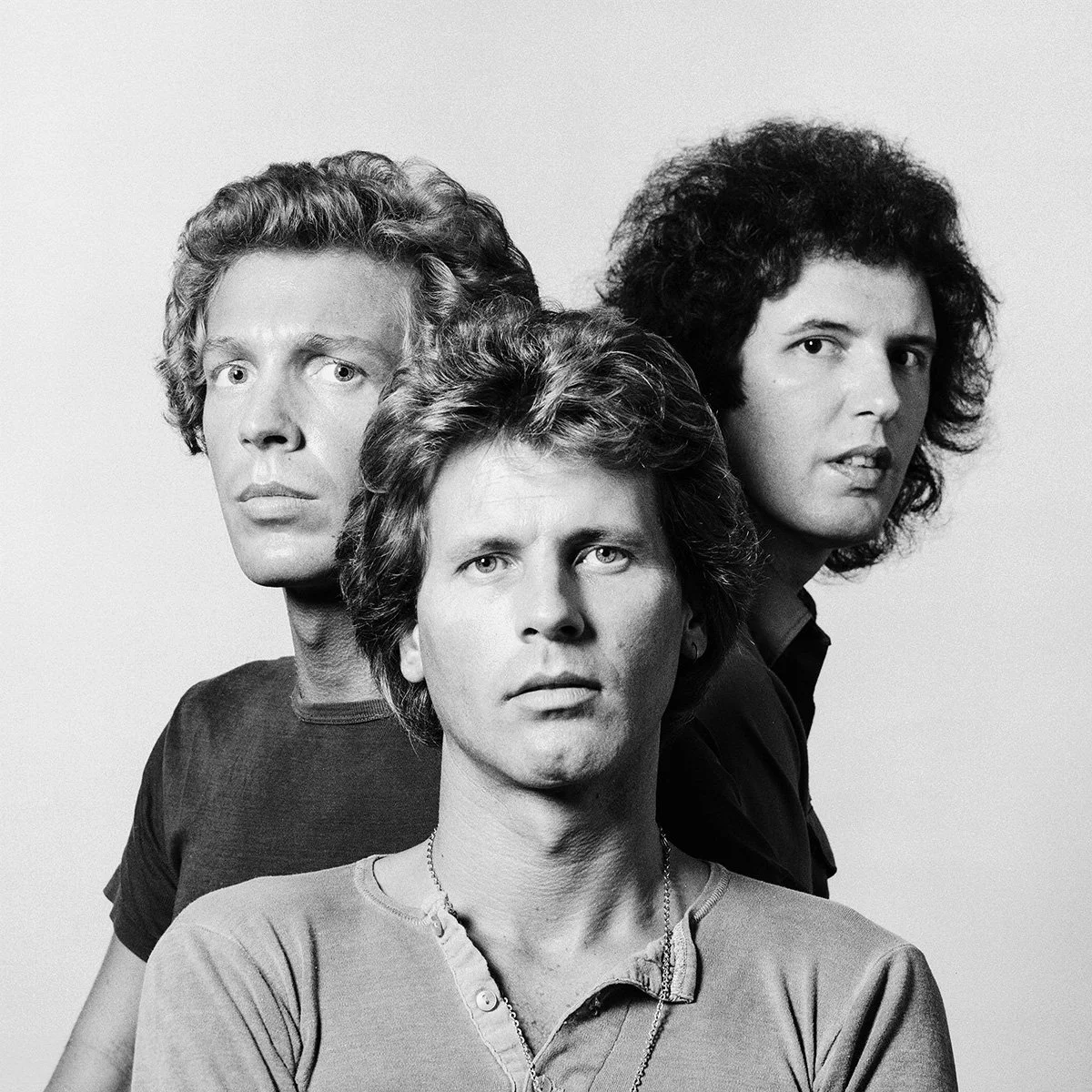
Photography By – Mike Putland
Interview
Melody Maker, 13 November 1976
by Steve Lake
Scott's visions of the future
Scott Walker sings New Poetry? It could happen, as STEVE LAKE discovers
IT’S September 1966, and Scott Engel has big plans for his pop group the Walker Brothers.
“I’m writing surrealist songs,” he announces, eyes wide behind the recluse’s obligatory shades, “and using surrealist arrangements—Gil Evans-type things. And”… (breathless now)… “and we’ll have lyrics that will be as strange as the arrangements — very Dylan Thomas, very Kafka.”
A decade and a few months later, the spirit may be somewhat bruised but the vision is still intact.
“Yeah, what I’d really like to do is try and combine New Poetry with some of that Schoenberg kind of orchestration. People tell Dylan he’s a poet, and he usually disagrees. He’s right, because he’s so tied down with regular metre, because of that 4/4 beat. And that’s very limiting. Nobody’s yet found a successful way to put the kind of stuff that, say, Snyder does (Gary Snyder: American Zen wilderness poet; recommended) into a musical setting.”
Which is not to say that Scott Walker hasn’t been trying. One of the old Philips solo albums, Scott 4, “tried to link lyrics influenced by Sartre, Camus and Yevtushenko to Bartok modal lines, but of course, nobody noticed, not even the arrangers and producers with whom he was working at the time.
“It was all screwed up. I didn’t have any management at the time. Everybody I came to thought I was a nutcase. You know how it goes. It finally got down to, like, ‘What can you sing?’ And I’d say, ‘Well, I can sing anything you want me to sing, what can you pay me?’”
Scott Walker’s career is probably the most chequered in pop history. From double bass playing in his Los Angeles High School Orchestra, to bass guitar sessions around Hollywood, hanging out with guitarist Elliot Ingber (the future Winged Eel Fingerling of Captain Beefheart fame); playing in the bands of Ike and Tina Turner and Sandy Nelson; heading for England with singer John Maus and former P. J. Proby drummer Gary Leeds; enjoying 18 months of chart success with classic sub-Phil Spector singles—“Love Her,” “Make It Easy On Yourself,” “My Ship Is Coming In,” “The Sun Ain’t Gonna Shine Anymore,” and touring with Engelbert Humperdinck, Cat Stevens and Jimi Hendrix (in one package!)… and then splitting up the Walker Brothers. Nothing ever quite fell into place again. There were TV programmes, rumoured suicide attempts, retirements and more comebacks than anybody cares to remember.
Possessed of a fine ballad voice that reverberated with tearful melancholy, and an imagination running permanently at odds with either of the public’s images of him — pop idol or supper-club — Scott Walker never could capitalise on the Walker Brothers’ brief burst of mad popularity. “My own trip just seemed to work. As you know, we’ve tried it again and again, but somehow I never seemed to be able to attempt concerts or whatever wholeheartedly.” Some sort of creeping self-consciousness seemed to paralyse the expatriate American. Even though he had (with Nik Venet and Jack Nitzsche) created the Walker Brothers’ sound, had sung lead vocals on all their hits, and had even produced much of their material, Scott lacked the faith to make his own thing work.
“There was one point way back there when I turned back from what I believed and I was never able to get round again.”
So, when the possibility of a Walker Brothers re-formation came up in late 1975, he almost jumped at the possibility. And propped up by two group members who appear, to this writer at least, to be virtually sleeping partners, Scott Walker is working again.
“No Regrets,” the disinterred Walkers’ first single (for GTO) was a hit worldwide, and though the follow-up, Jerry Fuller’s metaphor-crammed “Lines” (“it’s our best-ever single, but nobody’s playing it”) has yet to dent the charts, a tour is being considered.
It will not, however, begin in England. That, says Scott, would be suicide. “We’ll go out with two drummers, two guitars, two keyboards—one of them playing Moogs and stuff—bass, percussion… oh, and there’ll be a string section waiting everywhere we go. That’s what people hear on the records, that’s what we need. If we just go out and sing, man, and take some good players with us, it should be nice.”
Scott always had an ear for good players. He’d taken guitarist Terry Smith and altoist Ray Warleigh out on the road with the Walkers, and the Lines album features tenorist Alan Skidmore, 801 drummer Simon Phillips and ex-Matching Mole electric pianist Dave McRae. (In fact, he will produce an album for McRae’s new band, Pacific Eardrum.)
But what, one wonders, is the most that the Walker Brothers can achieve, limited, as they are, by the demands of image-creation and marketing? Scott has no doubts. “I would like to see them” (he has this disconcerting habit of referring to the group as some third-person entity) “I’d like to see them become a money-making organisation, man. Because I think it’s about time we had some bread because we never have had.
“I’m still in debt. I lost money all the way down the line. I still got problems with the tax people going back eight years, and I’ve never even lived in a big pad.
“But I feel that with the Walker Brothers can at least work. I’m sure of it. I feel stronger with them.
“I guess it’s got something to do with us knowing each other since we were kids and being expatriates together. With them I can do it. With them I can go out and do concerts. I don’t do any of my stuff. I’ll do what they want to do.
“And they wanna make some bread.
“But,” he insists, “that doesn’t mean that the Walker Brothers has to be a cop-out. It can be done with integrity; it can be a quality thing. For the past two albums I’ve gone out and listened to everything and come up with the best songs I could find.
“And I think there’s some writers that I can get hits for. Maybe more easily than they could themselves.”
Tim Hardin’s name comes up. Scott’s version of “Black Sheep Boy” could have charted if released as a single, his voice imbuing it with an implication of self-pity and regret that is nowhere in the original. But the capabilities of other contemporary songwriters—like Randy Newman and Joni Mitchell—have served more often to depress rather than inspire Walker. In his mind, his own talents shrivel every time he places an album on the record deck.
“Right now, I’m trying hard to not listen to any music at all, or at least, as little as possible. I have to free myself from this obsession to surround myself with music.
“Because, you know, I’ll put on Scriabin, or Scarlatti or Bartok, or even Joni and suddenly I’m not working any more.
“I’m completely dwarfed by other people’s achievements. Like, what’s the point of my even trying, when all that music is out there already?
“But I’m slowly beginning to understand how that attitude is really dumb. Everyone is creative in his own individual sphere…
“I figure that I’m a late bloomer. I really believe that. It’s an inspiration to learn — didn’t Henry Miller write Tropic of Cancer till he was 33. Of all the great writers in the world, he’s probably my favourite… And I’m 33. And I’m ready! (laughs).”
So Scott is looking to the Walker Brothers to provide the commercial front for his solo experiments, which will, for the duration at least, be confined to the recording studio.
“With the Walker Brothers thing happening on the one hand, I’m no longer afraid to put down what I have to say. And that makes me happy, man. If I can make money with the group and have full artistic control over my own records, then everything should be beautiful. There’s for me now. If I don’t do it this time, I’m just a jerk. I’m only fooling myself. Or else I just don’t want to do it, there’s no will left anymore.”
He washes down a couple of glucose tablets with a bottle of spring water he’s just produced from a backpack.
“Man, every time I talk to your paper, I’m really wasted. I haven’t slept for two days. John and I were up all last night making tapes. Really putting down some nice ideas.