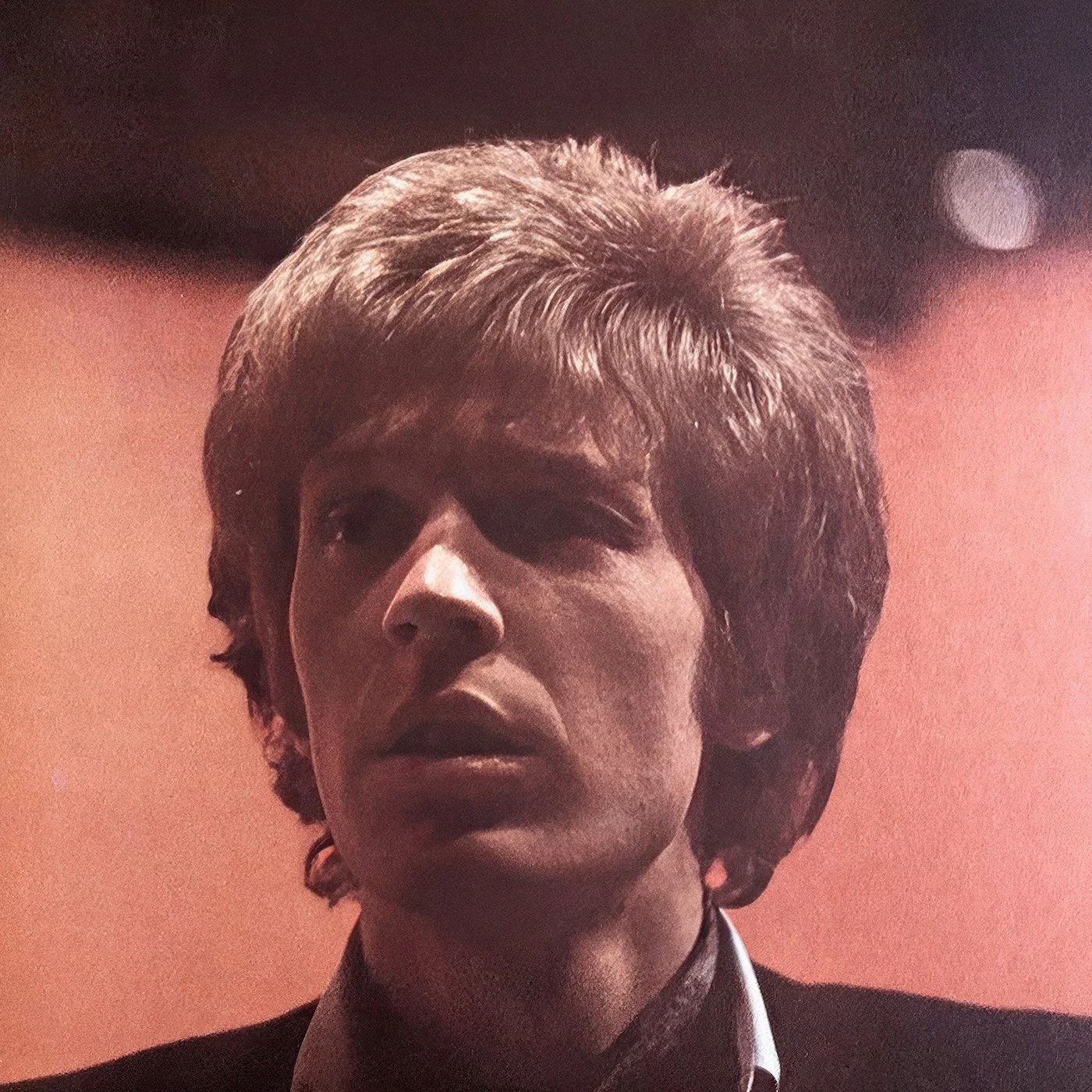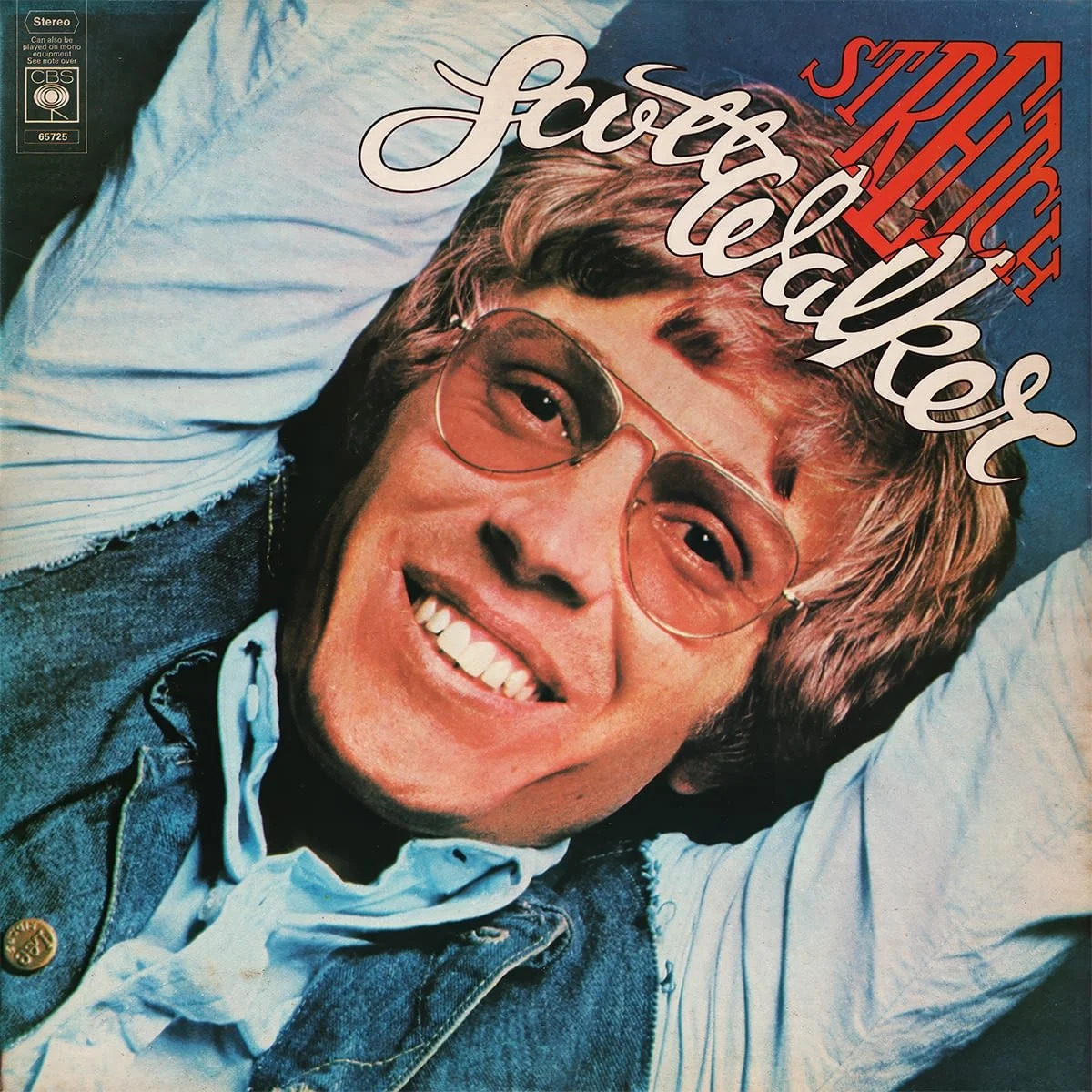
Stretch
Scott Walker
Released: November, 1973. Label: CBS
Stretch is the ninth solo studio album by Scott Walker. It was his first release with CBS/Columbia Records following his departure from Philips Records. It marked his first change of production personnel since his debut album with the Walker Brothers.
Opening with Someone Who Cared, written by the album’s producer Del Newman, the rest of the album comprises contemporary cover versions. Songwriters featured on Walker’s album from earlier in 1973, Any Day Now, appeared again in his choices of songs. He sings Randy Newman’s Just One Smile and I’ll Be Home, Bill Withers’ Use Me and Jimmy Webb’s Where Does Brown Begin?.
Country songs also feature: Tom T. Hall’s That’s How I Got To Memphis, Jim Owen’s Where Love Has Died, a 1970 hit for Waylon Jennings, and two Mickey Newbery songs, Sunshine and Frisco Depot.
The album was recorded at Nova Studios in Marble Arch, London, produced and arranged by Del Newman, and sound engineered by Richard Dodd. The band included Pentangle drummer Terry Cox and BJ Cole on steel guitar and dobro. “Technically, he’s the best singer I have ever worked with,” Cole said on the liner notes to the 1997 reissue of Stretch. “His vocal quality sent shivers up my spine.” Compiler of the liner notes, Alan Clayson, also points out that the title is one of Scott Walker’s nicknames.
The sleeve design was directed by Rosław Szaybo, with photography by John Brown and Mike Fowler. The album did not chart in the UK. Walker’s version of Dan Penn and Spooner Oldham’s A Woman Left Lonely was released as a single, which also did not chart.
Track Listing
Sunshine 4:27
Just One Smile 4:23
A Woman Left Lonely 3:22
No Easy Way Down 4:37
That's How I Got to Memphis 3:10
Use Me 4:19
Frisco Depot 3:46
Someone Who Cared 2:58
Where Does Brown Begin 4:35
Where Love Has Died 2:23
I'll Be Home 3:24
-
Arranged By, Producer – Del Newman
Engineer – Richard Dodd
Art Direction, Design [Cover] – Roslav Szaybo
Cover [Back] – Mike Fowler (3)
Photography By – John Brown
Acoustic Guitar – Brian Daily, Colin Greene
Acoustic Guitar, Electric Guitar – Paul Keogh
Bass Guitar – Bruce Lynch, Dave Wintow
Bass [String] – Chris Lawrence
Drums – Barry Desouza, Terry Cox
Electric Guitar [Solo] – Jim Ryan
Keyboards – Mike Moran, Ronnie Leahy
Percussion – Ray Cooper
Steel Guitar, Dobro – BJ Cole
Written By - M. Newbury (tracks: 1 & 7)
Written By - R. Newman (tracks: 2 & 11)
Written By - Penn, Oldham (track: 3)
Written By - Goffin/King (track: 4)
Written By - T. T. Hall (track: 5)
Written By - B. Withers (track: 6)
Written By - D. Newman (track: 8)
Written By - J. Webb (track: 9)
Written By - J. Owen (track: 10)
Interview
Melody Maker - 5 January 1974
by Michael Watts
Ol' Blue Eyes is Back
LOOK who’s just walked in here, in those skinny Levis and the Arran wool cardigan that’s suddenly become hip! Isn’t it? Same blond hair, barely a day older, with bush hat tipped over eyes to avoid prying stares. Isn’t that Scott Engel?
Who?
Scott Walker. You know, the Walker Brothers. “Make It Easy On Yourself,” “The Sun Ain’t Gonna Shine Any- more,” those those hits. The Sixties. Moody, they say, but beautiful, oh yeah! Scott Walker, right? Uh-uh.
THAT’S right. This rake-thin American has just walked into the teabar of the Hilton hotel in Mayfair, on the first floor, where young lady is playing very loudly the “Theme From The Godfather and other sentimental favourites, while Earl Grey tea is decanted from bright steel pots and petit fours are passed around.
He’s with his manager, a Mr Ady Semel, a dapper little Israeli who used to look after Esther and Abi Ofarim in the days when they got on famously. They are coming towards this table, where sits the publicist from CBS records. Scott is going to do something that’s quite rare for him now; he will do an interview. It’s a pot of tea all round. Well, Scott, we tell him, you’re an evergreen. Ha ha, he loves that – evergreen! But still, six years after the Walker Brothers have become a melted memory he’s got a bit of rass and image going for him. His voice still has a deep, rich agony to it. And if John Maus or Gary Leeds were to walk in here now, we would be truly surprised at that.
No, Scott Walker may not do much these days but whatever it is he does with taste and decorum, and that’s more than can be said for some of his past antics the maudlin boozing, the tetchiness, the rumoured suicide attempt all the garbage of the old clippings file. What happened? Well, after the heat was really off, he went away to Amsterdam and decided that this kind of frenzied activity should be made secondary to being alive, to trying to preserve a whole, real life, not that of a guy who spends his time on TV and in concert halls.
In fact, don’t even mention concert halls It makes him nervous ‘I’m always… every time I even come back to do the only kind of club appearance I do, the thing I’m always afraid that even the people there y’know, I’m gonna walk out to a load of strangers, or that I’m not gonna be able to do it. But… it does all come together on the night.” You see.
And no amount of urging him to promote himself is likely to work. Once you’ve done one thing, he says, you’ve got to do another, and been he’s involved in too much hype already. He doesn’t actually use the expression, but journalists on the whole have acted towards him like assholes. It was their own personal view, he goes on, of how they felt, and they interpreted it through him: “And so after a while I just… just got so angry with them for what I didn’t say. That’s why I keep the interviews down.”
The, uh, moody loner? “Yeah, that’s taken again out of context. Of course you have your moods! It was a lot worse when I was younger. In the Walker Brothers when everything happened I really didn’t know what the…. was going on. To tell you the truth, I was very confused by all of it.”
We feel as if we probably ought to apologise for all those journalists who have been assholes, but we change our mind. After this all, could have been a story of poor little Scotty, who came to grief on the rocks of his own emotions, but the guy has obviously got his karma together – for the occasion, at least – that we’d only be adding to the garbage.
Still, we’re thinking it’s rather a pity that he doesn’t want to be a star because with a little motivation it’s well within his grasp. He seems to have ever trembled on brinks and to have played the reluctant hero. until finally, when his reluctance into hardened resolve and some sort of maturity, he’d become too cautious and self-aware to venture leaps across chasms that might be remotely awe-inspiring.
We’re thinking he might have copped out on himself, and that’s the worst. Because his great gift, together with the richness of that smooth, brown voice, has been his divine discernment of quality in songs – his ability to see beyond trends and recognise that Randy Newman, for instance, was a great songwriter before almost everyone had caught on, and that Jacques Brel, whose material he used on three albums, could be introduced to pop audiences – long before David Bowie dared, indeed.
His mistake, if it can be called such, is that when he stretched outside the contemporary bounds of pop he was too far ahead of his time and opened himself up to charges of being a poseur. Now, on his latest album, “Stretch” – the title assumed from a nickname of his – he has, somewhat ironically, contained himself quite nicely within the limits of what one might expect from a tasteful balladeer, with songs by Newman, Jimmy Webb, Mickey Newbury and Goffin and King, principally. Only the inclusion of a song by Nashville’s Tom T. Hall, the most enlightened of new country writers, is slightly unexpected.
In mitigation, however, he has apparently had trouble with his record company, CBS, with whom he signed from Philips just over a year ago. He claims he was signed under the belief he would not just be an interpretive talent but would be doing his own songs – after all, he wrote “After The Lights Go Out” for Lesley Duncan but then CBS’ A and R department has since “rode shotgun on my ass.”
Half the material for the album, it seems, they gathered together themselves. The result has been inhibitive. “Now they’re coming on to me and saying well, where’s your own material? We must hear it some time.’ And I tell them, ‘I’m not gonna audition my songs for you.’ I mean, you know… If I can come to some sort of agreement with them then I’ll be happy, if I can’t I’d rather go somewhere else.”
Even worse, he completed some time ago an album for CBS of country songs, most of which are written by Billy Joe Shaver, a shooting star amongst these new C and W composers, but this lies in abeyance, waiting to be mixed and for some American deal to be set up. This one sounds truly adventurous, yet he maintains that CBS’ view was that country doesn’t sell in Britain and that in the States they were chary of “Mafia In Nashville.”
The situation irritates him considerably:
“Most of the stuff was brand-new, and that’s very hard to get. I had it all when it was new. This was the thing that pissed me off.”
And stirring the cauldron even more vigorously, his first album for the company they’d intended to be produced by Gamble and Huff, using their original numbers in a kind of Harold Melvin setting. At this point, though, Gamble and Huff quashed the deal by deciding to do a Motown and form their own label, Philadelphia International. This, effectively, was the end of an R and B Scott Walker.
CBS had hopefully been a fresh start as a writer after seven solo albums with Philips, the first four of which had been titled volumes one to four, and on the fourth of which he believes the record industry went out and “killed my ass.”
All in all, in his dealings record with companies, a feeling of persecution mania appears not to have been too far absent. He then wrote, in a week, “Til The Band Comes In,” which a Philips handout at the time described as “a musical interpretation of life in a block of flats in a frozen moment in time” – which does seem an excessively psychological explanation of a piece of music.
Even he says now that the songs, composed in Greece, lacked a cohesive spirit, but as with the fourth album, Philips, he alleges, weren’t really behind it – “some new people took over the company and I started to get preached to.”
They did release two more, however: “Moviegoround,” which he made whilst recovering from an illness incurred in Scandinavia, and “Any Day Now,” on which his intention had been just to “get together some nice tunes.”
By then he’d thrown up his hands in an emotion akin to resignation.
Ah well, he says, that’s in the past – and he tips his hat further up his forehead in a gesture of dismissiveness. The lady at the piano, meanwhile, hammers to a crescendo a version of “The Moonlight Sonata,” enough to emphasise a lacuna in the conversation.
The past, however, is a continuing process in both directions. He elaborates:
“I try not to go back because I’ve seen too many people sitting around playing the same old songs and saying, ‘wasn’t I great back in so-and-so? Listen to what I did there…’ That’s boring to the person that’s still progressing. I mean, I’d probably like some old Randy Newman stuff that he would loathe now and most likely doesn’t even have copies of, because he’s very cynical, too. It’s the same with me.”
Oh sure he’s cynical, Scott Walker, a dark side that’s represented for him by Jacques Brel, himself a curious mixture of cynicism and morality; or, as Walker puts it, not knowing where to go and yet stating it so beautifully, because, who does? “He can even state love beautifully, which, if you were pinned down, you’d probably say he didn’t believe in.”
He’s never met Brel, in fact, which isn’t that surprising in view of the latter’s reclusive nature and refusal to leave the Continent. The temporary infatuation for him, though, arose in turn out of a temporary infatuation for a German girl, with whom he once lived and who brought with her a collection of Brel’s records. She spoke fluent French and translated it for him. Then he finally got the full translations through Andrew Oldham: “I had to do a first album, anyway, and I thought, well, if I’m gonna do it I might as well take my balls in my hand!”
It would be a good idea, he now thinks, if Philips put out a budget album of the 11 Brel songs he recorded on those first three albums. Anyway, he’d really like to record “Port Of Amsterdam” again because he never had time to do it right, and more significantly he was probably too young to develop them as interpretations.
For some reason which he wouldn’t fully explain, however, Brel wouldn’t figure as one of his three favourite composers – perhaps partly explicable from some run-in he once had with Mort Shuman, a co-translator with Eric Blau of Brel’s songs. But Tim Hardin would, and Randy Newman most definitely.
Newman he first heard of when he was working in the back room of Liberty records in Los Angeles, boxing records and taking them out in a van to distributors. The head of Liberty was Cy Waronker, whose son, Lenny Waronker – he changed his name – was Newman’s best friend: “And in that building there was a great publishing house – I can’t remember the name of it now – but they handled Randy Newman, Jackie de Shannon and Proby, who used to write brilliantly that’s where I first saw Proby, in fact.”
Proby, of course, has another connection with the Walker Brothers’ story in that, when he was working under the name of Jet Powers, Gary Leeds was his drummer, later to join Engel and Maus after a row with Proby. The three of them came to England initially because Leeds had been here with Proby’s band and thought the time was right for three American cats.
The history of the Walker Brothers, he avers, has been seeded with various untruths that he’d like to set straight. For instance there’s a story about him meeting Eddie Fisher at a luncheon in Palm Springs and consequently being sponsored by Fisher, that he dismisses as cock-and-bull; and also, an early group he was in, the Dalton Brothers, featured himself and another guy called John Stewart, not John Maus.
Early on, when Stewart and he were in high school, they made demos for a man named Mark Taylor, who later, around ’63 and ’64, when the Walker Brothers were making it big, sold the stuff to Ember (he thinks). This seems to have been the basis of records that were released in the States on Tower, Challenge and Orbit. Maus and he, however, did record together for Smash, which was part of Mercury Records. With Nik Venet and Jack Nitzsche producing they cut “Love Her,” an old Everly Brothers single, at the end of ’63, which was released here in ’64 when they came over.
At the same session they’d also cut a Eugene Church number, “Pretty Girls Everywhere,” selected by Venet and arranged by Shorty Rogers; this was their first British single as the Walker Brothers. Thereon, it was Scott who picked most of the material, it seems, including Jerry Butler’s “Make It Easy On Yourself,” their first number one. This was when Butler was on Vee Jay and being cut by Gamble and Huff – neat pattern if Gamble and Huff had produced Walker.
They were tremendously influenced, of course, by Phil Spector’s production of the Righteous Brothers, though Walker says that was Jack Nitzsche’s doing; it was Nitzsche who’d suggested “Love Her.”
“In fact, I wasn’t the lead singer, John was. They said, ‘who sings the lowest?’ And they were told, well, Engel does.’ So after Love Her’ that became the formula of how the thing was done.”
Then, too, there was no escape from the endless sequence of ballads they produced. Though they tried it in every conceivable way the record company would play it to people, critics, before release and they’d forever come back with the wounding cliche – “the public wants to hear this sound.”
In the early days in England they had suffered the usual process of paying one’s dues – in fact, “freezing death” in a place in Surrey because money wasn’t coming in regularly. They were backed then by Leeds’ father, “a harmless man who made up syrup for Coco Cola, or some- thing like that,” though Gary had he and John hyped up on some story that the Mafia was behind them – “he didn’t want us to know because we’d take advantage and use a lot of money to live on.”
Gary Leeds is now back in America, where he’s worked as an agent booking acts, but he’s ill in some “Gary just hid himself away,” says Walker. “He’s like – that he just doesn’t want to see anybody. That’s why I never try to contact him again, and he’s just one of my dearest friends.”
He doesn’t see much more of John Maus, either, last heard of trying to get something together with Bill Wyman in the South of France: “Yeah, that got blown out. Now he’s back here. He got another guy and he’s doing a Walker Brothers.”
They were managed by an organisation called Capable Management – though we used to call it Incapable Mismanagement,” he laughs wryly. “We were making records in those days when (long pause) we were probably younger than David Cassidy Jeezus!.”
Then Walker had gone to live in Holland, from where he’s now moved to Copenhagen; his girlfriend is Danish. Classic showbiz stuff – he’d wanted to be a person and be able to walk down the street again. He’s got his wish. Even the tension of live appearances has been reduced. He plays clubs three times a year; lately he’s been at Fagin’s in Manchester. Hardly Wembley Empire Pool.
If the world was perfect he probably wouldn’t do any interviews at all now, and his manager would go along with that: “Journalists.” said Mr. Semel, lips pursed, turning away from the awful lady pianist, “if they need actual interviews in order to discuss the merits of the artist, then nothing has changed since the Walker Brothers.” Once an asshole, always an asshole, you see