
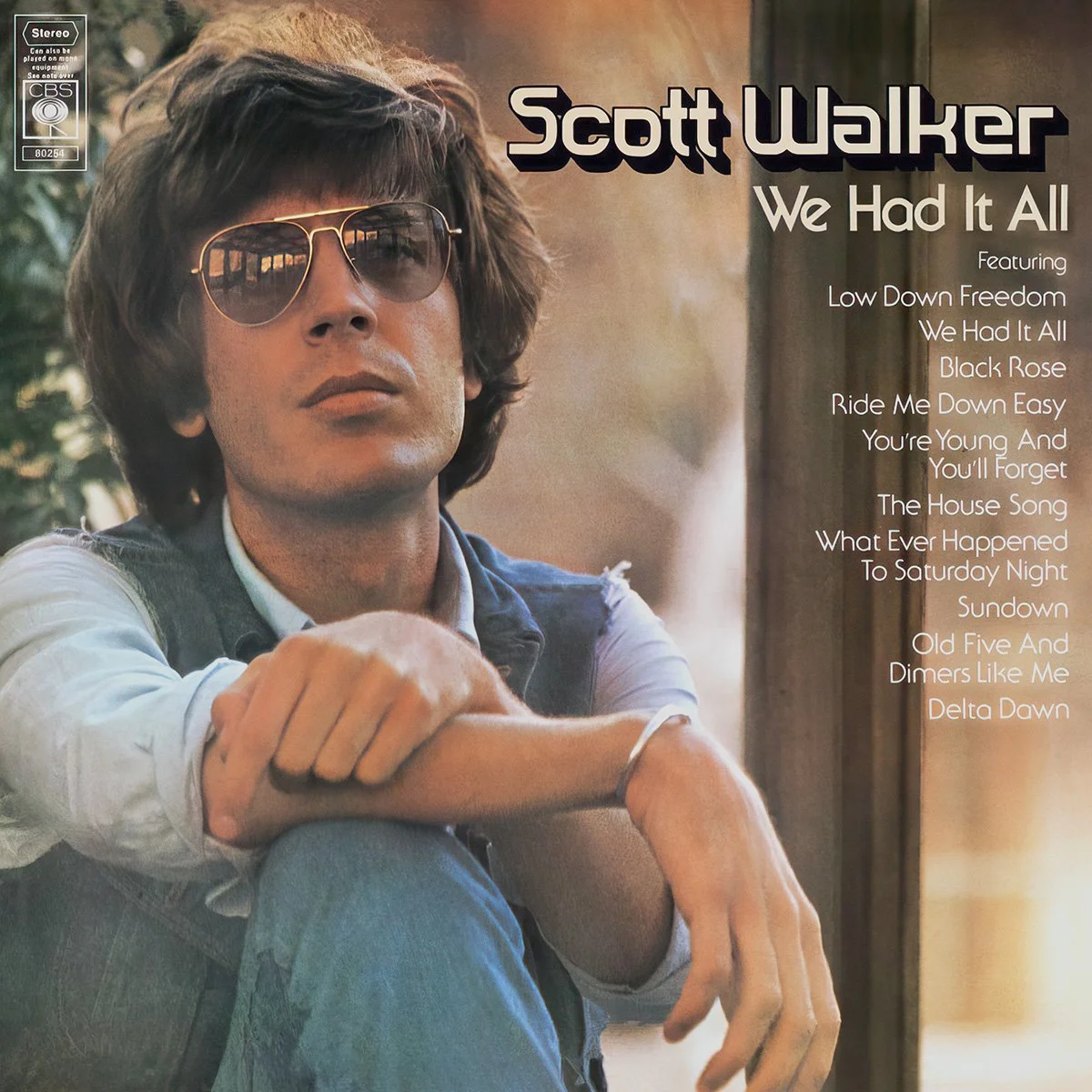
We Had It All
Scott Walker
Released: August, 1974. Label: Columbia
We Had It All is the tenth studio album by Scott Walker. Inspired by country music, it features five tracks recorded by Waylon Jennings for his 1973 album Honky Tonk Heroes. Four were by singer-songwriter Billy Joe Shaver (Low Down Freedom, Ride Me Down Easy, Black Rose and Old Five And Dimers Like Me), while the title track was written by Troy Seals and Donnie Fritts.
Alongside versions of The Eagles’ Saturday Night (Whatever Happened to Saturday Night?) and Gordon Lightfoot’s Sundown, Walker also covers other country songs, including Jerry Reed’s You’re Young And You’ll Forget including Larry Collins and Alex Harvey’s Delta Dawn, a 1973 no. 1 hit for Tanya Tucker which Walker would also release as a single. A 1974 Walker interview with the Melody Maker is quoted in the liner notes to the 1997 double-album reissue of Stretch and We Had It All: “[We Had It All] is a return to my roots, because I was raised in Texas and I know a lot about country music. It has the conviction that I lost.”
We Had It All was recorded at London’s Nova Studios. The sleeve was designed by Rosław Szaybo, with photography by Michael Joseph. It did not chart, and was Walker’s last solo release for a decade.
Track Listing
Low Down Freedom 3:43
We Had It All 3:29
Black Rose 3:16
Ride Me Down Easy 3:32
You're Young and You'll Forget 2:27
The House Song 3:44
What Ever Happened to Saturday Night 2:53
Sundown 4:49
Old Five and Dimers Like Me 2:58
Delta Dawn 3:47
-
Recorded At – Nova Sound Studios, London
Artwork – R. Szaybo
Photography By – M. Joseph
Producer, Arranged By – Del Newman
Written By - Billy Joe Shaver (tracks: 1, 3, 4, 9)
Written By - Donnie Fritts, Troy Seals (track: 2)
Written By - Jerry Reed (track: 5)
Written By - Robert H. Bannard, Paul Stookey (track: 6)
Written By - Randy Meisner, Don Henley, Glenn Frey, Bernie Leadon (track: 7)
Written By - Gordon Lightfoot (track: 8)
Written By - Alex Harvey (track: 10)
Interview
The Guardian, November 2012
by Simon Hattenstone
He made his name as a crooner with the Walker Brothers, then disappeared. Back with a new avant-garde album, Scott Walker says the darkness has always been there
Did he find fame hard to deal with?
“I did. But it’s OK now. You had to be there to understand what it was. There was a lot of pressure. I was coming up with all the material for the boys, and I was having to find songs and getting the sessions together. Everyone relied on me, and it just got on top of me. I think I just got irritated with it all.”
He drank himself into oblivion, withdrew from the world and thought about killing himself.
“Well, I was an intense young guy,” he says.
Which is a classic Walker understatement. To be fair, I say, you’re hardly unintense now. I can’t see his eyes, but I can see a lovely boyish smile. He smiles and laughs a lot. It’s one of the great surprises about meeting Walker.
“Well, no. But this was hyperintense.” Is he surprised he’s still making music today? “Of course. Surprised to find myself alive. Hehehe!”
It’s amazing how sane Walker sounds. Most people expect you to be mad, I say.
He nods. “I think I did temporarily go crazy, because I don’t remember the period at all very well. I can hardly remember it.”
How long did it last? “Probably from 1969 to 75.”
The funny thing is, I say, during that period, you began making your most commercial records – show tunes, movie themes, songs from a short-lived TV series.
Absolutely, he says. It all came about after Scott 4 failed to chart.
“The record company called me in and carpeted me and said you’ve got to make a commercial record for us.” So he did. And another, and another. “I was acting in bad faith for many years during that time.” Why? “Well, I was trying to hang on. I should have stopped. I should have said, ‘OK, forget it’ and walked away. But I thought if I keep hanging on and making these bloody awful records…”
A lot of people like them, I say.
“I know they do.” He looks embarrassed – whether it’s at the albums themselves or his intolerance of them, I’m not sure. I tell him that nowadays many of his fans have revisited them and found darkness in them. He laughs loud and joyously.
“Well, there’s darkness in everything I do. But I did act in bad faith. I thought, this is going to turn round if I just hang in long enough, and it didn’t.”
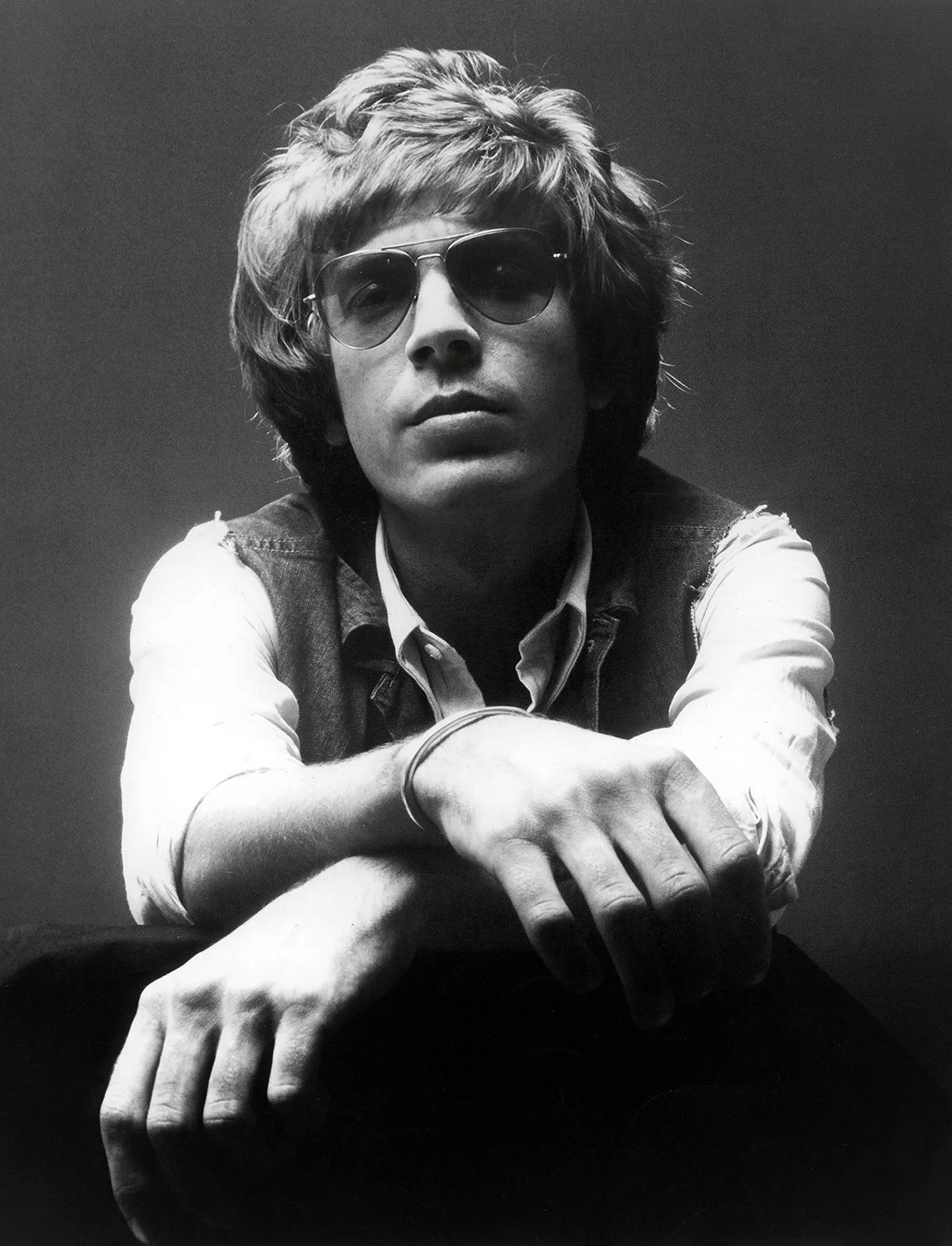
Photo by M. Joseph