Climate of Hunter
Scott Walker
Released: March 1984. Label: Virgin
Climate Of Hunter is the eleventh studio album by Scott Walker. The album comprises eight Walker originals, with lyrics exploring subjects including early man, exile, death and the body. “This is how you disappear,” begins its opening track, Rawhide. “Try and hear your own way out,” he sings in Track Seven. “I’m carrying on, really, from what I was doing in my solo thing,” Walker said to Muriel Gray on Channel 4 music programme, The Tube, in March, “and hopefully picking up some pieces”.
The album was written in August and September 1983, with Walker working in isolation in a workman’s cottage near Tunbridge Wells. “I told Virgin I’d have it ready in two months – I had to run a bluff on myself,” he told the NME’s Richard Cook in March. “I knew I had it. And I made it.” Climate Of Hunter was then recorded from October to December in three London Studios – Virgin’s Town House (in Shepherd’s Bush), Sarm West (in Notting Hill) and EMI’s Abbey Road Studios. Alongside Mo Foster on bass, its personnel includes Dire Straits’ Mark Knopfler on guitar, trumpeter Mark Isham, percussionist Gary Kettel, drummer Peter Van Hooke and saxophonist Evan Parker. Billy Ocean provides backing vocals on Track Three, the album’s only single.
Walker gave half of the eight tracks numerical titles, telling Muriel Gray on The Tube that he thought traditional titles might “lopside them or overload them”. Brian Gascoigne provided arrangements, based on rough drawings Walker had made of chord clusters. No demos were made, so that the musicians would play spontaneously in the studio.
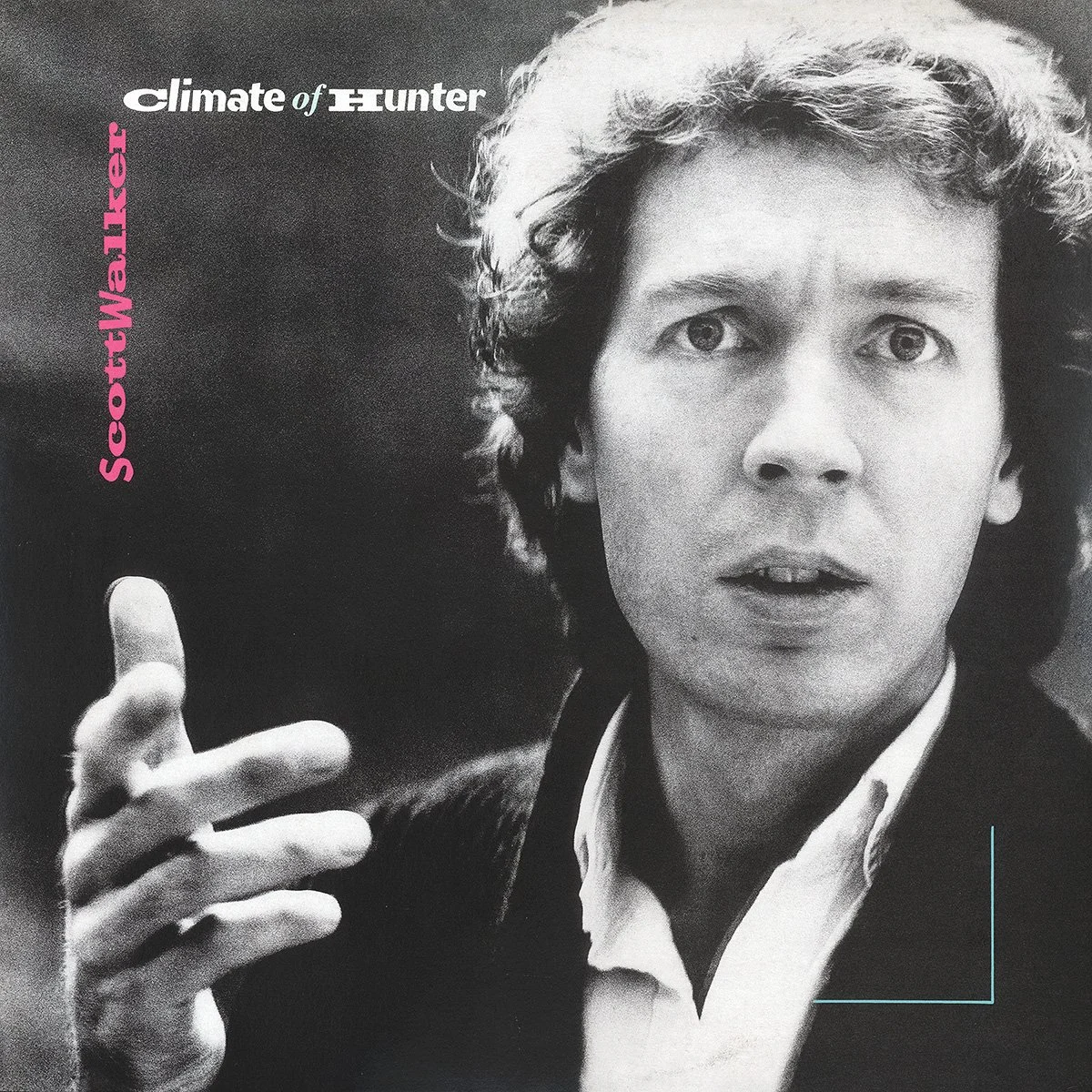
The album was produced by Peter Walsh, who had recently worked on Simple Minds’ New Gold Dream and Heaven 17’s Penthouse and Pavement. Walsh went on to produce Walker’s every subsequent album. The cover image was by Bob Carlos Clarke, better known for his erotic photography.
Climate Of Hunter reached no. 60 on the UK Albums Chart. It was Walker’s only album of the 1980s.
Track Listing
Rawhide 3:55
Dealer 5:12
Track Three 3:50
Sleepwalkers Woman 4:11
Track Five 3:35
Track Six 3:12
Track Seven 3:46
Blanket Roll Blues 3:16
Credits
Produced by Peter Walsh & Scott Walker
Recorded and mixed by Peter Walsh
-
Produced by Peter Walsh & Scott Walker
Recorded and mixed by Peter Walsh
Recorded at The Townhouse, EMI & Sarm West Studios Oct-Dec 83
Assisted by Gavin MacKillop, John Kurlander & Ross Mallion
Composed by Scott Walker, Aug-Sept 83
*Except "Blanket Roll Blues" words by Tennessee Williams music by Kenyon Hopkins
Orchestral Arrangements by Brian Gascoigne
L.P. Co-ordination, assistance and management by Damage
Cover photo by Bob Carlos Clarke
Sleeve Design by C-More-Tone (Chris Morton)
Featuring:
Mo Foster - bass (except tracks 4 & 8)
Brian Gascoigne - keyboards (on tracks 2, 3 & 5)
Peter Van Hooke - drums (except tracks 4 & 8)
Mark Isham - trumpet (on tracks 2 & 3)
Gary Kettle -percussion (on tracks 5 & 7)
Billy Ocean - harmony vocal (on track 3)
Phil Palmer - lead and background guitars (on track 3)
Evan Parker - tenor & soprano sax (on tracks 2 & 6)
Ray Russell - lead and background guitars (on tracks 3 & 7)
and Mark Knopfler* - guitars (on track 8)
*Appears by permission of Phonogram records (London) Ltd.
Peter Walsh “Did you have any sort of preconceptions of what the session might be like?”
Mark Isham “I didn't, you know, he was such an interesting guy in the sense that there's so much drama in his delivery of a lyric, that you wonder what that's going to be like in a person in the room. He was sort of the opposite of that in my recollection just very, very quiet and I remember it being a very fun, relaxed, creative session, there was no doubt in the room, it was like yeah let's dive in let's do something we've never done before you know.”
Mark Isham in conversation with Peter Walsh
Evan Parker on Climate of Hunter
The Guardian - 25 March 2019
Interviews by Ben Beaumont-Thomas and Laura Snapes
My experience of working with Scott Walker [on Climate of Hunter] was short but unforgettable. I was puzzled about why he wanted me. I was not known as a session player. I was puzzled. I asked his office to get Scott to call me. He made clear immediately that “this is not a funk session”, that he knew my work and had the idea of piling up layers of it. He mentioned Ligeti. At that point I was in. I feel that those tracks on Climate of Hunter were the start of what became an ever more radical direction in his music. His subsequent commitment to explore to the limits make him one of the great individuals of our times. His voice will remain.
Uncut - August 2025
by Rob Hughes
“In those later years, I think he was following a very clear line which was, to reference a great Eric Dolphy record title, ‘Outward Bound’” says free jazz saxophonist Evan Parker who played on Climate of Hunter “His spirit was pure at that point and his muse was powerful”
Mark Knopfler on Scott Walker
The Joe Jackson Interview Podcast
This audio clip from The Joe Jackson Interview Podcast features Mark Knopfler discussing his involvement in the recording of Climate of Hunter. In conversation with interviewer Joe Jackson, Knopfler recalls being asked to play guitar on Walker’s version of the song Blanket Roll Blues and reflects on Walker’s approach to music and studio work.
Interview
NME - 17 March 1984
by Richard Cook
SCOTT WALKER The original godlike genius
Richard Cook goes Walker Bout with a fallen '60s pop angel who launched a solo career that was to inspire the music of Marc Almond and Julian Cope. Now, with the release of his first LP in four years 'Climate Of Hunter', Scott Walker himself is about to enter the '80s..
“I LIKE to watch people throw darts.”
But where have you been all this time?
“In a trance. I’ve been here drinking!”
Scott Walker sits at a table in a hotel bar and sips gingerly at a very modest scotch and soda. He thinks back to the period between 1978- when we last heard from him and now.
“Well, time flies when you’re not working. I haven’t been doing anything that anyone else wouldn’t be doing. Movies, reading, music, everything…some travelling, but nothing exotic like I used to.”
Amused, a little nonplussed at the attention. He’s turned 40 but looks ten years younger: the same sweep of gold hair secrets no greyness and only a pair of steel frames alters his unchanged teen idol features. Scott Engel Walker can’t really understand what the fuss is all about.
It’s about an American singer who won a brief, explosive acclaim as the lead voice of a group of sentimental crooners nearly 20 years ago; who went on to track out the decade with four astonishing, unsurpassed solo records that match a consummate musical and songwriting mind with a voice of vast strength and power to affect the emotions; and who got lost in a wilderness of neglect, wasted opportunity and-it seemed-final withdrawal.
When The Walker Brothers lazily reformed in the late ‘70s, Scott Engel gave one further indication that his powers were undiminished: four songs on the ‘Nite Flights’ LP that demonstrated a chilling grasp of a modern dynamic, graphically intense slabs of darkness and tumult. Then he was gone again.
Now, at last, he surfaces once more.
First there was a single, “Track Three’, and now an LP called ‘Climate Of Hunter’ falls into a pop world that has nurtured his name through its maverick tributes: Julian Cope’s ‘Fire Escape In The Sky’ compilation, Marc Almond’s loving touch-up of ‘Big Louise’, secondary echoes of his sumptuous melancholy drifting through most of the romantic pop of recent times.
Seven or eight years ago I paid 90 pence for a second-hand copy of his 1967 solo debut ‘Scott’. Walker’s grip on a lover’s passion as translated with his tempestuous charge through Jacques Brel’s ‘Mathilde’ and ‘My Death’ and his own ‘Such A Small Love’ and ‘Always Coming Back To You’—left me numb. I scoured the city until I had everything else he’d ever breathed on. Since then this voice and music have been a constant resource: they inspire fanticism.
None of those records have been in catalogue for years, and if Cope’s choice made a fine collection it’s only a shadow of the achievement that Walker pulled off. He fashioned an impression of a young man’s journey out of the awkwardness of adolescence into the loneliness of maturity through music that incredibly fitted the severest of pain and disrepair inside a skin of rare grandeur. If Scott agonised and flaired, he kept his head, If he was indulgent and occasionally mawkish, his experiments with form- the huge music of the great ballad singers brought to bear on ‘pop’ concerns remain unique, unanswered. This was a most splendid isolation.
As the few who stood by him always insisted, there is no music like this. Its mystery makes idiots call it pretentious; its delivery doomed it to esoterica, an arcane quirk in the annals of lost pop singers. To me it doesn’t have to compete: it’s work that stands as alone as the private and abrasive figure that Engel seemed to portray. It has mirrored and cast light on a young person’s experience with the world s more than any other vocal music I know,
I was afraid to to meet its maker, even though I’ve waited a long time for this interview. But he dispels anxiety. His soft Californian accent is untouched by his many years living quietly in London. Slowly we picked up the pieces of a carcer that looked in ruins: mere MOR fluff for Philips and CBS followed ‘Scott 4’ in 1969, until the Walkers reformed in 1977.
“It started off as a situation that that we tought might be amusing,” he recalls. “But everybody just got sick of each other again. When we’re not working together it’s fine. I keep in touch with the guys every week. Then when GTO fell apart Virgin approached me and I signed with them.”
But still nothing happened..
“I was trying to get some studio work on the quiet but, uh… I didn’t know who to go to. Then I found this management through Al Clark. I was pretty broke. They said, well, why don’t you finish your contract? I had a bad history-I’d lost three flats just as I was gaining any kind of impetus-but they said, at least start talking to Virgin again. I didn’t know if that was the problem-they didn’t realise I had to have money to complete it. “Then last year I got a fairly hefty publisher’s cheque and I had these bits and pieces and I thought, I had to finish it. I couldn’t seem to get anywhere in my life until I’d done this—completely leave or murder myself or anything.”
The story is eked out slowly in a lot of broken sentences. Scott hasn’t been interviewed in a long time.
“So… I rented a cottage in the country. I looked in the paper and saw this workman’s cottage near Turnbridge Wells, so I rented it for two months, on my own. I put all of ‘Climate Of Hunter’ together down there. I told Virgin I’d have it ready in two months — I had to run a bluff on myself. I knew I had it.” He clenches his fist. “And I made it.” Wasn’t there a list of songs from the lean times, waiting to be made?
“No, no, I never write without a definite. project. I get very disheartened if nothing’s going to happen. And I’m not one of those people who sings at home, so I had to work on that too.
It sounds like Gissing: the artist in a garret, forcing the inspiration.
“I’ve been doing that anyway! It seemed like everything was crumbling around me each time I tried to get started. But I knew I had to find it this time even if I never made another record. C’mon you old bastard, keep moving!
“A meeting was arranged for me with Eno who wanted to do a record, a coupla years ago, an LP of some kind. But I thought rather than destroying his career too I had to do one on my own (laughs). It’s like everybody was working in the dark on it, until the late stages.”
Was he rusty, making a record again? “That’s what I was worried about. I asked Virgin to send me some producers’ tapes because I thought I’d be behind with all the studio technology, and you have to make that stuff work for you. That’s how I got Pete Walsh. I thought his stuff sounded more total. I work very much on no crowds a one-to-one with everything in the studio.
And the voice?
“That was the great thing. This is the best age to sing at until you reach 50, when it starts to go down. Right now you’re at your peak. I was very worried about it but once I started it was easier than I’ve ever found before. And I can’t tell you why. The physical act of singing is very hard, but I was doing something that was complete to myself again.”
THAT VOICE is peerless, something more than the Scott we remember-darker, even more finely controlled. Whatever was expected of ‘Climate Of Hunter’, the results are different.
It maintains his position outside, for there is practically no precedent for this new music, Perhaps the urgent propulsion of the ‘Nite Flights’ songs recurs again in “Track Three’, or whatever. But rock is atomised and reshaped in this record: the songs swirl out of widescreen orchestrations or paradoxically sparse tre rhythms and take substance through a jangle of harsh, freezing images. They take in vistas and delineate detail like a slow-motion blink.
“As the heat in your hands/Carve the muscle away/And he grins from a break in the backflash”. When Walker’s voice looms out of the dense thundercloud of sound at that moment on ‘Rawhide’ all the indecisions and false starts of his battered career are obliterated in an instant: Walker has come back stronger than ever before. These songs-lyricised in the most abstruse poetry, put to music that turns rock upside down-have him at the height of his powers.
It stems from a tiny group of players, including older associates Mo Foster and Peter Van Hooke-and, of all people, the improvising saxophone genius Even Parker.
“I love his playing. I knew he’d be perfect for it, but Evan was very worried. I said, what I want you to do, you can do better than anyone else. And then he got into it. He’s a marvellous guy. Getting him out of the house is a problem.” Um. It sounds like…
“Yeah, we related perfectly,” Scott smiles.
Four songs are named simply for their position on the record ‘Track Three’ and so on. Does he follow Anthony Braxton’s dislike of titles, things which introduce emotional or sentimental connotations which might be misleading?
“That’s very well explained, but he’s an instrumentalist. For me it was just that the lyric was complete and adding something later on was totally unnecessary. I didn’t know if it had been done before.”
ALTHOUGH HE is reticent about it, Walker’s reappearance was first signalled in the attention that suddenly came his way in 1981. What was his reaction to the refreshed cult status triggered by Cope’s ‘Godlike Genius’?
“Well, I wasn’t aware of it until then. And I didn’t know what to think. You know, when it’s just one guy doing it…I can’t think about that too much. Yeah, I guess I was embarrassed by it, since I didn’t know anyone who’s connected with it. I wasn’t bombarded with it.” Didn’t he see it as an opportunity to (ahem) come back?
“No, because I wasn’t ready,” he responds immediately. “Unless I’m ready to go at any time for anything it would take a bear to drag me out. Even this isn’t a ‘comeback’. It’s just a record I had to get done.’
What of Marc Almond’s interpretations of neglected Engel songs like Big Louise’ and The Plague’?
“I haven’t heard them,” he admits. “People say I must. I don’t know what they’d be like.”
He laughs in some amazement when I tell him that Almond began his Christmas shows with ‘The Plague’.
“I don’t listen to the old songs. I don’t have the records. People don’t believe that, but I say you can come and listen to my apartment, like Gene Hackman. I think a lot of it was absolutely awful. That’s not false modesty, it’s absolutely true. Some of it was very good. But the time I wasted after those first records was shameful.
“It’s the old story of the guy who made it seeing flaws. I was sent Cope’s compilation and I put it on and listened to this young guy singing… thought, hey that’s not bad. But one play was enough. What’s the greatest difference in making records now, instead of then? “You don’t have to do it live. We did, everything live-everyone was in the studio at once and I’d be running back and forth as co-producer. Now you can take your time. But the prime way of making records hasn’t changed, you just have to modify things. I wanted a hi-fi sound. Like Rudy Van Gelder (Blue Note’s master producer)-a sound where everything is as pure as possible. The voice was recorded. absolutely purely, just a couple of places where it was compressed for the lyric. “Artificial techniques can be good. You can make great pop records that way, like with Michael Jackson. The output of the record industry today has created more diverse situations. When I started… well, now is a perfect time to make records. The ‘70s were a real dry gulch but now everyone can make the record they want. If they want to make it.”
The best time? I thought this was a time when there was no dissonance, all smoothness, a bland obedience to some idea of ‘modern pop’?’
“But then that’s the kind of record they’re going to make anyway,” demurs Walker. “If there’s pressure on them then I know what that’s like ‘cause I had pressure on me too in the ‘70s. They’ve gotta get that pressure off and this is the time to do it.
“You’ve not had people like Costello or Almond making records before-that’s what makes this time different. There certainly weren’t in the ‘70s, even the ‘60s. There were good records and maybe there were moments like The Sex Pistols. But now, if they can pull it off, they can do it. Before there was an inability to pull it off. That was my problem. Elvis Costello doesn’t seem to have it.”
How far can you go in giving a song weight?
“It’s all down to taste, isn’t it? You can hit a sequence of things in a song that will somehow match up and work. That’s part of the magic. But it’s a hard question.”
In Walker’s songs the sequences sound inconceivable at first: but hear ‘Dealer’, and see how a cinematic jumble of images eventually focuses. A phial of metaphysic! “The idea is to make it resonate. If you de can find a polemic in there, good for you (chuckles). But it’s to get this resonating factor going. I don’t cut up, I’m not that kind of writer. I can just tell you that, uh, it’s not easy. I have to work at it and, please, someone else work at it when they’re listening.”.
Tough work. Reference points to other music are hidden or overturned. The great spread of sound suggests a bathos that the melodic strength of the songs never admits.
“The idea is that if you’re a strong enough singer-and I know that that’s not stylish today, but that’s why I worked so hard on the lyrics and getting it right, getting the melodies to match-then I know that if I’m there I can sing the songs no matter what. And we found that the songs virtually mixed themselves.” Is this work designed entirely for a studio context?
“I wouldn’t know how to do it outside.
Performing is one of those things I don’t like to do, like flying. Nowadays it seems you can put anybody on a stage and make them sound great. I’d do it if anything happened with my record. But I think they’ve got a long wait. It’s just not worth it as something to do-if it’s not happening in the studio then it’s not happening. I’m not advocating just making studio records because surely I can go out and sing tomorrow-but everything has to be right.”
Does the finest music develop from a great literacy in the form?
“I think you should know as much as you can but it doesn’t necessarily help to make anything better than something else. The problem I have is this basis as a pop musician which is something you can never drop. You can use other disciplines, if you know how, but it’s all according to the thing you do originally-everything will work around that. I could have done this whole album with just a bass tracked a few times, varispeeding it, and used some percussion.”
Why not do that?
“Well,” he smiles, “I thought if this was the first record I’d done in a long while I thought it’d better be something I could live with a little longer.”
YOU MAY detect some reserve here. Walker politely turns away from discussing the flesh of his work. When asked about his old fixation with Brel he dismisses its relevance. He respectfully concurs that his own songs might have a similar role for others. But he won’t talk about them.
“I’m a little loath to discuss material. It’s so damn hard, you know, and it brings it all back to me and I feel unlucky when I have to discuss it. What was on my mind was getting it to flow together. I was trying to remember how I’d done this before and how I was going to compound it all. You really have to do it on your own.”
The scrutiny is still the price of a pop star. He might even have a hit again. Is he prepared to embrace all aspects of a pop culture once more?
“I did a video the other day so I’ve embraced that much. Very Tarkovskian. I think if I did another record I’d have to do the video myself. It’s another apparatus that’s grown out of this business and I have to have control of it if I’m to have it all right.
“It’s easier to be selective. I’m not doing a lot of interviews, as you know. That’s another thing that’s easier about today- you have a choice. Generally speaking people who buy this record won’t be interested in who you’re shacked up with or whatever… well, they may be. I don’t know. But I’m not doing too much, Richard. I want to see what’s going on.”
Does he ever wish he’d started like Townshend or Davies, a beat group leader instead of a crooner?
“Well, it would’ve been easier. Yeah. Credibility all down the line, on a lot of levels. Now I think I’m better off.” Though it doesn’t sound as if you made as much money as them.
“No. The money escaped me. It’s not bothered me a whole lot, just sometimes. I deserved it, anyway. The CBS thing went wrong and I kept on going with it when I should’ve just walked out.”
He looks back again, unprompted, at a career that might have been a mere cabaret turn.
“People wanted to sign you as a singer. The slothfulness and… you see, I can’t tell you what a fight it was to make those first records. Even though they were charting. It was like those people at Philips were just waiting to say, no more of this shit! I went to CBS and the bad fate started - they said first I could do my own songs, but they changed their minds and it was tawdry and I gave up there… I thought I’d get some kicks with the guys at GTO, sure, why not? And then the kicks didn’t work out..
“So I went to Virgin and got a hassle because I didn’t bring an album in in two months! That slowed me up. I just had to pull myself together.”
What kind of recognition does he want now?
“It’s a cliché, but in the end you have to work for yourself. It’s come to me like that. It’s everything I’ve been telling you.
This is the only way I can do it now, the only way I can make records. What kind of recognition I’ll get, I have no idea.
“I’m just gonna check this out. I have a totally different record I want to do now because I discovered all the new things I can use in the studio now. But I have to wait. This is a waiting game.”
Is there a particularly valuable thing his work can do for other people?
“Not more than a good record by anyone else can. Sometimes you think, maybe nobody’s seen it this way before, and then… Maybe a good Lionel Richie or Michael Jackson record is as important. If they work-a record by John Coltrane or Michael Jackson can become the same thing. The finality of everything, if it’s resonating in the same way, it’s the same thing.
“But I want it to be placed in the right setting,” he adds, his voice as languidly rich as his singing. “The best analogue is film: Syberberg works to evoke a seriousness, only realeasing a film to certain cinemas and so on. As far as joy goes, though, there’s no reason why you can’t go see Dead Men Don’t Wear Plaid and let it put you on the deck.”
I know what he means. I like movies that make me laugh, but I return mostly to a deeper seam, a Godard or a Bergman. I like ‘The Art Of Falling Apart’, say, but it’s ‘Scott 4 ‘- and now ‘Climate Of Hunter’ - which renews one.
NINETY MINUTES with Scott Walker allowed no penetration of the certain mystery that succours his work, and it’s something I’m glad of. This deeply private man might not be a Godlike genius, but he is as equidistant from being a pop artisan grafting for hits. It might always deny him the status he once had; it might sustain a unique insight. Either way, he embodies a particular aloneness.
“There’s a lot of things I’d like to do still.”
Scott listens for a moment to the chatter of drinkers and darts players.
“Or I could be good at just doing nothing.”
Interview
Blitz - April 1984
by Johnny Black
A SHADOWY booth in the mock mock-tudor Tudor Bar at the Kensington Hilton. SCOTT WALKER is studying his whisky as if its iced amber depths hold the secret of life.
“My problem,” he ruminates in a speaking voice exactly equivalent to his singing voice, resonant, intense and anguished, “was erasing my sin.”
I had just asked why, considering that he signed to Virgin Records in 1978, it has taken him six years to produce one album. “See, I don’t have any of my own records, don’t even remember them too well. I wish they could be destroyed, but you have to make up for your sins later on.”
In the late ‘sixties, Walker Brothers concerts were attended by throngs of weeping, squealing, wailing girls. The Califomian trio, who had come here to escape the Vietnam draft, were staggeringly handsome, possessed of awesome vocal equipment and every record was guaranteed a top ten place.
“There’s large chunks of that I don’t remember,” says Scott. “We were the drunkest group ever, which was a reaction to watching people around us behave in the most incredible ways.” When drinking and fighting split the group up, Scott landed a BBC television series, “for six weeks but it sorta fell apart” and although his albums sold well, they were dealing with existentialist philosophies and cerebral processes which had more to do with art and suffering than with chart success.
The public impression was of a man retreating inside himself and, in the business, Scott gained a reputation for being difficult to work with. The group re-formed and charted again in 1976, but the collapse of their record label, GTO, led to disintegration of the group. “We tried, but it didn’t work again. There was something tawdry about it.” Still smarting from the experience, Scott signed to Virgin and, finally, there’s a new album, Climate Of Hunter.
A complex and solitary man, Walker now lives in a small flat in Hammersmith, where he spends most of his time reading or listening to music, everything from Scriabin to modern jazz. He is disinclined to be sociable in large groups, preferring to venture forth in his yellow Volkswagen for quiet drinks or meals on a one to one basis.
At times, an innocent question will be met with an awkward conversational gap and a stare which suggest you’ve just tried to surgically remove his heart.
He refuses point blank to discuss his material, and even a fairly obvious question like, “Why are there tracks on your album called 3,5,6 and 7?” elicits an ambiguous response: “When something is finished, it is finished,” he shrugs. Approaching the subject obliquely by telling him I listened to the album five times that morning results only in a raised eyebrow and “Glutton for punishment, huh?”
At least he accepts that the material is not easy to assimilate. “Some friends say I have a character deficiency inasmuch as I am afraid of success. They could be right. There’s certainly nothing on this album that sounds like a hit single,” he chuckles into his glass. “I have experienced every aspect of success, the fame, the jealousy, the intrusions. Everything except maybe the money, but that never worries me. Like, regrets are a waste of time.”
He survived the lean period between 1978 and 1984 on advances and royalty cheques but admits to living “literally hand to mouth at certain times. I was looking for jobs, but nobody would hire me to do anything but sing.” His awkward reputation made him unacceptable as a producer, and nothing else was being offered. Amazed to find that Virgin still wanted an album although the contract had technically expired, Walker used a royalty cheque to hire a country cottage and “spent two months alone last summer and just did it.”
Then into the studios with an elite bunch of sessions men, (Scott also in the producer’s chair) and whizz-bang, out pops an album, immaculately recorded, spontaneously performed, deceptively simple and pretty well impenetrable to us lesser mortals. And Walker’s voice, always thrust to the front of the mix with perfect clarity, sounds better than ever.
“Once I’m in the studio, I work very fast. I was frightening myself a bit because I hadn’t sung in a long time. I’m not one of those people who sings for pleasure in the shower, but this went better for me than any time I’ve ever recorded. I think maybe I’ve got a couple more albums in me still.”
One intriguing possibility is an album produced by Brian Eno (a long time fan of Walker’s, along with Bowie, Midge Ure, Marc Almond, Julian Cope and others). “Sure, we’ve talked, in this very hotel, about producing an album, but I wanted to do this one myself. If it goes well I might bring him in and kill his career too.”
Interview
Time Out - 4 April 1984
by Peter Silverton
Walk About
A ‘60s heart-throb as one of the Walker Brothers and a latterday hero for the likes of Julian Cope, Scott Walker has resurfaced again with a new LP. Peter Silverton meets one of pop’s first ‘moody geniuses’.
Heads no longer turn when Scott Walker steps up to the bar. Now 41, he’s traded mystique for anonymity. His small, close- set, startled eyes which once took shelter behind the studied cool of dark sunglasses are now shaded by the deliberate ordinariness of a New York Yankees baseball cap. More than anything, he looks like Tom Robinson’s elder brother. Which is scarcely what you expect of a former teen dream, a one-time Walker Brother, a major icon of the Great Pop Wars of the 1960s. Or a man whose solo work was described by an over- excited journalist as ‘nilhilistic, grandiose, debauched, schizophrenic, souls-in-torment, night-riding, heart-rending’. Or a singer who inspired former Teardrop Explodes singer Julian Cope to compile an album called ‘The Godlike Genius Of Scott Walker’.
‘The worst thing about that was that people kept on coming up and saying, “Hey, you’ve got a lot of nerve putting that out. They thought I did it.’ He grunts lightly and pauses a few seconds standard punctuation. ‘Kind of hard to live with.’ The voice hasn’t changed though: slow, soft, light, almost bored, still recognisably American despite the fact that over the last 20 years he’s spent less than three months in the country of his birth. The Vietnam war and being pursued by the Draft Board ‘jaded me so badly I couldn’t go back to the place with a positive feeling for years. And when I go in there I still get…’ He taps his chest, miming heart palpitations.
‘Climate Of Hunter’ is his first record since 1978’s ‘Nite Flights’, the last fruit of a mostly barren Walker Brothers reunion. ‘It seemed like a good idea at the time but it was bad.’
He signed to Virgin as a solo act immediately after the collapse of the Walkers’ record label but arguments kept him out of the studio till last autumn. ‘They hung in there even when I went away and pouted for a year and a half.’ Virgin helped him find new management which he shares with Dire Straits but he’s only ever been to their offices once. ‘Is that unsual?’ Yes.
‘Oh… okay.’ All meetings including interviews with him take place in the bar of an expensive but singularly tasteless West London hotel. It’s not an aesthetic choice. Virgin once suggested it for a meeting between Scott and Eno and he’s stuck with it ever since.
Scott was one of pop’s first ‘moody geniuses’. Adam Faith had had his Classics Illustrated comics bound in leather; Scott read Dostoevsky and Sartre. ‘When he sang,’ wrote Nik Cohn, the sharpest observer of ‘60s pop, ‘his hands went up in front of his grieving face and, delicately, his body curled up like a lettuce leaf…he surrounded himself with heavies, spoke to hardly anyone, and he lived in a room with all the curtains drawn, huddled tight into himself, playing romantic music very loudly, Wagner or Jacques Brel or Tony Bennett.’
The Walker Brothers were a Californian trio who crossed the Atlantic for all the usual pop reasons (fame, money, the Ad Lib, Cuban heel boots) and to evade the draft but also because Scott ‘had this connection via this girl who was going to introduce me to Bergman’. Ingmar, that is, not Ingrid. Not that he’s ever met either. Six hits - neurotic ballads, rich as chocolate cake - in two years gave the Walkers the mass appeal to young girls of a Duran Duran.
Behind the image things were somewhat different. ‘I can’t remember a thing hardly about the ‘60s. I was the biggest drinker when we came over but then the other two guys got worse and I slowed down, eventually went on the wagon totally. They were left with the problem for many years.’ Scott sipped his white wine.
When the Walkers broke up in 1967 Scott embarked on a solo career which was strong on the romance of the gutter. As well as his own compositions, he was the first to record Jacques Brel’s work in English. Bowie made Brel’s ‘My Death’ a focus of his act but only long after Scott had sung it live on the Billy Cotton Band Show. ‘Today I don’t know if the songs are substantial but then they certainly were. They were very much a young man’s thing and I was a very young man at the time.’ A little grunt and a total contradiction. I was probably too young to sing them.’
Although Scott’s early solo albums sold well, his career slowly shuffled into a siding. ‘I was a ‘60s casualty. My success was when no one got paid. But I didn’t take another shot to make it back like the Who did.’ These past few years ‘whenever I got dollar bottom… which happened quite often’ he’s lived by doing a couple of weeks at a Northern club. ‘Just singing standards. That would get me enough money for the year to go on doing virtually nothing.’
When a reasonably large publishing cheque arrived last year he used the windfall to rent a cottage in the country - well, just outside Tunbridge Wells — for a month where he wrote all seven of the originals on ‘Climate of Hunter’.
Like most songwriters of his generation, he talks about doing his best work when he’s writing for himself but he’s conscious enough of the changes in studio technology to have hired Simple Minds’ former producer Peter Walsh as engineer and co-producer. ‘I just wanted the best recording I could get and that’s really what he was there for but he gave me so much more.’
Like all who come in from the cold, he doesn’t want his return to be seen as a comeback. ‘They’re kind of tawdry. I just wanted to make one more record that kind of…’ The grunt. ‘… To see if I wanted to go ahead or stop at this point. I’ve been unlucky? Well, I’ve been lucky in the sense of muddling through: I’ve made this album. But you can do a lot of things that make you lucky, like panto. I haven’t done that. Or a lot of breakfast television.’ The grunt. ‘But you pay for that in other ways.’