
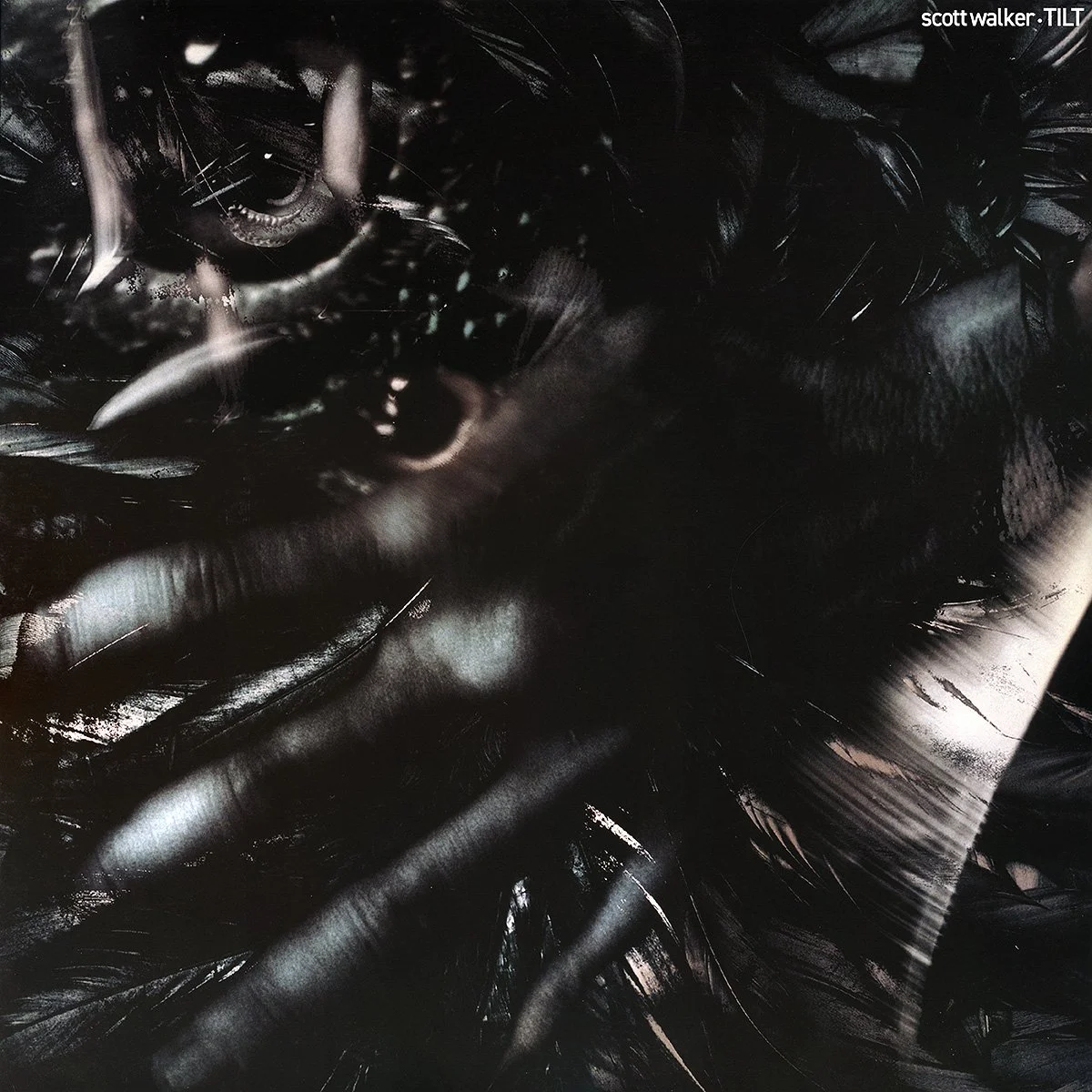
Tilt
Scott Walker
Released: May 8, 1995. Label: Fontana
Tilt is the twelfth studio album by Scott Walker. Opening with Farmer in the City (Remembering Pasolini), which quotes from Uno Dei Tanti Epilogh (One of the Many Epilogues) by Italian poet and filmmaker Pier Paolo Pasolini, it comprises nine original songs, with lyrics that reference religion, refugees, conflict and the Holocaust. The Cockfighter references the 1820 trial of King George IV’s estranged wife, Queen Caroline, to dissolve their marriage, and the trial of Nazi SS officer Adolf Eichmann, who managed the logistics involving the deportation of Jews to be murdered in concentration camps. Its title track was described by Walker to The Wire’s Richard Cook as “satirical… a kind of a black country music song”.
While preparing the album, Walker also listened to Beethoven piano sonatas, Bartok string quartets and blues records, before adding to Cook: “I can’t tell you where [the music] comes from. It comes from silence, most of it. I sit around, and I’m waiting. I’m waiting and waiting.” Recorded in London at RAK Studios in Regent’s Park and Virgin’s Townhouse Studios in Shepherd’s Bush, Tilt’s personnel includes bassist John Giblin, percussionist Alasdair Malloy, Elizabeth Kenny on lute and folk musician Andrew Cronshaw on concertina and flute. The Strings of Sinfonia of London feature throughout, as does the Methodist Central Hall Pipe Organ, played by Brian Gascoigne, who also handled the album’s arrangements.
“I never try to give [the band] too much indication of what I’m going to do,” Walker told Cook. “Because then it’ll turn into a group thing, which is what I don’t want either. I want each piece to have an intensity of its own.”
Tilt spent a week in the UK charts, reaching number 27 in its first week of release.
Track Listing
Farmer in the City (Remembering Pasolini) 6:38
The Cockfighter 6:01
Bouncer See Bouncer... 8:50
Manhattan 6:05
Face on Breast 5:15
Bolivia '95 7:44
Patriot (A single) 8:28
Tilt 5:13
Rosary 2:41
Credits
Words and Music by N. S. Engel
Produced by Scott Walker and Peter Walsh
Recorded by Peter Walsh except
TILT and FACE ON BREAST recorded by Richard Evans and Peter Walsh
-
Words and Music by N. S. Engel
Produced by Scott Walker and Peter Walsh
Recorded by Peter Walsh except
TILT and FACE ON BREAST recorded by Richard Evans and Peter WalshScott Walker Vocals
lan Thomas Drums
John Giblin Bass
Brian Gascoigne Keyboards
David Rhodes Guitars except ROSARY played by Scott Walker
Additional playing:
FARMER IN THE CITY
Strings of Sinfonia of London arranged and conducted by Brian Gascoigne
Elizabeth Kenny Chittaroni
Roy Carter OboeTHE COCKFIGHTER
Hugh Burns Guitar
Alasdair Malloy Percussion
Louis Jardim Percussion
Andrew Cronshaw Horns and Reeds
Brian Gascoigne Celeste and Organ of the Methodist Central HallBOUNCER SEE BOUNCER...
Jonathan Snowden Flutes
Andy Findon Bass Flute
Jim Gregory Bass Flute
Roy Jowitt Clarinet
Roy Carter Oboe
Brian Gascoigne Woodwind Orchestration and Organ of the Methodist Central Hall
Peter Walsh Prog Bass Drum
Locust sounds taken from Nigel Eaton's Hurdy GurdyMANHATTAN
Alasdair Malloy Percussion
Louis Jardim Percussion
Brian Gascoigne Organ of the Methodist Central Hall
Andrew Cronshaw ConcertinaFACE ON BREAST
lan Thomas Bass Drum on lap and kit all at once
Colin Pulbrook Hammond Organ
Scott Walker and Peter Walsh WhistlesBOLIVIA ‘95.
Hugh Burns Guitars
Alasdair Malloy Percussion
Louis Jardim Percussion
Andrew Cronshaw Ba-Wu Flute
Greg Knowles CimbalomPATRIOT (a Single)
Strings of Sinfonia of London orchestrated and conducted by Brian Gascoigne
Jonathan Snowden Piccolo
John Barclay Trumpets
lan Thomas Military Bass Drum and CymbalsAdditional engineering BOUNCER SEE BOUNCER... BOLIVIA ‘95. MANHATTAN and FARMER IN THE CITY Richard Evans
Mixed by Peter Walsh and Scott Walker
Recorded at RAK Recording Studios
Assistant engineer Henry Binns
and at Townhouse Studios
Assistant engineers Lorraine Francis and Pete Lewis
Organ recorded at Methodist Central Hall
Assistant engineer Craig Walmsley
Orchestra recorded at CTS Studios by Andrew Taylor
Mixed at Metropolis Studios
Assistant engineers James Loughrey and Kevin Jacobs
Monitors by P.M.C.
Mastered by lan Cooper Metropolis Mastering Limited
Cover photography and image manipulation David Scheinmann
Concept and hand Scott Walker
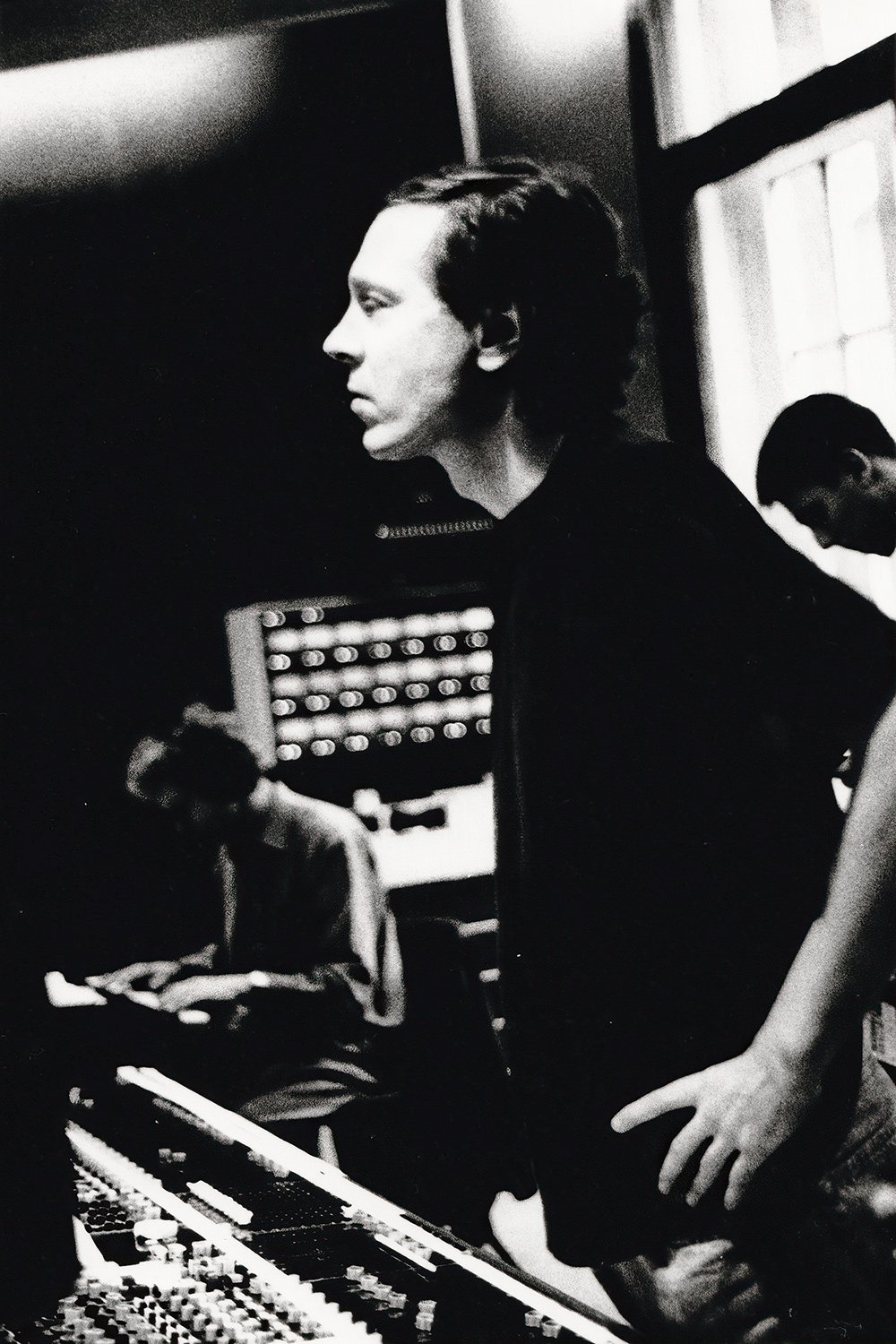
Studio photography Phil Knott
Art direction and design Stylorouge
All songs composed ‘91 ‘92 except MANHATTAN composed ‘87 and ROSARY composed ‘93
For THE COCKFIGHTER excerpts relocated from the trial of Queen Caroline and the trial of Adolf Eichmann
“He believes, and I take issue with this, that to convey a very strong emotion in the music, you have to be feeling it when you're making it. That couldn't be true because the people who are playing Bruckner and Mahler every night would be basket cases... after three of four hours in the studio, he is a basket case because he lives the thing with such emotion.”
Brian Gascoigne
Stephen Kijak interview for 30 Century Man
Photos by Paul Cox
“Scott had me and percussionist Luis Jardim and Alasdair Malloy making the worst possible fucking noise that we could create,” says drummer Ian Thomas “Metal on metal. I remember layering up cymbals and then hitting them as hard as I could – recorded in stereo – while Luis had all these chains. It was very like a Neanderthal scene. It was intense!”
Ian Thomas
Rob Hughes, Uncut - August 2025
Tilt Sleeve Design
Rob O’Connor - Art Director Stylorouge
June 2025
It came as a massive surprise when I got the call from PolyGram Records in 1995 asking if my company Stylorouge would like to work on a sleeve design for Scott’s forthcoming album of completely new material Tilt. It was one of those pinch-me situations – I actually couldn’t believe I’d have the chance to work for another one of my musical heroes.
Scott was already well into the production of the Tilt album when we met him, but he shied away from people being in the recording studio unless they had a specific job to do – Phil Knott had already been appointed to document the activity in the studio photographically – fly-on-the-wall style, so there was no ‘in' for me there… Instead we met at Cathy and Charles’ house where Scott described the music and the themes on the album, quietly but with intensity and deliberation – the typically arcane narratives and gothic atmosphere he wanted to portray, not only in the music itself but on the album cover. This was never going to be a portrait-of-the-artist record sleeve, but historically Scott was unused to much else, so it was a great opportunity for both of us to flex some creative narrative muscle in interpreting his new material.
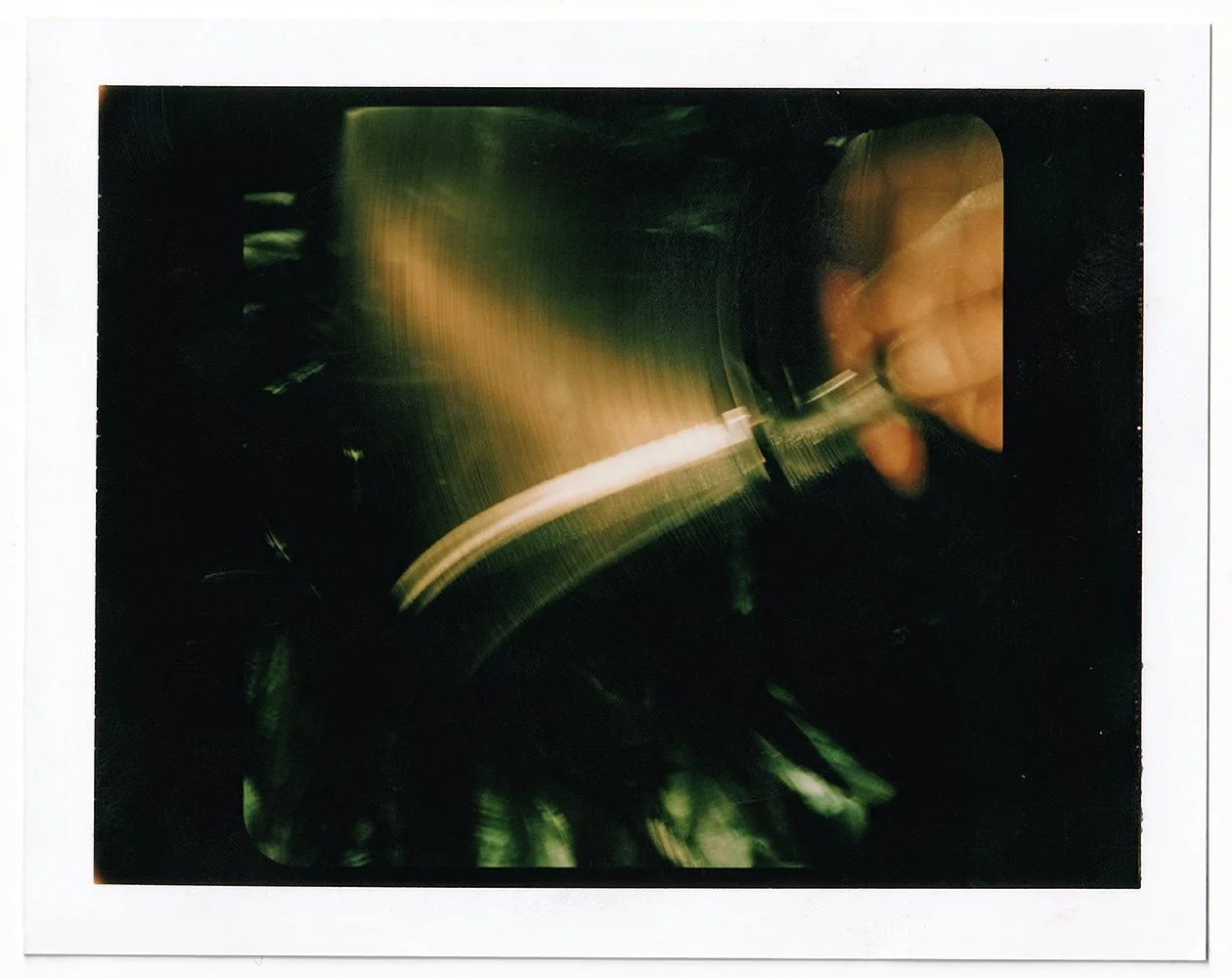
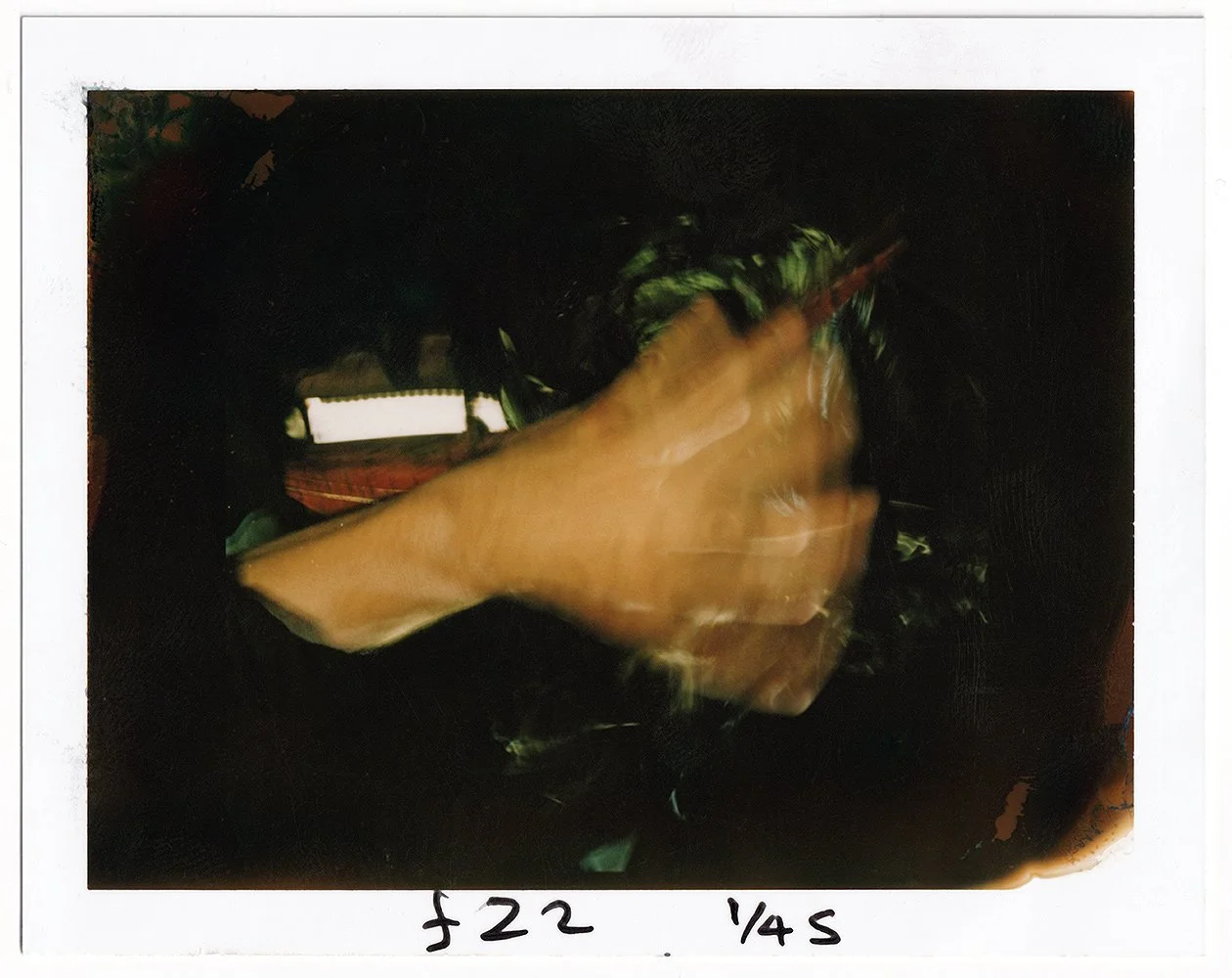
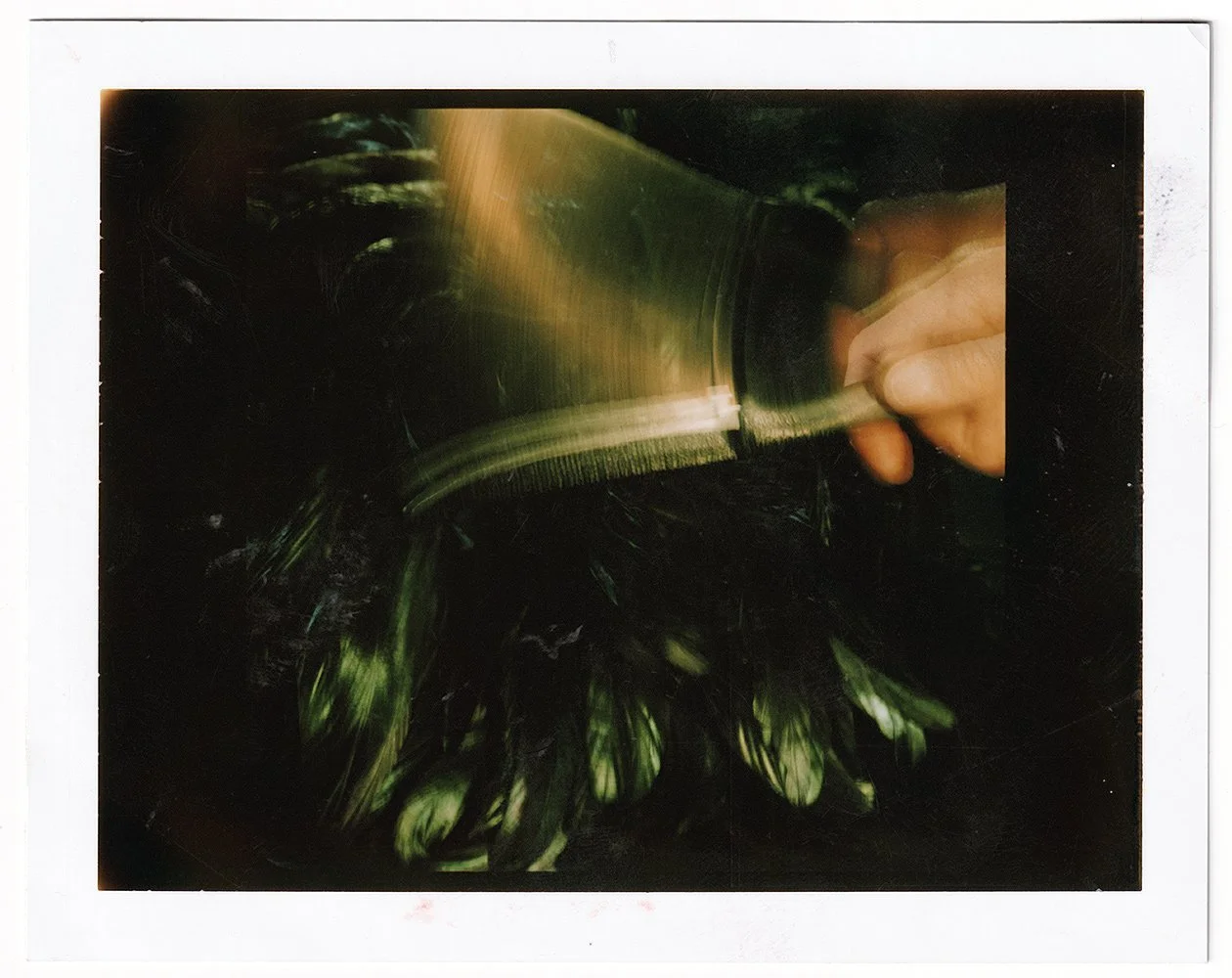
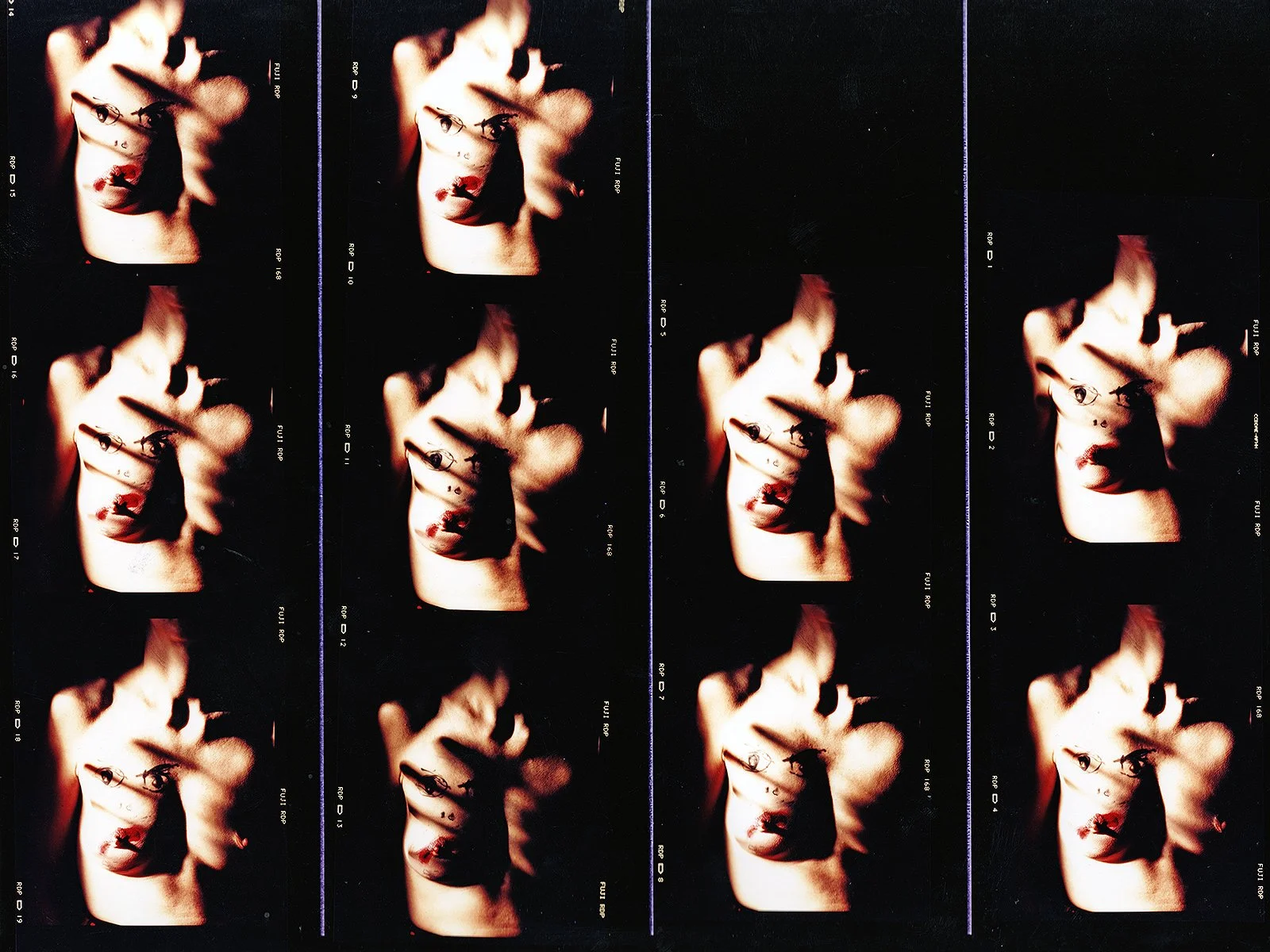
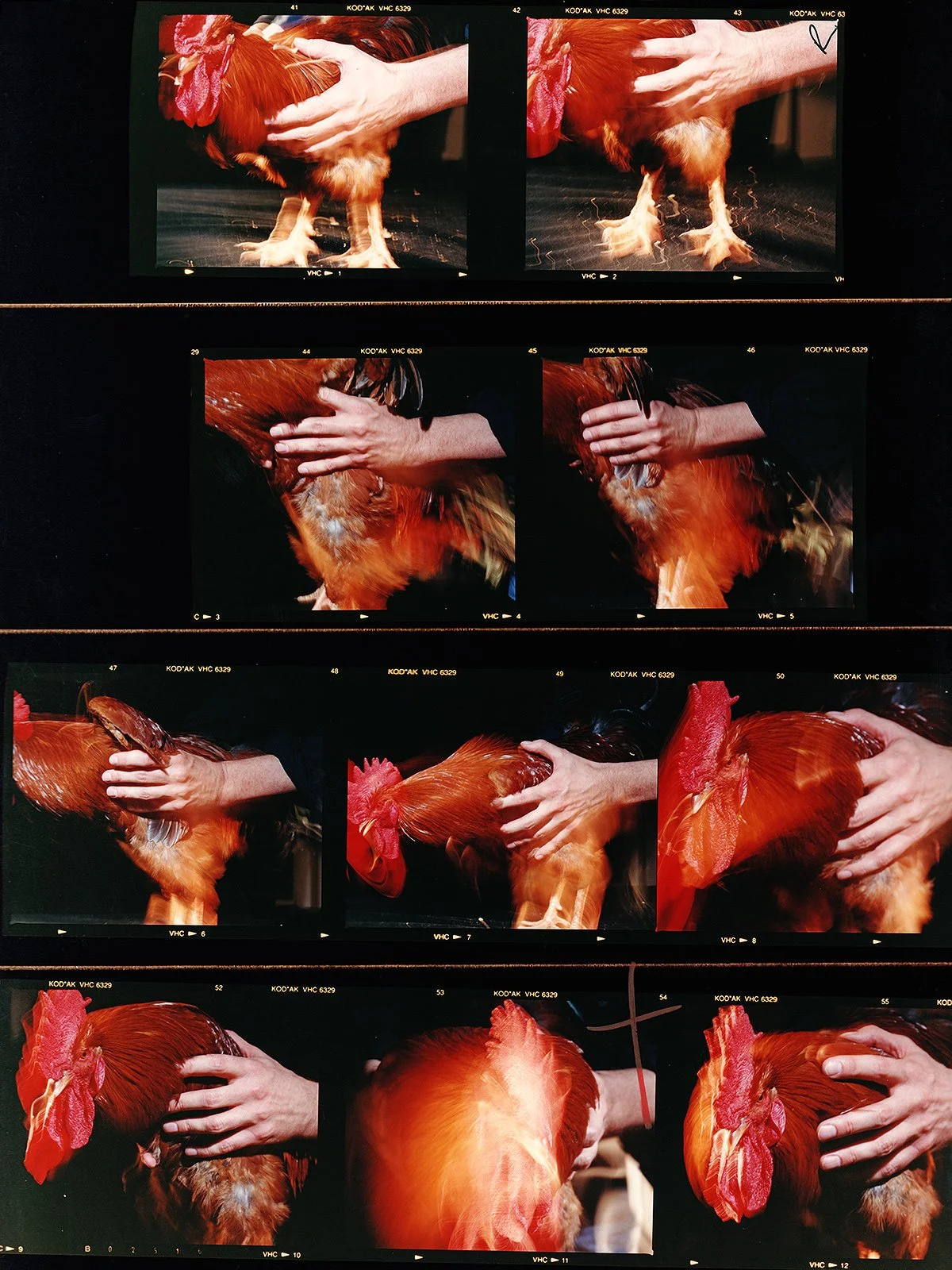
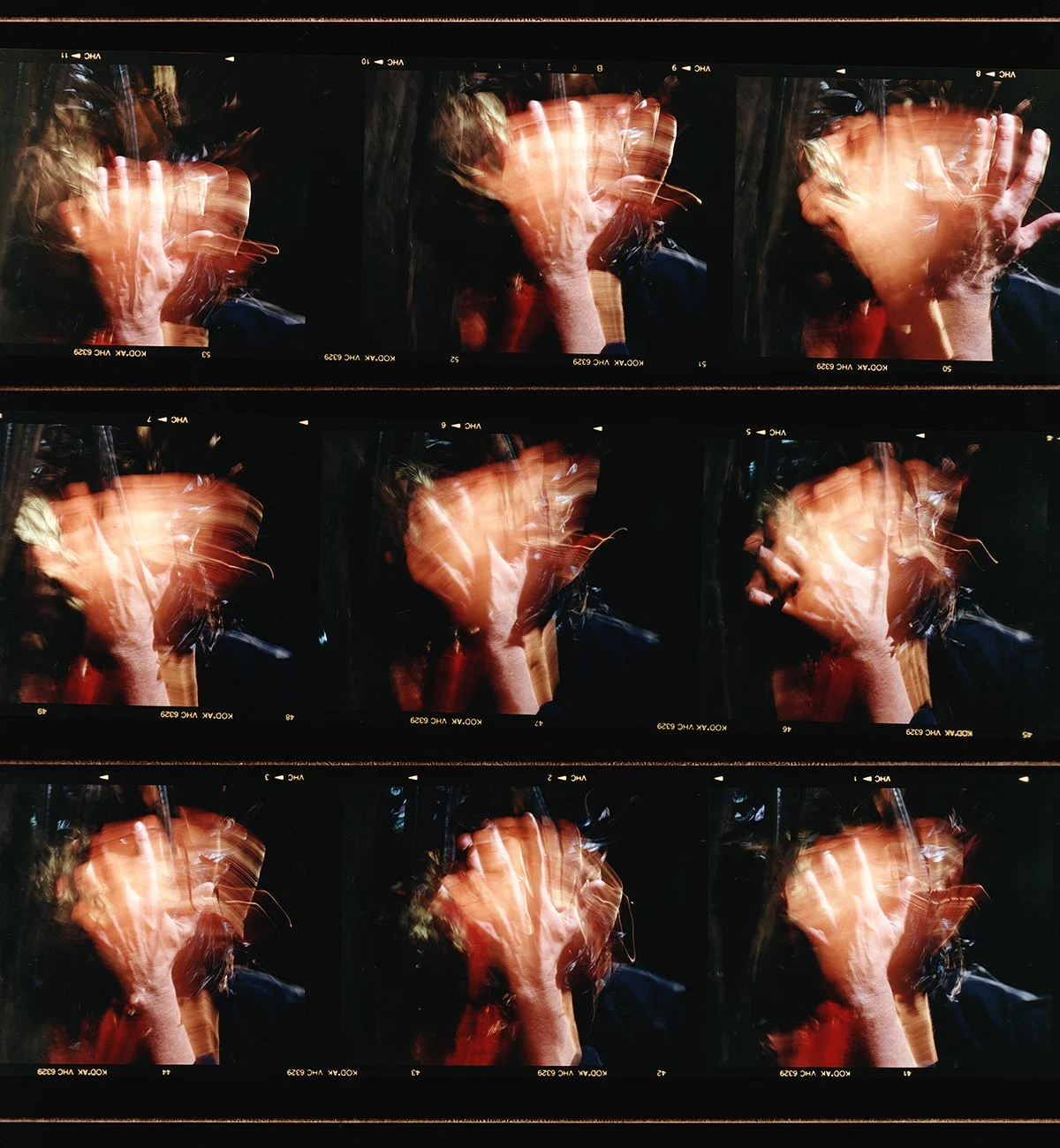
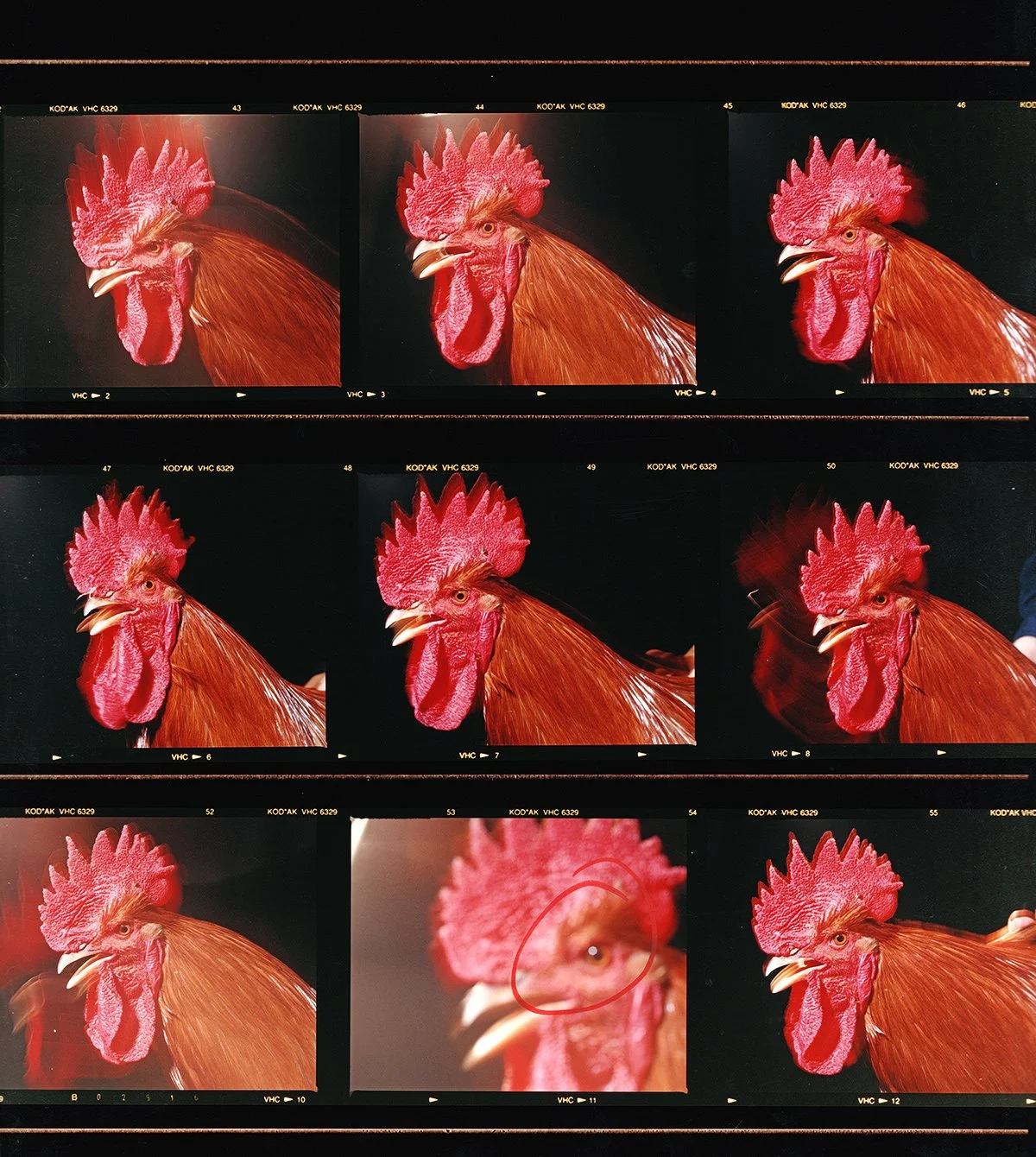
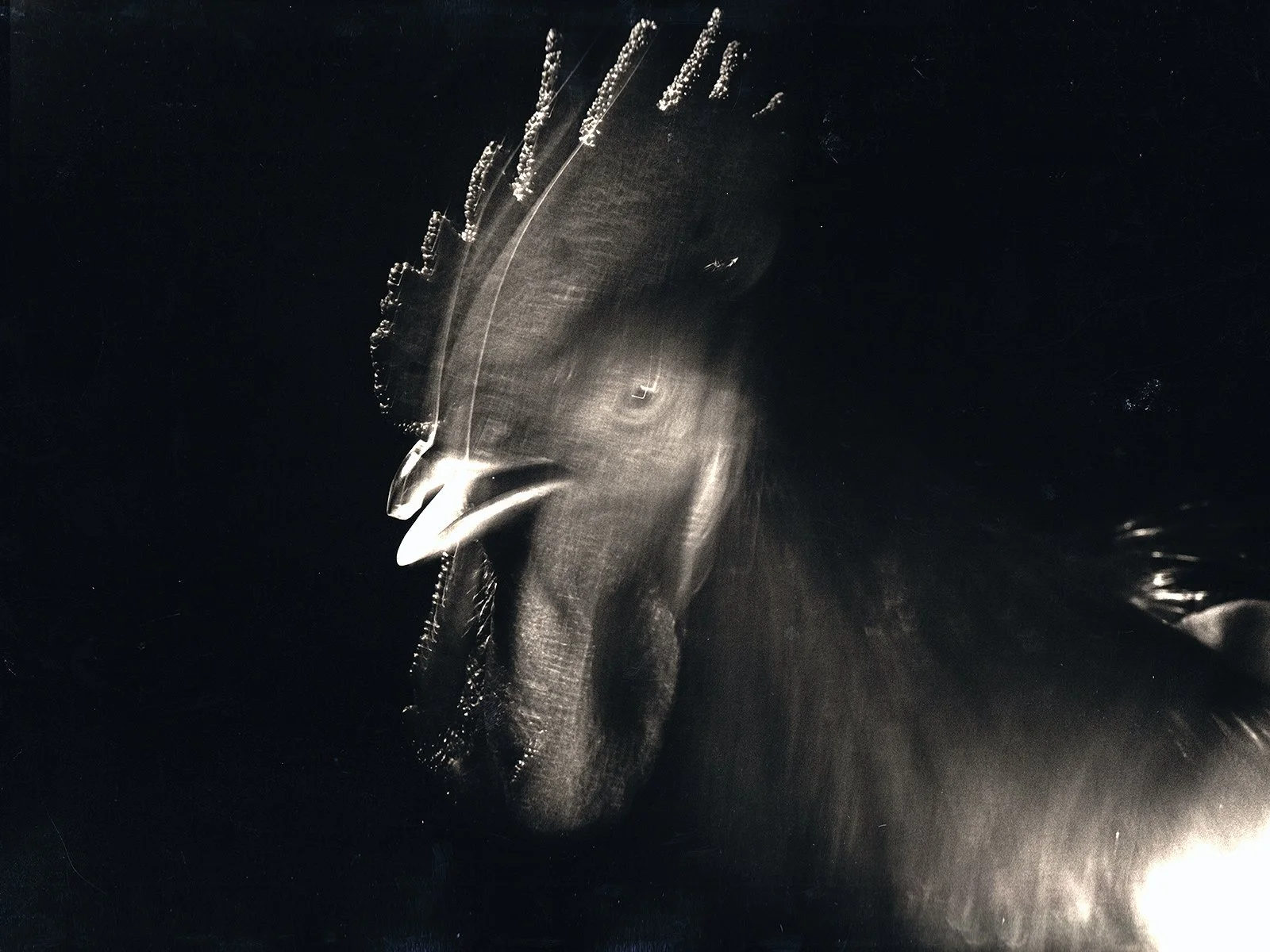
We understood the importance that Scott had already placed on the song The Cockfighter, so this became a favoured visual route – to create an abstracted nightmarish portrayal of the song, mainly by reflecting the song title. The juxtaposition between the cockerel and his handler, the blurred hand and the accusatory eye. Somehow we needed to allude to the 'killing machine' horror of the song’s inspiration. It became a flagship for the mood of the whole album, and Scott was front-and centre of the whole process.
Our photographer was David Scheinmann, whose own penchant for the theatrical made him a perfect choice for the project. He sourced the knife and the cockerel for the pictures (no poultry were harmed in the making of this cover!) and Scott supplied the hands.
“Despite the serious nature of the image there was a lot of craziness and comedy in David’s Soho basement studio that day. I’m given to understand that Scott’s propensity to keep his face covered by the peak of his ubiquitous baseball cap was a measure of how comfortable he felt in the company of others. I’m pleased to say that the peak was well off his face at various points during the photographic process. Difficult to stay calm and straight-faced when there’s a rampant cockerel escaping our clutches after every shot.”
The cockerel was bright red, but this wouldn’t have suited the atmosphere that Scott was wanting to create for the album sleeve (in fact I understand that he was colour blind…) It was to be substantially monochromatic, but as I have been reminded there needed to be a level of green in the final image at Scott’s behest, which was finalised as a layered Photoshop file, created on David’s straight-out-of-the-box new-fangled Apple Mac llci…
Once the shoot day was behind us we could reflect on the transition that we had witnessed in our understanding of Scott’s personality, and perhaps the revelation of a side of him that we didn’t know existed. We saw creative collaboration, patience, even laughter.
Our next lesson about Scott’s MO was in how exacting he was about the presentation of his lyrics. Our designer Mark Caylor seemed to have the artwork for the inner sleeve of the album open on his computer screen on and off for weeks, as he followed Scott’s ongoing instructions – fragmenting the lines of the songs – often into individual words, changing lines from upper to lower case and back again, and line spacing… all tweaked to order. When it takes you eleven years to make an album I guess you’ve earned the right to get the words laid out exactly as you want them. Such is the man that we discovered Scott to be. Quietly focused and unexpectedly confident. It was a brief relationship, but from it we realised that you shouldn’t equate solitude, silence and apparent diffidence with inactivity or lack of warmth and humanity.
I’m sure Scott wouldn’t have liked the flippancy of the epithet ‘Godlike', but whatever made him the person he was, there is no doubting his genius.
“Scott would roll up to the studio on his bicycle in the morning, wearing his baseball cap” says guitarist David Rhodes “his approach was always interesting. He wanted me to tune the guitar really low”
“I remember sitting with Scott over supper during the Tilt sessions and talking about when he kind of disappeared. He was very funny. He said I thought I wanted to go to Scandinavia, sit in bars and talk about Ibsen. But I only got as far as Amsterdam”
David Rhodes
Rob Hughes, Uncut - August 2025
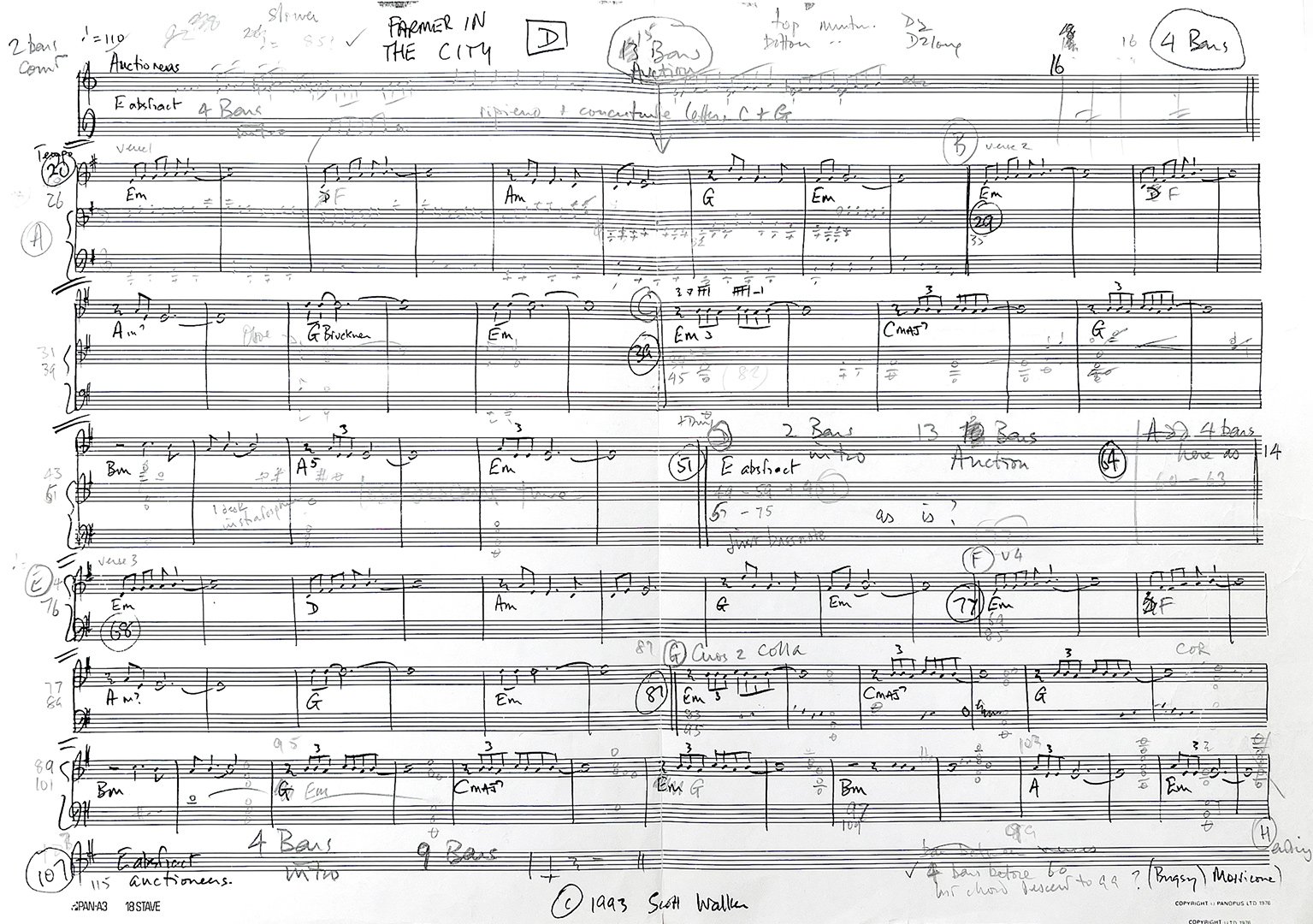
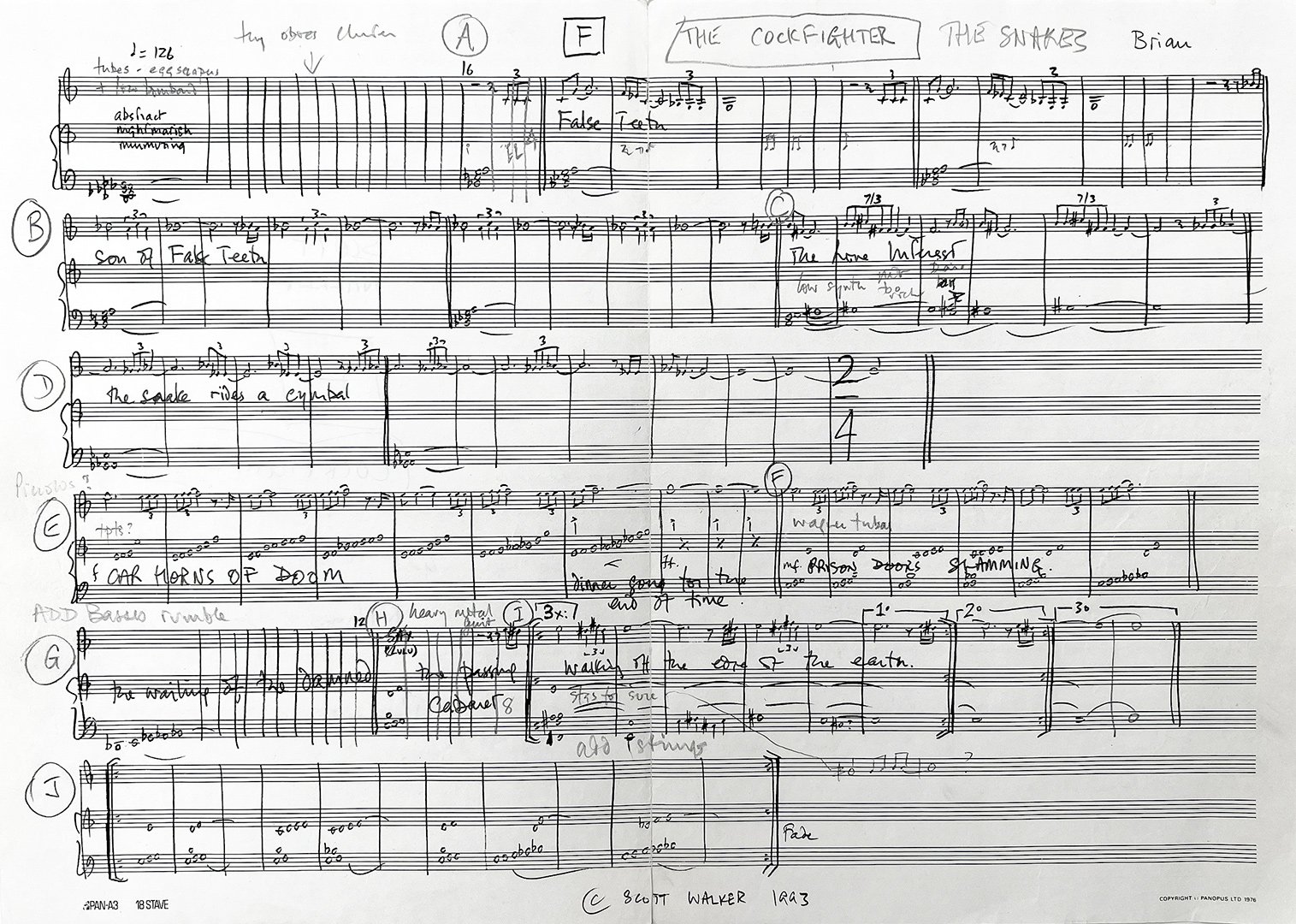
BBC Radio 4, Kaleidoscope, 19 May 1995
Stuart Maconie talks to Scott Walker
BBC Radio 3, Late Junction, 1995
Robert Sandall talks to Scott Walker
New York Times, The Pop Life, December 21st 1995
A Romantic, Darkly
When asked whether he thinks any of his European solo albums will be released on an American label, Scott Walker just laughs and says “no chance.” He’s being a little pessimistic, and that is in line with his reputation as a dark and morbid romantic.
Mr. Walker, 51, was born in Ohio, and moved to England in the mid-1960’s to seek glory with his beautiful baritone in the Walker Brothers, a band that achieved superstar status there with hits like “The Sun Ain’t Gonna Shine (Anymore).” But the pop machine soon wore Mr. Walker down. A singing idol on the surface, he longed for privacy and to be taken seriously as a songwriter. In the solo albums he has released since the group broke up in 1968, he has slowly turned from crooning pop to brooding French chansons to minimal art songs, growing more morbid, cerebral and intense with each new record and influencing such musicians as David Bowie, Elvis Costello and Julian Cope.
“You use whatever comes up,” Mr. Walker said of his dark side, speaking by telephone from London. “And that side flows for me more than another side does. Unlike other artists, I don’t have a constant dark side, and I don’t think I had it when I lived in America. You don’t have time to develop it much in America, unless you experience something really extreme, because the speed of life there is just too fast.”
In England, life moves a little slower for Mr. Walker. This year, he released his first album in 11 years, “Tilt” (Fontana/Mercury U.K.), with sparse, orchestrated pieces sung in the upper register of Mr. Walker’s voice. Its lyrics are slippery and complex, ranging from quotes from the trial of Adolf Eichmann to a soliloquy to the corpse of Che Guevara. Mr. Walker demands a lot of his listeners. “I had to work at the lyrics, so they should too,” he said.
“In the studio I was trying to find things that weren’t related to ‘anything anyone had heard before,” he said of the music. “I picked a group of musicians very carefully so that we could make a song that related to the lyrics. We worked as economically as possible, using no frilly or superfluous sounds. I let the words create each track for me.”
Mr. Walker let a decade elapse before recording “Tilt” because he could not find a record company that would agree to release his music without making him submit a demo tape. Mr. Walker says he believes that the first time he sings a song is the truest and most representative version.
“I have a terror of singing,” he said. “That’s one of the reasons I don’t perform. I want to do my vocals as quickly as possible, because that’s going to be the one that’s closest to the vocals in my dreams. If I get it wrong when I try it, it drives me insane. I even had an arrangement with the studio so that I could call up on the day I felt like singing it and go in.”
“I don’t even own any of my own records, and I would never listen to them,” he continued. “They would drive me crazy. They drive other people crazy, but not for the same reason.”
Mojo, May 1995
by Jim Irwin
Scott Walker: “That Francis Bacon, In-The-Face Whoops Factor…”
TWENTY-TWO YEAR OLD Noel Scott Engel was on the run from Uncle Sam. He was fleeing from a country that would never connect with his mordant soul. He was not the hail-fellow jock type that sunny California seemed to require. He was stirred by Albert Camus and Ingmar Bergman and his head was full of European romance. He felt alien in his homeland at the best of times, but now it was at war in Vietnam and pretty soon Uncle Sam would be drafting his meek, existentialist ass. He was afraid. And, as his plane touched down in England one freezing February morning in 1965, he couldn’t know that he was running from one unasked-for terror into another. He was about to become very, very famous.
HE IS POP’S OWN Salinger. A strikingly handsome and talented young man who could have taken everything the ‘60s had to offer, but who jilted fame. Nowadays he’s only famous for being absent. Salman Rushdie is seen out and about more often. Howard Hughes cuts more albums. People speak of him in quizzical, often concerned tones. He is revered and adored for his integrity, his sensual, serious singing voice and his artful and fascinating body of work.
He is Scott Walker. This is the first British interview he has consented to in 11 years and it’s a terrific temptation to turn up in a comedy wig, pump his hand violently – electric shock buzzer concealed in one’s palm – and bellow “’Scuse the warts, Sunshine! Mind if I fart!?”
After days spent filling my head with his legend – tales of an enigmatic recluse, an eccentric, a painfully shy man who shuns sunlight –it’s hard not to succumb to nervous laughter. And, because the interview has been rescheduled several times, I’ve started to wonder if it’s actually going to happen. In the ‘60s, Scott Walker developed a reputation for turning up hours late for interviews or gigs, if at all. In the ‘70s he was interviewed on only a dozen occasions. He hasn’t stepped onto a stage since a toe-curling Birmingham cabaret date by the revived Walker Brothers in 1978.
He signed to Virgin in 1979, but it was five years before he delivered Climate Of Hunter, his first and only album for the label, warmly received by critics but doomed to sell poorly. Since then he has seldom been glimpsed, his last appearance being a tiny cameo in a TV ad for Britvic fruit juice. It was assumed that Scott had retired from music forever, especially when word spread that he’d enrolled at a South London art college.
But in June 1993 a single, ‘Man From Reno’, appears on the Fontana label in France. Scott had turned up unexpectedly at the London office of Fontana head Dave Bates, and expressed his desire to record again. Bates, who had sanctioned the release of several successful Scott and Walker Brother reissues in the ‘80s, is more than happy to welcome him back to Phonogram. The contract stipulates that Scott has total freedom and Bates will not hear anything until the album is finished.
With new music on the way, Virgin Books commission a biography from fans Mike Watkinson and Pete Anderson. Scott Walker: A Deep Shade Of Blue appears early in 1994.
Still no album. Seasoned Walker-watchers anticipate a wait even lengthier than that preceding Climate Of Hunter. But suddenly, Scott Walker’s new album is ready. Entitled Tilt, it is to be previewed before a small, invited audience at the Royal College Of Art on Thursday March 16. The playback goes ahead. Scott Walker does not attend.
A FEW DAYS LATER, I’m shown into a vast sitting room in his manager’s four-storey house in Holland Park. White wooden shutters cover most of the main window and keep out the bright late-afternoon sunshine.
Someone enters.
“Hello.”
The soft voice belongs to a tall, trim man in blue jeans and baseball boots. He’s wearing a roomy blue-green bomber jacket over a navy blue shirt. Graduated pilot shades cover his eyes. His hair is light brown – not that much thinner than it once was – and worn short.
Scott Walker. He does not look 52.
His handshake is firm, his manner poised. He tells me he’s just been having his picture taken and he hates that. Interviews, we’ve heard, are where Scott Walker suffers for his art.
And art it is. Tilt is a wilfully abstract record. Bewildered faces at the playback tell the tale. At first it sounds like there are no songs at all. Your next reaction is that it’s mad but adventurous, a record to be greatly admired, if not enjoyed. Scott’s voice is surprising too, it has moved up the scale, away from his sonorous baritone into a crestfallen tenor.
Further plays at home and access to the strange lyrics quickly undermined those first impressions. Tilt is a cantata, vocally operatic and sonically dramatic. A wild rattling wall of high snare drums dominate one track, ‘The Cockfighter’. On another, ‘Manhattan’, a great obelisk of church organ bursts through the arrangement. Throughout another piece, ‘Bouncer See Bouncer…’, there’s the chatter of locusts. Those expecting stately balladry will be disillusioned; those anticipating a quantum leap from Nite Flights and Climate Of Hunter will be thrilled. Anyone who hears Tilt will be fascinated that someone has made such a record.
It seems like a very painterly recording. Almost a visual piece of music.
“I wonder if the two can be married,” Scott says, settling in a huge rococo armchair. “I know that people are saying that the divisions are being blurred today. My records have always been visual, though, tied up with cinema or something. Maybe it was going through my mind in that way I certainly thought about it more, having worked in conceptual art.”
The return to art was for three years of a four-year course at Byam Shaw, a private college in South London.
“I just wanted to groove up on drawing and painting and to be around people who were involved in that.”
He insists that he didn’t have a solid reason to record again, but just thought, Hell why not? There was no material ready when he signed to Fontana so he spent two years pondering what sort of record to make. He is not, he claims, the kind of person who has to write. “I feel the need to, but I restrain myself. Because I know better, basically.”
ALL THE WALKER BROTHERS had to do to become famous in Britain was show up. Imagine a trio of tall, rail-thin, pretty American boys with identical Brian Jones hairstyles and a lush, swoony, Spectorish new single in their luggage. It would go over big even today; in 1965 it was dynamite.
Gary Leeds, the newest Walker Brother, understood that. He’d already toured Britain, drumming for PJ Proby, a wayward young American unknown at home who’d caused a sensation in the UK. It was Gary who told guitarist and lead singer John Maus (pronounced Moss) and bass player/backing vocalist Scott Engel, that the UK was easy prey and urged that they go there immediately.
By this time, The Walker Brothers were attracting a crowd to Gazzari’s, a club on Sunset Strip. They’d been signed to Mercury by famed A&R man Nik Venet (who’d also discovered The Beach Boys), cut two singles (‘Pretty Girls Everywhere’ and ‘Love Her’), shot an appearance in a particularly cheesy beach movie (Beach Ball), and landed a residency on Jack Good’s Shindig TV show. Scott, although fascinated by Europe, took some persuading by Gary’s idea. John was concerned that the proposed trip would harm their local success. But the hot breath of the draft board and a $10,000 loan from Gary’s dad clinched it. The Walker Brothers left America on February 17, 1965. Only John would ever live there again.
A couple of weeks later, The Walker Brothers swanned into the offices of the Melody Maker wearing “king-size Beatle haircuts and dark glasses”, buttonholed staff-writer Chris Welch and used Gary’s PJ Proby connection to get his attention. Welch, impressed by the bright, articulate and attractive ‘brothers’, wrote a small story about their visit for the issue of March 13. (The article also noted that they’d just appeared on Ready Steady Go!) Presumably someone had alerted Philips, the British arm of Mercury, that the boys were in town and ready to promote their singles But after a couple of months of intensive schmoozing, The Walker Brothers were nothing but cold, fed up with British food and desperately homesick. Then Gary located hot management team Maurice King and Barry Clayman and pestered them until they signed the band. By September, The Walker Brothers’ third single was at Number 1.
SCOTT WALKER, pop singer, was born by accident during the session at RCA Studios, L.A., when Jack Nitzsche cut ‘Love Her’. Nik Venet had hired Nitzsche to turn the former Everly Brothers B-side –written by Barry Mann and Cynthia Weill – into the Walkers’ second A-side. Nitzsche, famous for his arrangements on Phil Spector’s hits, conceived a cavernous, Righteous Brothers feel. Unfortunately, John’s gritty voice didn’t suit it. So Nitzsche turned to bassist Scott, who had spent the day backcombing and dressing everyone’s hair. Scott didn’t think of himself as a lead singer any more. He’d hardly sung since cutting some flop singles for the tiny RKO and Ember labels, but, with some coaxing, thought he could conjure the liquid baritone Nitzsche had in mind. Studio jitters were exacerbated by a surprise visit from The Rolling Stones during the recording. Venet was thrilled with the results and kept telling Nitzsche it was his greatest ever arrangement. From that moment, The Walker Brothers’ sound was immutable.
The Walker Brothers achieved an irresistible blend of melancholy and optimism. They made the statement “My ship is coming in” seem ineffably sad and the assertion that “The sun ain’t gonna shine any more” supremely uplifting. Their records understood that emotions are illogical and treacherous. Their records still move people.
“It’s strange,” says Scott, removing his shades and revealing pale, calm eyes, “because everybody says – people who aren’t particularly into what I’m doing now –Why don’t you make another Walker Brothers record? I don’t think anyone’d be that interested, quite honestly.”
Scott’s euphoria at their success was short-lived. “It lasted through the first album and about halfway into the second one and that was it. Then the vampire teeth started appearing on everybody We were locked into this sound and couldn’t change. The formula was embedded in everybody’s minds. The protests I made fell on deaf ears. Everybody got greedy and kept it going like that and it wore us all down.”
The Walkers came unstuck when Scott attempted to marry his interest in brooding, European culture to their epic, orchestral pop; tried, in effect, to become Ingrnar Sinatra. “The public who liked our kind of records would not have gone that little bit further. We tested them, they wouldn’t.”
Remember, this was the mid ‘60s, that strange period when the Stones would turn up on The Billy Cotton Band Show, or something. Standards were different then. And pop music was a rapidly expanding universe. Scott insists, however, that he felt no temptation to move into the regions being explored by for example, Dylan and The Byrds.
“It was too folky for me,” he says emphatically, “and I don’t like folk music at all. I liked jazz in those days, I wasn’t interested in following Dylan.”
Neither did he see any mileage in joining the hippy movement.
“I think it was just so silly” he asserts, suddenly animated. “They really weren’t prepared to go far enough. I realise everyone was naive, including myself. It’s just that everything I was influenced by was being blown away by this inane attitude.
“It just drove me crazy I still see red if I hear Glastonbury mentioned,” he laughs. “I can’t help it! Hendrix was exciting. We toured with him and he was amazing, the Beethoven of his time. But I couldn’t see anyone else who was. It was all very cheesy and easy to manufacture. Which they did, group after group.
WHEN THEY SPLIT in 1967, the Walkers had two Number 1s, three Top 5 albums, and solo singles by John and Gary on their hitlist. Scott’s solo career was more spectacular still. By the summer of 1969 when the let’s-not-mess-about album entitled Scott Sings Songs From His TV Series scaled the Top 10, Scott’s fan club had 16,000 members; more than The Beatles’ fan club. His albums Scott 1, 2 & 3, had been best-sellers. Scott 2 had topped the charts. He’d also won several Best Male Singer polls, beating Elvis, Tom Jones and Paul McCartney
But the statistics don’t really tell the story The Walkers’ good looks and Scott’s sensitive nature naturally drew out the innate lusts and mothering instincts of thousands of screamage fans. Individually they sympathised. As a pack they were merciless. And took no notice when Scott complained about their intrusion or violent enthusiasm at gigs, or when he subsequently developed crippling stage fright and began missing shows. As a pack they saw no irony in rushing to find Scott when he bolted into a monastery for some peace for a week in February 1966. By the time he was discovered unconscious in a gas-filled flat in the summer of 1967 (an episode Scott claims barely to recall and so shan’t discuss today), it was clear that the pressures of fame on Scott Walker were serious, but letters to the music papers from fans had been saying that they were tired of him moaning about everything. Even so, he never reproached them.
“You can’t despise your audience,” he says, replacing his shades. “Well, you do, you despise everybody but it’s irrational because you made all those moves and decisions yourself You do go through a lot of self-loathing. It becomes very out of control in your head. There’s so much going on and so many ways that people see you, after a while you don’t know how to approach anything any more. It’s different for me now, I don’t think about that, but I see these young guys coming up with these kind of problems.
Pop wasn’t ready for Scott’s proto-Cobain personality. Or for such a stylistic loner, not quite MOR, not really avant-garde. So, when he began to record alone, spoke in inte-views of writing surrealistic songs that were “very Dylan Thomas, very Kafka”, refused to release singles and started singing stuff as darkly comic as Jacques Brel’s ‘Jackie’, consumer confusion was inevitable. On his TV show he crooned digestible standards. On his following, entirely self-composed album, Scott 4 – which he insisted issuing under the name Noel Scott Engel – he’d sing copiously of death and despair. The album opened with ‘The Seventh Seal’, inspired by Bergman’s film, included a song, ‘The Old Man’s Back Again’, dedicated to “the Neo-Stalinist Regime” and the sleeve carried a quote from Camus: “A man’s work is nothing but this slow trek to rediscover, through the detours of art, those two or three great and simple images in whose presence his heart first opened.” Engelbert Humperdinck it wasn’t.
It didn’t even graze the charts. Scott’s dismay at its failure provoked a turning point. His next record, Til The Band Comes In, featured one side of sharp songs co-written with his manager, one side of lacklustre covers.
On every subsequent album (two more for Philips, two for CBS, the first two GTO sets by the revived Walker Brothers) he did it their way. His heart wasn’t present. This is the work Scott refers to as “whoring”. Then, right out of left field, came the final Walker Brothers album, Nite Flights, made in 1978, marking the start of his current way of thinking, that his records should be full-on statements of intent or nothing. “It isn’t easy,” he says, ruefully, “people will always pay you to do something else, something other than what you want to do.”
TILT IS DEFIANTLY HIS. There isn’t the slightest whiff of A&R man about it. And it isn’t the kind of record you bung on while doing the housework.
“I wanted to make a nowhere record,” he says. “I’d like people to sit and listen to it, get into it through the words. I’m looking for that Francis Bacon, in-the-face, whoops factor in the sound. And I get it sometimes.”
It’s easy to misconstrue Tilt as mere self-indulgence or pretension. But isn’t self-indulgence the essence of art? “Well, it is today. Pretension is very ‘in’ as well. But that’s a very fine line, that one. If you don’t balance it with humour and so on, you’re in trouble, you just become some awful moaner.”
How would he react if people got the giggles while they listened to Tilt? “Oh that would be fine, because we did while we were working on it.”
How would he react to someone who said it was just showing-off and not purposeful? “I’d say they weren’t listening to it. If you wanted to show off you wouldn’t go the hard way around like that. It’s an acquired taste, you like what I do or you don’t…”
Tilt’s lyrics go way out into uncharted territory sometimes vividly engaging, sometimes apparently scornful of sense, images flashing by without any clear connection. Scott agrees this gives a kind of cinematic jump-cut effect, but sees it more as collage, open to many interpretations hut always controlled. Things do get very oblique, however. Take, for example: “Spared/I’ve been spared/all the powder/on a trumpet/of Gabriel.” Is he disguising things too far? Scott, do you know what you’re –
“Do I know what I’m talking about?” he interjects, laughing. “Oh yes. I’m not someone who puts in a line for the sake of it. I know exactly…I’ve honed and honed those babies down.”
So why make them so obscure?
“This isn’t anything new, I’ve always done this. It’s just a way to talk about the unsavable things of existence, the unnameable. You’re working around it, it’s a lot of edge work. You’re using language to discuss things that are beyond language.”
Walker once scrapped an album begun with Eno and Daniel Lanois. People who’ve heard the abandoned instrumental tracks say they’re beautiful and should be released, but Scott rebuts the suggestion that a good track is enough. “To me the lyric really matters. I work hard to get it pared down as much as possible because if you get the lyric right it can kick off anything, from the photos, to the concept of the design, anything you want.”
There are moments on Tilt when Scott’s singing leaves the mothership too. He says he never sings around the house for pleasure, so it must have felt strange after more than a decade, wondering what was going to come out.
“Singing’s hard for me. I’ve always found it difficult but it’s even harder now I don’t mean physically doing it, I mean in the sense of how it sounds, how to make it sound neutral. Everybody can overload it emotionally or underplay it deadpan, but to get it neutral is very hard, and that’s what I’m after. It’s an indecision, a grey area of vocal I want to produce.”
Tilt was recorded live and surprisingly quickly, Walker avoids the synthesizer where possible, preferring to use the imaginations of his musicians instead. While each player works from sheet music, Scott arranges on the hoof, coaxing unexpected sounds from the ensemble. Some of the textures the percussionists generate are particularly startling.
It’s a dark, intense sound, unfettered in comparison to his previous work, although there are echoes of the past. His trademark high, droning strings reappear – as used on ‘Such A Small Love’ and The Walker Brothers’ astonishing final single, ‘The Electrician’. The church organ has been a favourite component ever since a ‘60s B-side, ‘Archangel’. Here, at last, it’s been properly recorded and is like the Voice Of God. “That baby’s gonna blow you away!” Scott laughs.
As for subject matter, the death imagery seems less obtrusive on Tilt. It might seem that this is the work of man who, in his fifties, is losing his fear of the end. But Walker disagrees.
“I don’t think I’ve left that behind. I think I’m further into it. I felt it when I was younger in a very vertiginous kind of way, but this time it’s more reconciliation, a weightier thing. I realised all the phenomena of existence very young and it was a very hard thing for me. Now I’m living with it a little easier, more as an astonishment thing than a negative thing.”
FIFTY-TWO YEAR OLD Scott Walker lives alone IN London. He has very rarely returned to America in the last 30 years. His marriage to a Swedish woman is long over. Their daughter, Lee, is 22. Scott lives as best as he can on royalties and advances. He paints and draws. He likes to cycle. He doesn’t listen to music much, but has enjoyed recent albums by PJ Harvey, Portishead and, especially, Nine Inch Nails. He doesn’t possess any of his own recordings. He hasn’t read his biography He avoids contact with the media unless it’s absolutely necessary.
Once you’re a star who’s been tagged “an enigma” your mythology is sealed, whatever you choose to do. You don’t have to bounce down the King’s Road on your head whistling Dixie; simply pop up to your local on your bike and play a game of darts. Astonished rumour-mongers will do the rest.
When Scott Walker began to question what was expected of a young star in the ‘60s, people thought he was a bit touched. And nobody listened. Far be it from me to demystify Scott Walker for anyone, but it seems that real eccentricity lies in those who thrive in the boiling idiocy of the fame game. Scott strikes me as a very balanced person.
He twists in his seat. “I can always talk about art or recording in a balanced mode,” he says. “If I was talking about something else you might not think the same thing, but I think I’m all right. A lot of people think I’m mad. Even some of the people I work with. But I’m not worried about it. I think I’ve got it pretty well sussed.”
We are interrupted. Scott’s first interview in 11 years is over. Clearly relieved, he rises, smiles, shakes hands once more and briskly leaves the room.
The Wire, May 1995
by Richard Cook
Scott Walker: Tilting at Wind
Scott Walker, perhaps the most enigmatic singer in recent times, has returned with his first recording since 1984. But is it a work of experimental genius or one man’s towering folly? More than a decade after conducting Walker’s last major interview, Richard Cook meets him again to hear about the years of silence.
WELL, I HAVE to ask. Where have you been all this time? “Who knows, right? Hanging out. Doing a little traveling. Nothing constructive.” An answer to induce despair in the most patient of observers. Scott Walker is, though, his customary charming self. The most singular underachiever in music is a past master at explaining away whatever creative difficulty or business block he’s had to labour under. One gets a glimpse of the beguiling manner that he’s used to fend off some kind of disaster these past… oh, 25 years or so.
It’s that long since the epochal Scott 4 was released to deafening disregard; 18 years since the tantalizing EP’s worth of material on Nite Flights; and more than a decade since Climate Of Hunter was detonated on the feckless pop surroundings of 1984. Some work rate. No wonder Walker exists as little more than a shadowy half-presence in music.
Tilt, his 1995 record released this month, has a spectral quality about it that derives in part from his elusive, bewildering legend. It’s a record of skeletal parts that coheres in the mighty, scarcely diminished voice that acts as its narrator. Just as Climate Of Hunter slipped Scott loose, finally, of most of his old associations – the tormented crooner and lovelorn young man of 20 years before – so Tilt seems like a bulletin from an outer darkness that is very strange and rare ground for a “rock” record to tackle. Or: who is this man and what is he doing here?
Now past 50, he is a veteran in a business that thrives on youthful fizz. At a time when Elastica and Oasis are touted as young radical gods, it might be asked who’ll want to hear such a dense, opaque meditation as this hour of music. There isn’t much left of the thick romantic swirl that the early Scott Walker records were drenched in.
As finicky and detail-minded as Brian Wilson or Phil Spector, the young Scott Engel used European string writing to finesse a sorely beautiful songwriting style. The grand, sobbing orchestrations of Peter Knight, Wally Stott and Reg Guest on the early Walker Brothers records were a potent backdrop for his looming baritone voice. But now, that music seems as far away and remote from his current work as Beethoven is from Peter Maxwell Davies; as Charley Patton is from Robert Cray.
“I didn’t listen to a lot of pop while I was doing this, because you subconsciously reference a lot. I listened to Beethoven’s piano sonatas throughout and some Bartok string quartets. And some blues records. After it, I did what I used to do and gathered in every single thing that was going on and listened to all of it, to be sure I was… that the recording was going to be what I wanted. I can’t tell you where it comes from. It comes from silence, most of it. I sit around and I’m waiting. I’m waiting and waiting.”
Like the rest of us. Perhaps Scott Engel is just more patient than most. The waiting sits well on him: the famous Walker Brothers mane of hair has receded into a trimmed and thinning top layer, but otherwise he still has the lean, cowboyish physique that he brought with him from Ohio to London when he and John Maus and Gary Leeds set out to become “bigger than The Beatles” on an exploratory trip to the city in 1965. As the Walker Brothers, they sequenced some huge hits in the summer of that year. It didn’t last long, and Maus and Leeds have never made much of an impact outside their few hits together. For Scott Walker, forever stuck with his adopted name, it was a different if equally star-crossed story.
Five solo records for Philips, cut between 1967 and 1971, were touchstones for a singer-songwriter generation that never knew they existed. While bedsits everywhere hummed to the sound of Al Stewart or Cat Stevens, the deeper draughts of Scott Walker barely registered beyond his original following, which would always prefer him to return to ‘The Sun Ain’t Gonna Shine Any More’ in any case. By the time Scott 4 was deleted less than a year after it was made, the pop idol had lost his place and the enigmatic recluse had taken over.
Scott Engel’s transition from one rock era to another might seem trudgingly slow. In fact, on the early records, he worked with almost indecent haste by today’s standards. After a few compromised MOR records came the Walker Brothers reunion, which seemed like no valuable escapade at all until the four mesmerising pieces which emerged on the Nite Flights album of 1977. Scott blueprinted all his subsequent work in those fractured, driven songs, culminating in ‘The Electrician’, which enumerated many of the issues which have fired him since: the interface of politics and love, societies in flux, and music that bridges classical tradition with some displaced part of rock language.
It took him another seven years to release Climate Of Hunter. Frustratingly brief, the record still seems like an interim report: half of it is so powerful that it shames almost everything done in rock before or since, while some of the tracks seem nearly but not quite right. As with Scott 4, his other half-baked masterpiece, Engel couldn’t seem to see it absolutely through. The best of these records is so extraordinary that anything less seems like failure.
Now, though, 11 years after we last met at the time of the release of Climate Of Hunter, we have some catching up to do…
“I think I said to you before, I don’t write until I’m ready to record. It’s pointless. If I’m going to sit around in a wilderness because I can’t record any songs… I threw a whole lot of songs away, as many as I could write. Which isn’t a lot. Ever.”
Finally, with a deal with Phonogram/Mercury/Fontana having bubbled under for several years, he started work on a new record.
“I’ll start an idea, the next part might come up in a couple of months… Nothing’s wasted at all. I’ll read something or see something and think, that’s where that goes… I’m trying to go for something as carved down as possible. It’s unlike a Dylan song or a Neil Young song where everything is moving along. That’s not what I want. Everything that way seems too pat to me.”
Nothing on Tilt could be described that way. From the aria-like opening of ‘Farmer In The City’ to the Delta blues threnody of “Rosary”, the record unspools as a sequence of tableaux that abjure both simple interpretation and gratification. This is hard stuff so far removed from rock songwriting that it might as well line up with Franz Schubert as with Van Morrison. How is it put together in the studio?
“By the time I get to the studio, it’s all written down. I have to have readers I can work with, because I always want the music to be played together, at once. I don’t want any drum machines or click tracks. Nothing like that. Very little overdubbing, if possible. I never try to give them too much indications of what I’m going to do. Because then it’ll turn into a group thing, which is what I don’t want either. I want each piece to have an intensity of its own. So it has a kind of a febrile quality.
“I’ll do a couple of tunes on the first day, then take them home and listen to them in the evening, go in and do them again if I don’t like them – I don’t have any equipment at home except a guitar and an amp and a little five-octave keyboard, so I don’t have any fantasy or idea of what it’ll be like when I get in there. So I’m surprised, constantly.”
What does Peter Walsh (co-producer of both Tilt and Climate Of Hunter) do? “He understands how I work. It’s hard for a co-producer to work with me because everything is… everything comes from the songs. Every single sound in the track is related to the lyric in some way. So there’s a security thing there. As it goes along, I give him indications of what I want and he tells me if he can get it. I leave that to him. That’s valuable to me, because a lot of guys will feel they have to justify themselves in some kind of way. And then they get in the way.”
Which is what seemed to happen in the lost collaboration with Brian Eno and Daniel Lanois (about whom, Engel confesses, “I just couldn’t get along with that guy”). With another record left on the blocks before it even got started, Scott’s contract with Virgin, who only ever had Climate Of Hunter to show for their association, was axed. Still, one feels that such superstar collaborations aren’t really Engel’s forte. One striking aspect of both Climate Of Hunter and Tilt is the way he coaxes scintillating work from a cast of relative unknowns: such as Brian Gascoigne (Bamber’s brother), keyboards and string arrangements, or the almost subliminal bassist John Giblin. Or free improvising saxophonist Evan Parker, who has so far not been asked to perform on any Peter Gabriel records.
“I’ve no idea where this record belongs. I’m not making records for that reason.”
Was he disappointed with the commercial failure of Climate Of Hunter?
“No, I stopped expecting it years ago. My only thing is I want to make the records. That’s where I get off. After it’s finished, I’ll promote it or whatever, but there’s nothing I can do about it then. It’s done.”
Surely a musician wants an audience for his or her work?
“I’m trying to get one. But there’s all kinds of artists who have different audiences for their work. I know I’m not in the mainstream at all. I’m a marginal artist. But these days so is Lou Reed or John Cale or anyone like that. I don’t think I’m unusual in that kind of way.”
The difference, perhaps, is that for all their geopolitical musings and “adult” preoccupations, the likes of Reed or Cale have never really aspired to the density and weight – at both a lyrical and musical level – that distinguishes the processes of Tilt. Cale, for instance, may have done songs about Hedda Gabler and Chinese envoys, but Engel, in the thematic threads of the Tilt material, spins together a vista of war criminals, immigrants and displaced persons, Pier Paolo Pasolini, South American despots and a host of unidentified “personal” matters with a delicacy and intensity that is heartstopping.
What, for instance, is ‘Tilt’ itself about?
“I can only say that it’s satirical. It’s kind of a black country music song. I structured the chords very carefully through the whole album and there are new chords, not used before. The chords in ‘Tilt’ are mean to be like a yin and yang thing. David Rhodes is actually playing a major and a minor at the same time. I’m trying to avoid talking about the material, aren’t I? It’s a country song that becomes my own vision of something else during the key change. That’s all I can say.”
Do you want people to work at this material?
“Yes. Because otherwise it would have been a dance record or something, something for the background. I don’t want to make that kind of record and I’m not the only one. I worked at it and they should work at it as well. More and more, I think, there are people around who’ll do that.”
The cult of Scott Walker has persisted through the ’80s and into the ’90s. After Julian Cope’s Fire Escape In The Sky compilation and the long-awaited reissue of the first four solo albums on CD, at least people could get their hands on material that was more often talked about than heard, even if its creator still spent most of his time hidden from view. Occasional hints of activity have filtered through, though, such as a project with David Sylvian.
“Nothing really happened. I don’t really remember. I was doing something else at the time…” He furrows his brow. “All those years of drinking have finally taken their toll! [David] did say that he felt his stuff could use a little more balls. He’s much more of an ethereal merchant than I am. I’m a man who struggles with spirituality whereas he’s given in to it. My album and the one before it is about struggle in a Dostoievskian sense. It’s a real fight for me in every line. Whereas he’s given in to a state of grace. I wouldn’t want someone to come along and suggest a collaboration with a record that they thought was like mine. You might as well make your own record. When you can get someone to finance you!”
It might be fanciful to trace the influence of Scott Walker’s voice on David Sylvian. In any case, the Engel baritone still has no real precedent elsewhere in the music. When his old producer at Philips, John Franz, first heard that voice, he thought he was going to be grooming the greatest ballad singer in the world. One of the fascinating things about the early records is the split between Scott’s ambitions as a writer and composer and the inevitable leanings towards territory staked out by Sinatra and his generation. It was a time when the worlds of pop and MOR were still not far apart, when the old-timers of the business had worked in the industry since the days of Glenn Miller. The sleeve photos on Scott 4 show the besuited Franz and Peter Knight at work in the studio, as if they might have been recording Edmund Hockridge. But that peculiar British elegance gives those records much of their invincible refinement.
The voice was still in magnificent shape on Climate Of Hunter. On Tilt, there is a stretched quality to some of the singing, and the vibrato that used to bother John Franz can occasionally sound more like a quaver. Engel has also mixed himself further back than he ever has on some tracks. But it’s still an astonishing voice.
“I usually sing afterwards, so the musicians don’t know what’s going on. But I don’t do a lot of takes and I don’t rehearse it at home. So I’m surprised as well, when I’m doing the vocal. I have the spontaneity. I don’t always sing what I’ve written but I might keep it anyway. In the ‘Bouncer’ song I didn’t sing a line as it was written, but because I felt I couldn’t improve on the take, I kept it.
“Singing’s always hard for me. Not physically. But to get it neutral, where it’s not too emotional and not too deadpan. Somewhere in between is what I’m looking for. It drives me crazy sometimes. In this case, I think it’s a little better than some of the shots I’ve had at it.”
He agrees that an album done all in the style of the closing ‘Rosary’, a voice virtually alone in the studio, would be an interesting idea. But he laughs at the suggestion that his records are never finished because of a temptation to spend hours brooding alone in the digital silence of the studio.
“No, I’m very confident in the studio! The first day I was a bit edgy, but I don’t feel like I’ll never come out with anything. I don’t work in digital silence, either. I record in analogue. I just hope my option’s going to be picked up and I can do more stuff.
It’s so crazy to me. You get unbelievable, or even believable people being picked up all the time who aren’t selling any records. It’s puzzled me. People expect a lot more sales out of me than are generated. So they’re vastly disappointed. Whereas with other artists they’ll eke it out.”
Which leaves us with the future.
“I’ll do something else, and if I get a positive reaction, I’ll do a little tour with the band. Well, I won’t love the idea. I’ll…go and see. You don’t think I can do it, do you, Richard?”
I’m waiting, and waiting.
Silence.
Scott Walker Protest Placards at Turner Prize 1994
Interview
30 Century Man - Stephen Kijak, 20th April 2006
Excerpt from interview transcript
Stephen Kijak: I recall another idea from when you were talking about ‘Tilt’ all these years ago, it was this notion of removing the subjective self. I know it sounds kind of abstract, but these aren’t songs about you…
Scott Walker: Well, I mean, ultimately your work is yourself. Ultimately it is, unless you’re writing out-and-out genre things. So, it is in a sense about the self always. But it’s very difficult because this subjective thing, I’ve gotten more and more as with shaving down all the tracks and things like that there’s less personality as the years have gone by, in the singing. So ultimately, it’s just a man singing now. There are no soul inflections, not that there ever were many with me, but there’s nothing like that. I just want to get to a man singing and when it has to have emotion, hopefully it’s real emotion when it comes. I mean, that’s why when Pete (producer Peter Walsh has been working with Scott since 1984’s ‘Climate of Hunter’) and I are doing things, I don’t get much better after the first or second take. Even if we try to comp something, we’ll take a lot of things, but generally we’ll always go back to those because that’s when I almost got it right. So, it’s kind of draining everything away.
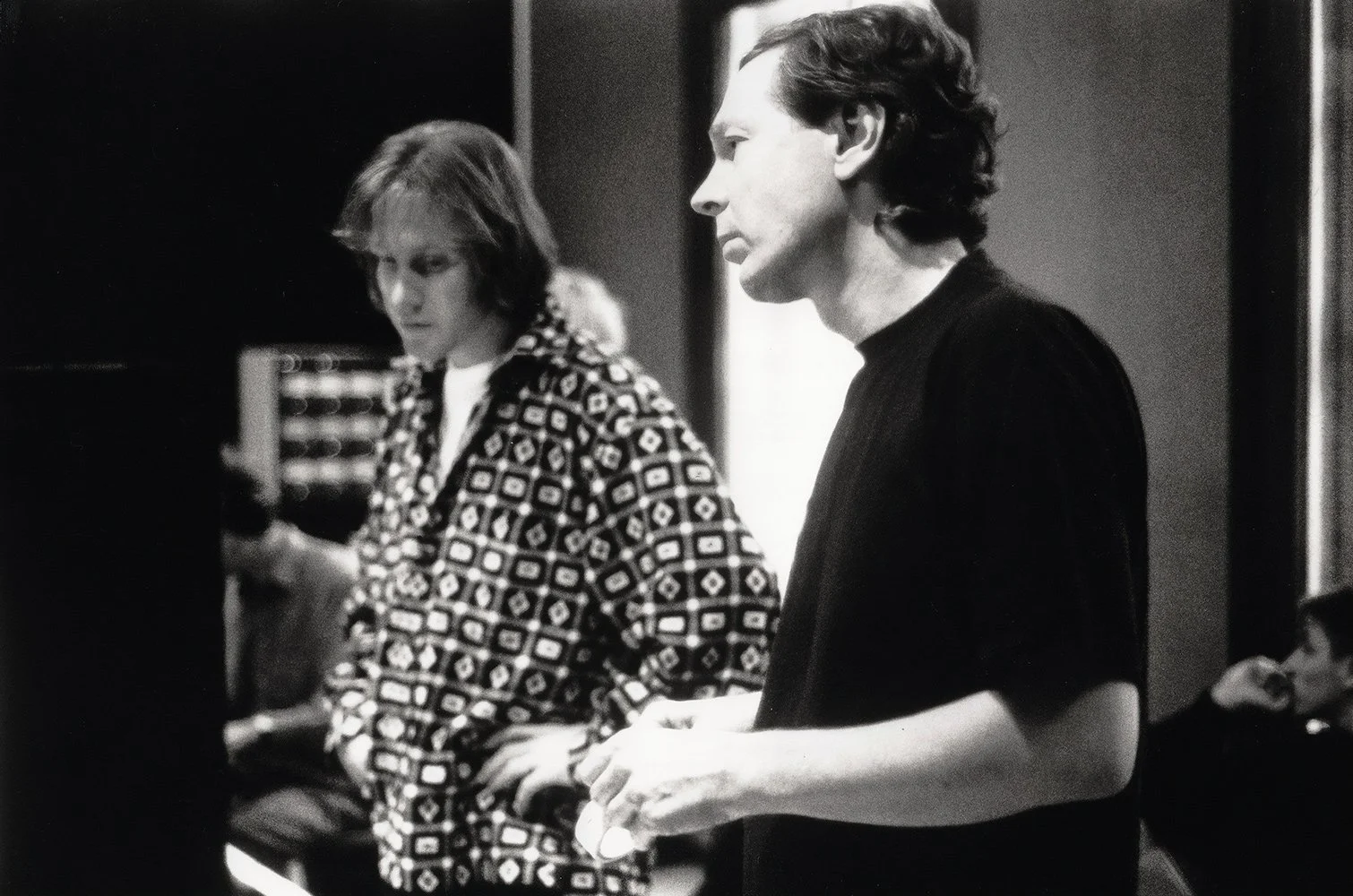
Puncture 40, Summer 1997
by Johnny Ray Huston
Great Scott
Not many musicians reach the rank of pop heartthrob the American Scott Walker attained in England in the ‘60s, emoting smashes like “The Sun Ain’t Gonna Shine Anymore” with the Walker Brothers, then carrying his audience along into the brooding, impassioned lyricism of his early solo work.
Fewer still come to view that kind of success as failure-to turn away from it and go on to a more rarefied greatness. But the reclusive Walker has emerged from a decade’s silence with an album that shatters most conceptions of what popular music can do. Tilt illuminates a landscape of horror, excitement, and loss with melodic and lyrical lightning flashes.
Tilt opens with “Farmer in the City (Remembering Pasolini).” Clocking in at six minutes 37 seconds, it’s alternately stark and symphonic. The most startling element is Walker’s voice. The deep, rich tones, the swoonworthy croon of the ‘60s, is gone. In its place is a trembling tenor, poignant more than handsome. At times the voice cries out into an ominous pitch-black silence; other times, it strains to match swelling orchestration. The words are cryptic. Some function like a camera, alternating between establishing shots and symbolic close-ups. Others could be the final thoughts of a man unknowingly walking towards his death.
Next comes “The Cock-fighter,” which begins with a minute and a half of unsettling atmospherics before a metallic rhythm track crashes in. Half of the lyric, accompanied by discordant horns, is a cockfighting scenario. The rest, accompanied by brooding organ, is constructed from trial excerpts that alternate between interrogation, justification, and banal detail. The young Walker was prone to purple prose; one sense flowed into another in an alliterative river of lyricism. Now his words seem painstakingly chosen to never quite connect as different selves struggle in the detached eye of a song.
Tilt’s lyrics are meticulously arranged, two or three words a line, ten words or fewer per stanza. Their final meaning is a mystery probably only Walker grasps, and he’s not about to explain. Certainly, his method has shifted from standard narrative scene-setting to a more abstract juxtaposition. But songs like “Patriot (a Single)” have a pathos absent from most avant-garde language games. The emotion stems from Walker’s voice, which brings the words to life without giving away secrets.
In the song about the death of Pier Paolo Pasolini, are you more interested in Pasolini the artist or Pasolini the man?
I’m not particularly interested in Pasolini as a film-maker, though I’ve liked a couple of things by him. But his death was interesting because what exactly happened still hasn’t been resolved. They convicted one person, but there’s a conspiracy theory that it might have been a right-wing government move.
He was murdered next to a big European football field. The whole scenario was bizarre, with very dark associations. I wanted to set a mood, so I used the words like a montage.
Tilt has a solitary feel. Did you have set ideas that you wanted to grapple with thematically?
If I’m using politics, l’ll use it to talk about an inner state rather than a political state. They’re related. It’s a way to break out of the [traditional] songwriting format. I’m looking inward-that’s why you get a solitary feel from the music. I’m composing something of myself through fragments.
How do the extracts from the 1820 adultery trial of Queen Caroline of England and the war-crimes trial of Nazi Adolf Eichmann that you incorporate into “The Cockfighter” enable you to compose something of yourself?
In juxtaposing trials that happened in different centuries and applying the answers of one trial to the questions of another, it was possible to play with the concept of timelessness. And it enabled me to say something about a subject that certainly calls for silence-the Holocaust. Adorno said that poetry could not be written after the Holocaust. I believe we know what he meant, even though it has proved not to be the case. It allowed me to pass beyond judgement and to indicate something about silence. Finally, it questions the concept of law itself and its inbuilt absurdity as a means for dealing with anything, let alone something as unspeakable as that.
I was not interested in the Queen Caroline trial in particular. I simply had the idea and picked a book off the library shelf at random. But if one is interested in tabloid scandal of another century, the sexual aspect of the trial repays attention.
You clearly have deeply held political views, but your political critiques are too covert to be pigeonholed as “protest music.”
Sometimes politics acts as a springboard to a larger picture, a way to stretch fragments into song. In the case of “Patriot (a Single),” the song ends as it begins, with the bombing of Iraq. That’s why I call it a single: a single disc, or perhaps a single human being. Before the song starts, there is 20 or so seconds of silence, and the same again at the end. It interrupts the narrative. The song could be read as a single circle including maybe 50 seconds of silence. It’s simply about a character, perhaps a spy, wandering the desert outskirts of Iraq. That’s really all I want to say about that.
The lyrics on Tilt are imagistic, as on your previous albums, but the imagery is more stark.
That’s because language means less and less. It’s been systematically strangled through technological misuse and cliché. We’re entering into silence—the most noisy, chaotic silence. It seems to be dawning on the Western world that there really is not much we can say about anything, especially the prime movers-birth, existence, sex, death. Nature is certainly out of bounds for everyday language. But it is possible to indicate something about them through certain types of literature, poetry, and song; it’s a question of edge work—a touch here or there-of very careful treading, until it reaches a kind of concentrated, formless form.
How long did it take to write Tilt’s lyrics?
A long, long time. Years.
I’d been out of the game for a decade, so I was reluctant as well-perhaps I could have gone a little quicker. But not that much quicker. With me, everything’s got to set right. Words are like little soldiers, a little army. If they’re set right, I can carry on. Until then, it’s a matter of waiting and waiting and wait-ing. But that’s the magic of language: nothing can speed the process. If you force it, or try to be clever, it shows. So I decided to take my time. For the next album, I managed to do the lyrics in a few years, but only because I’d had the experience with Tilt. The lyrics have many of the same qualities, but they were generated over a shorter period of time.
I work a very long time with the words, then if I know I’m going in to record at a certain time, I wait until about two months before to put on the melodies, maybe less, so the material is fresh. It’s just one more step. Then I’m in the studio.
Tilt seems most effective to me if I look at the lyrics while I’m listening. As you sing them, a metre and a mood is revealed.
Basically, Tilt is lyric-led. At the time I recorded it, everybody was doing things to a track. They’d lay down a track and then go home and put lyrics over it. That’s OK, it kind of jells, but I felt I’d take the time with the words. I figured if I did that, the words would lead me, they’d tell me what to do. And they absolutely did. If you get into their world far enough, they’ll take you where you want to go. Whatever happens in any part of the album is led by the lyric.
Did Tilt take long to record?
No… including the mixing, it was about a month and a half. It’s a strange process, because I don’t like to use click tracks. I like to do things live with the musicians, as much as possible, so we’re discovering together as we go along. The way I work, the top line of the song is notated, with the chords. The musicians always have that to refer to in times of lostness. But I compose very minimally: not with synthesizers, just a guitar or keyboard, so I’m absolutely free and open when I go into the studio. The important thing is getting the right guys to go with me. Then I work from the basic chart, without individual parts written.
It can be a disaster. Or it can work.
Initially, you don’t connect words with melodies? No. It helps because I don’t do the vocal until the end, and I only do it once because I want it fresh and tense as possible. It’s hard for musicians that way, but it keeps them from grooving. I don’t want anyone playing licks or grooving; that’s not my interest.
Is that because grooving makes songs fall into set patterns you find limiting?
Yes. Also, it tends to characterise the track, which is not what I’m after.
This avoidance of grooving, plus the fact that the lyrics are written first, invites comparisons to 19th-century classical lieder. Is that a tradition you’ve consciously drawn on?
Tilt has sometimes been described as rock lieder, and I suppose there is something in that, but it’s not particularly a conscious approach.
Is there an element of acting in your singing?
My background isn’t Dylan and folk, but the chanson singers, and they’re grounded in drama. I used to be a lot more dramatic when I was younger: I was emotionally fuelled by all kinds of things, booze included, I’m afraid.
But when the Walker Brothers did Nite Flight, my writing changed. These days I respect the lyrics. That’s why I don’t do many takes. I feel it’s part of the process of living with the words so long: you should be ready.
You said you do the vocal in one take- do you rehearse before the recording session?
I write the stuff so I know how it goes. I rehearse as best I can at home-not too much. I leave everything as late as possible; I know much of the material might be daunting to the listener, so I want to keep involved. I want to keep the performance as spontaneous as possible.
It doesn’t always work; it may take longer than I’d like. But I’m going for spontaneity, not perfection. You can tell if you read the lyric sheet: at times what I sing doesn’t coincide; but it’s as close to the feel as I can get, so I keep it — a personal tragedy considering how long the lyrics have taken!
The orchestration on Tilt, while just as lush in many ways, is very different in tone from the arrangements on your early albums. Did you learn from the arrangers you worked with in the ‘60s, Johnny Frantz and Jack Nietzsche-both in terms of what to do and what not to do?
It’s worked both ways. I learned how to use strings — the amounts, what sounds certain things make. But if you listen to records those arrangers made with other people, those records sound totally different from anything they did with me. We got a particular sound from each other. Today, I wouldn’t be able to handle those orchestrations, they’re much too fussy. I’d rather do them myself, with Brian Gascoigne.
Beyond Björk?
Tilt bears resemblances to Walker’s past work, but it has no precedent: it’s a classic example of idiosyncrasy blooming in innovation. The motion of the music is unconventional—it seems to respond to Walker’s voice, rather than the other way around. Strings, woodwinds, and traditional rock instruments materialise, then vanish; the sinister percussion is difficult to identify, yet never sounds (and is not) sampled. One possible reference point is Björk’s Post, and Walker seems to accept the parallel, while noting, “She’s thinking about a dance audience, so she’s stuck with 4/4 at a certain metre, no matter what she does.”
Walker isn’t. On Tilt, he no longer makes any attempt to fit within pop structures. The majority of the songs are over six minutes, and many contain passages of near silence, usually broken by Walker’s throttled voice. The grandeur of his tenor and the constant sense of drama- of an event unfolding— give the album an operatic quality. But Tilt has little to do with traditional opera and nothing at all in common with Andrew Lloyd-Webber’s multi-market rock operas; it’s an uncommercial, unsolvable puzzle. Initially, it’s almost off-putting, yet its pleasures grow with each listening.
It’s not catchy choruses but ephemeral moments that offer pleasure-the way the title track’s bizarre major/minor-chord hybrid mimics the stampede imagery of Walker’s lyric; the way the pitch-black, violent stillness of “Bouncer See Bouncer”-Walker repeatedly crying “Spared, I’ve been spared” over an executioner’s drumbeat— metamorphoses into a sunny interlude of equal stillness. But as the musical originality and lyrical obscurity here defy imitation, they also defy easy description. Tilt needs to be heard to be appreciated; heard not to be understood.
Once upon a time
Tilt arrives in America at a time when many listeners have only recently been introduced to the Scott Walker of three decades ago. In postpunk England, crooners from Julian Cope to Marc Almond paid tribute to him via liner notes, compilations (notably Cope’s personal selection, entitled Fire Escape in the Sky: The Godlike Genius of Scott Walker), covers of his songs, and of course, inferior vocal imitation. But the 1996 compilation It’s Raining Today, coordinated by Marshall Crenshaw, marked the first stateside release of material from Walker’s landmark albums Scott 1 through Scott 4, initially released from 1967 to 1969.
When the notoriously reclusive Walker, who dismisses “compilations of any kind,” agreed to do a few interviews in conjunction with its release, word was that instead of talking about the music on the compilation, he was hoping to talk about Tilt, which had been released in the UK the previous year. Walker isn’t allergic to questions about his commercial heyday—he just gives short, rote replies that convey his lack of interest.
He’s a little more forthcoming when asked about other ‘60s figures. When I mention Jackie Trent, an underrated vocalist and Bergmanesque lyricist who co-wrote the 1968 Walker single “Joanna,” he asks, “Have you ever seen her? She’s a really large lady, so she can really belt it out.” A query about French acoustic chanteuse Françoise Hardy, who Walker (according to the Watkinson and Anderson biography A Deep Shade of Blue) once considered an “ideal girl,” gets an anticlimactic, antiromantic response: “When the Walker Brothers arrived in England in the early ‘60s, it was midwinter and we were staying in an extremely cold flat. We listened to Radio Luxembourg at the time, and Françoise Hardy had a song called ‘All Over the World’ that I found very seductive. That’s the extent of my interest.”
Taking a cue from Stereolab, the current vogue for soundtracks, and other extensions of pre-millennium retromania, American rock has been exploring European and cinematic influences recently. This exploration adds timeliness to the great songs on It’s Raining Today, for as a recent British documentary on Walker asserts, he’s very much an “American with a European imagination.” Since Walker left California in search of Brit-pop success at the height of Swinging London, his creativity has continually extended past national and genre boundaries, blending surrealism and easy listening, Burt Bacharach and Jacques Brel. Listening to his early albums is not so much an act of nostalgia as a discovery, for there are no contemporary recordings that can match the lushly imaginative orchestration and the richest lyricism (mostly by Brel) on Scott 1-4.
Though Marc Almond once noted that Walker has “more in common with Jean-Paul Sartre than John, Paul, and Ringo,” the marriage of Walker’s tenor and Brel’s scathing chansons is on a par with the best moments of Lennon/ McCartney and Morrissey/ Marr. Having heard versions of Brel’s “If You Go Away” (originally “Ne Me Quitte Pas”) by everyone from Nina Simone (scary) to Sheena Easton (scarier), I can vouch for its being one of the most covered songs of modern times—but only Dusty Springfield’s version approaches Walker’s. As for Walker’s own baroque compositions, solitary characters like the ageing transvestite “Big Louise” and filmic scenarios like “The Seventh Seal” are melodic precursors to Tilt’s stark symphonics.
Do you ever listen to your older albums, even simply as a record of how you once were?
It’s so difficult for me to get through making a recording that when I’m finished, I’m finished. Maybe if I did go back and listen I’d be disappointed; or maybe I’d like it. But I’d rather get on with life.
Do you ever feel any desire to return to California?
My daughter’s out there. I was there last year when my mother died, and I stayed for about three weeks. If I could compound the amount of time I’ve spent in America over the past 30 years, it would probably be about six months. It’s always quite a shock when I go back.
Sometimes I feel I wouldn’t mind being an expatriate.
It has its drawbacks, too. America, like it or loathe it, is where everything happens first. Everybody here longs to be there. So I’d think about it if I were you.
Do you see any contemporary songwriters who are close to the calibre of Brel, and do you still like him?
I kind of went through that phase. When I listen to him now, I still think he’s a wonderful writer, of course. There’s a guy named Michel Sardu in France who’s a good writer. But it’s a very different game now, for everyone. No one’s writing songs anymore. If Brel were around today, he’d probably be considered very dated. Music today is fragmented and sample-based.
The contemporary bands that are compared to you, like the Tindersticks, have you heard them?
Yes-some are very good. But the connection seems tenuous. Perhaps I conjure up an atmosphere for them. When someone is compared to me, my manager will sometimes send me the records, but I don’t usually recognise myself in them.
I was impressed by the new Radiohead album. Like all albums today, it has too much compression, though. God, it’s unbelievable, because the radio stations have compression too, so when they play a record, there’s double compression. There’s no space. You can hear the vocals clicking away almost metallically.
How do you feel when people refer to you as a legend?
You can’t take it seriously. I remember Brel saying that. We all look up to someone when we’re young. I did with Brel, and he did with somebody else, Bresson or someone. We all need that in order to get to the next stage.
What do you think of writing that portrays you as a melancholic figure? Is it accurate?
It depends on how far over or under it goes. No one knows what another person is up to. Writers go by extraneous things. Many people hear something in the music they can relate to, and they’re writing autobiographically.
But the “melancholy” tag is something that started in the early days here, and it has stayed with me. It comes out of my music. Some people flow through life easily, and you hear it on their records. Mine don’t come out that way.
For obvious reasons, fans bemoan the time spans between your records. Have you created only when you felt it was necessary? Today there’s a corporate-driven mentality about music, with artists having to produce every year.
We have artists like that here in England. Especially the ambient brigade, who make records in their bedrooms. It’s cheap, and they have to feel they’re constantly being creative; they don’t realise that without time and space, what you do is half thought out.
Admittedly, with Tilt, I had too much time. I don’t think you need a decade, but I had extraneous things going on. There’s a Spanish director who’s made three films in 30 years; but they’re all stunners. I take the time I need. You’ve got to have the courage, otherwise you cheat yourself.
A solitary man
Not many people get to talk with Scott Walker. Even fewer people capture his voice with a tape recorder. The Walker mystique was already alive in the late ‘60s, when he broke free from the Spector-style pop of the Walker Brothers with a quartet of solo albums that established his persona: a solitary man creating and inhabiting darkly romantic, cinematic soundscapes.
Over time, Walker has lowered his profile further still. Each of the last two decades has brought a single solo work. On 1983’s Climate of Hunter, the lush, string-laden surroundings of Walker’s earlier albums had already begun to evaporate; on 1995’s Tilt (finally released this year in the US by Drag City), widescreen melody gives way completely to an equally vast darkness.
Over time, Walker’s mystique has been fuelled by his infrequent recording and his steadfast avoidance of live performing. In an era dominated by promotion, an iconic artist who follows his own counsel is apt to become a cult figure. This is a man who rarely takes off his shades for photo sessions or TV interviews. He probably even wears them during tape-recorded phone chats—| forgot to ask him.
I did learn that at least he won’t be avoiding the studio for yet another decade. For one thing, he’s accepted an invitation to write the soundtrack to a new movie by French director Léos Carax (a major figure in Europe, but still largely unknown here). The music will be mostly orchestral, says Walker, “and at several points it will have band things going on. Very dark. But mainly it will be stringy.”
It probably won’t involve singing, though: “He might want me to interject a word here or there for mood, but that’s all.”