The Drift
Scott Walker
Released: May 8, 2006. Label: 4AD
The Drift is Scott Walker’s thirteenth studio album, and his first on the 4AD label, on which he released all his subsequent recordings. He spoke of the unexpected delight of being signed as a 4AD artist to Dazed Digital in 2011:
“Pleasantly surprised? I positively tingle. Especially given the current state of affairs. I was very fortunate to hook up with them.”
The album comprises ten original Walker compositions, bringing together the subjects of 9/11 and Elvis Presley’s stillborn twin brother Jesse in September Song, and in Clara, the Srebrenica Massacre and the execution of Mussolini and his mistress Clara Petacci, an event Walker remembers watching on a historical newsreel on a childhood cinema trip. An early live version of Psoriatic, under the title Thimble Rigging, debuted at the 2000 Meltdown Festival, which he curated.
The album was recorded in London at London’s Metropolis Studios, with the orchestra recorded at AIR Studios. New personnel included guitarist James Stevenson, who had previously worked with The Cult and Tricky, and singer Vanessa Contenay-Quinones. The musical director for the album, and Walker’s subsequent releases, was Mark Warman.
In an interview with Verity Sharp for the BBC’s Culture Show, Walker described the music, in relation to his early solo work, as: “a lot harder…it’s very shaved-down, but I think the mood is probably the same… if you go back, you can find out whoever that young guy was, in the woodwork.” Speaking to The Observer’s Sean O’Hagan about the album’s subjects in 2008, he said: “Essentially, I’m really trying to find a way to talk about the things that cannot be spoken of.” Of his music, he said: “It’s generally just big blocks of sound, raw and stark. A big emotional noise….there is an absurdity there, too, of course, and I hope that people pick up on that.”
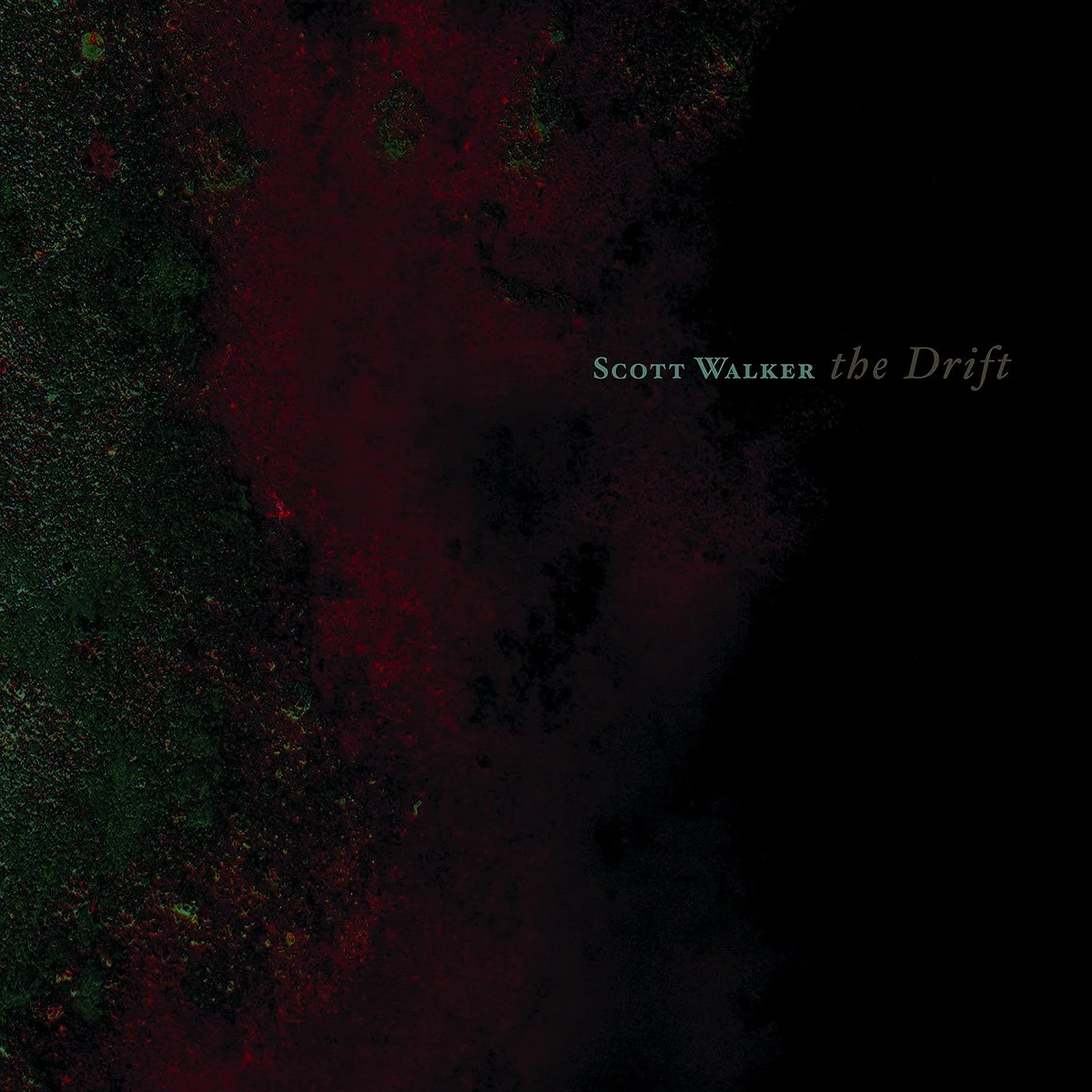
The Drift’s producers are Scott Walker and Peter Walsh. The cover design is by Vaughan Oliver and Chris Bigg at v23, with photography by Marc Atkins.
The Drift spent one week in the UK charts, reaching no. 51.
Track Listing
Cossacks Are 4:32
Clara 12:43
Jesse 6:28
Jolson and Jones 7:45
Cue 10:27
Hand Me Ups 5:49
Buzzers 6:39
Psoriatic 5:51
The Escape 5:18
A Lover Loves 3:11
Credits
Produced and mixed by Scott Walker and Peter Walsh
Recorded by Peter Walsh
-
Produced and mixed by Scott Walker and Peter Walsh
Recorded by Peter Walsh
All songs written by Scott Walker except “Psoriatic”, in which the words
Ja-da ja-da
ja-da ja-da
jing jing
jingwere written by Bob Carleton and published by EMI Feist Catalog Inc
COSSACKS ARE
Drums: Ian Thomas
Bass: John Giblin
Electric Guitar: Hugh Burns
Keyboards: Brian Gascoigne, Mark Warman
Percussion: Alasdair MalloyCLARA
Drums: Ian Thomas
Bass: Steve Pearce
Electric Guitar: Hugh Burns
Echoplex Guitar:James Stevenson
Ocarina: Mark Warman
Shawm: Andrew Cronshaw
Percussion and Meat Punching: Alasdair Malloy
Sound Treatment: Peter Walsh and Mark Warman
Vanessa Contenay-Quinones as the Voice of Claretta Petacct
Strings Orchestrated and Conducted by Philip SheppardJESSE
Electric Baritone/Electric Guitar: Hugh Burns
Mosquito/Echoplex Guitar: James Stevenson
Strings Orchestrated and Conducted by Mark WarmanJOLSON AND JONES
Drums: Ian Thomas
Bass: Steve Pearce
Electric Guitar: Hugh Burns
Violin: Thomas Bowes
Alto Sax: Scott Walker
Keyboards: Mark Warman
Percussion: Alasdair Malloy
Sound Treatment: Peter Walsh
Man Descending Stairs: Peter Walsh
Concertina: Andrew Cronshaw
Strings Orchestrated and Conducted by Mark WarmanCUE
Drums: Alasdair Malloy
Bass: John Giblin
Acoustic Baritone Guitars: Hugh Burns and Scott Walker
Electric Guitar: Hugh Burns
Flugelhorn: Derek Watkins
Big Box Percussion: Alasdair Malloy
Big Box Construction: Tim Painter
Strings Orchestrated and Conducted by Philip SheppardHAND ME UPS
Drums: Ian Thomas
Bass: John Giblin
Electric/Acoustic Guitar: Hugh Burns
Vox Continental: Mark Warman
Children Scream Vocals: Ralph Warman, Rebecca Painter, Lucv Painter
Choirboy: Ralph Warman
Tubax/Baritone Sax: Pete Long
Percussion-Claps: Rohan OnraetBUZZERS
Bass: John Giblin
Electric/Acoustic Guitar: Hugh Burns
Percussion: Alasdair Malloy
Newsreader: Beverly Foster
Sound Treatment: Scott Walker and Peter Walsh
Strings Orchestrated and Conducted by Philip SheppardPSORIATIC
Drums: Ian Thomas
Bass: Steve Pearce
Electric Guitar: Hugh Burns
Sitar Guitar: Peter Walsh
Hi Sus Guitar: James Stevenson
Electric Cello: Philip Sheppard
Sound Treatment: Brian Gascoigne and Peter Walsh
Di-Zi: Andrew Cronshaw
Percussion: Alasdair MalloyTHE ESCAPE
Drums: Ian Thomas
Bass: Steve Pearce
Electric Baritone/Acoustic Guitar: Hugh Burns
Cello: Philip Sheppard
Harmonica: Scott Walker
Keyboards and Percussion: Mark Warman
Strings Orchestrated and Conducted by Mark WarmanA LOVER LOVES
Acoustic Guitar: Scott WalkerSTRING PLAYERS: SESSION 1
VIOLIN I:
Janice Graham, Paul Willey, Julian Tear, Ofer Falk, Sophie Barber, Ben Buckton, Clare Hoffman, Elizabeth Wexler, Karin Leishman, Matthew ScrivenerVIOLIN II:
Steve Morris, Simon Smith, Deborah Wddup, Alison Kelly, Clive Dobbins, Amanda Smith, Ulrike Kipp, Jo Godden, Ruth Funnell, Sue BriscoeCELLO:
Alistair Blayden, Nick Roberts, Jane Fenton, Andrew Fuller, John Tunnell, Tamsy Kaner, Judith Herbert, Jackie Phillips, Robert Max, Roberto SorrentinoBASS:
Neil Tarlton, Chris West, Matthew Corman, Clare Tyack, Roger Linley , Diane ClarkeSTRING PLAYERS: SESSION 2
VIOLIN I:
Michael Davis, Paul Willey, Julian Tear, Ofer Falk, Sophie Barber, Ben Buckton, Clare Hoffman, Elizabeth Wexler, Ralph De Souza, Robert SalterVIOLIN II:
Steve Morris, Simon Smith, Deborah Widdup, Alison Kelly, Clive Dobbins, Amanda Smith, Ulrike Kipp, Jo Godden, Charles Sewart, Celia SheenCELLO:
Alistair Blayden, Nick Roberts, Jane Fenton, Andrew Fuller, John Tunnell, Tamsy Kaner, Judith Herbert, Jackie Phillips, Jonathan Williams, Joely KoosBASS:
Neil Tarlton, Chris West, Matthew Corman, Clare Tyack, Roger Linley, Diane ClarkeAlbum Recorded at Metropolis Studios, London
Assistant at Metropolis: Matt Paul
Additional Assistants: Rohan Onraet, Dom Morley, Richard Wilkinson, Neil Tucker, Nik Pugh, Iain Gore, Adrian Hall
Technical Support at Metropolis: Jim Kelly, Simon SaywoodOrchestra Recorded by Geoff Foster at Air Studios
Assistant: Chris Barrett
Orchestra Contractor: Richard Nelson, Cool Music LtdDesign: Vaughan Oliver at V23
Design Assistance: Chris Bigg at V23
Photography: Marc Atkins at panoptika.netPortraits: Grant Gee
Special thanks to Alison Hussey at Metropolis
Thanks to Jarvis Cocker, Fuckhead, Chris Sharp
On Hugh Burns
From interview with Stephen Kijak
30th Century Man DVD additional footage
Stephen Kijak: Never a temptation to, I mean, it sounds ridiculous, but you have the album, why not recreate it in a way that could be mobile or portable. Not quite do an unplugged, but....
Scott Walker: I can't imagine how we would do it. I mean, I can't, because we strive so hard to get everything just right. You know what I mean? So, it shouldn't be synthesized strings. It shouldn't be. It's got to be exactly what it is.
And of course, it would drive Hughie (Hugh Burns, guitar) crazy because he's one of the heroes of the record, because he had to translate all of these chords, these horrendous things I'd written, on to guitar or baritone guitar, which is even out of the normal tuning space. And he'd have a nervous breakdown in one evening! I was trying to play it at home, and I was like... (mimes trying to make impossible chords!)
SK: Is there a little bit of a mischievous quality to looking for the impossible chord? Let's see if he can do it?
SW: No, no, no. I've done that to Ali, you know Ali (Alasdair Malloy) the percussionist, a few times (he is featured in perhaps the documentary’s most famous scene, as he pounds out a percussion part on a slab of raw meat), but no, I've never done it to Hugh. I was so grateful he could do it, because that is the exact sound it should be. I never fool around with music to that extent. I mean, I never put anyone an to that. Pete (producer Peter Walsh) and I do a few jokes here and there, but not in the music, because it's too difficult to get a sound that isn't a cliché that will relate to the lyric, absolutely distill it for what it is.
“And I remember playing very very long notes. I can circular breathe, which facilitated this. So I was circular breathing, and he wanted the bottom six notes on the instrument in semitones. So it was a D flat and the next 5 semitones up. It was the most impenetrable noise I've ever heard, because once we got to about the third semitone, each one was knocking into the harmonics of the one before. Because as you know, in those rich, low sounds there's lots of harmonics”
Pete Long in conversation with Mark Warman
“Scott was all about getting a performance out of musicians that had cost them something, emotionally or physically. It absolutely didn’t come from a personal desire to see another human being suffer. It wasn’t on that level at all. He adored British musicians. But he was just hard-wired to believe that there was always a more committed, more intense performance to be had.”
“His material is very serious, but Scott would puncture that pompous or dour mood with humour. It might be a throwaway line, the sound of farts or a quote from a Road Runner cartoon”
Mark Warman
Rob Hughes, Uncut - August 2025
“He was precise as to what he wanted. He wanted me to feel like a swallow, vulnerable and in pain. So I pictured myself as that broken bird. There was no backing track. I had to sing acappella. I didn’t know anything about the real Clara, but he did say the song would be an emotional epic. When I finally heard the finished thing, it did disturb me. I think Scott wanted to communicate emotions in a raw way, make the listener sometimes uncomfortable”
Vanessa Contenay-Quinones (voice of Clara Petacci)
Rob Hughes, Uncut - August 2025
Interview
The Wire, May 2006
by Rob Young
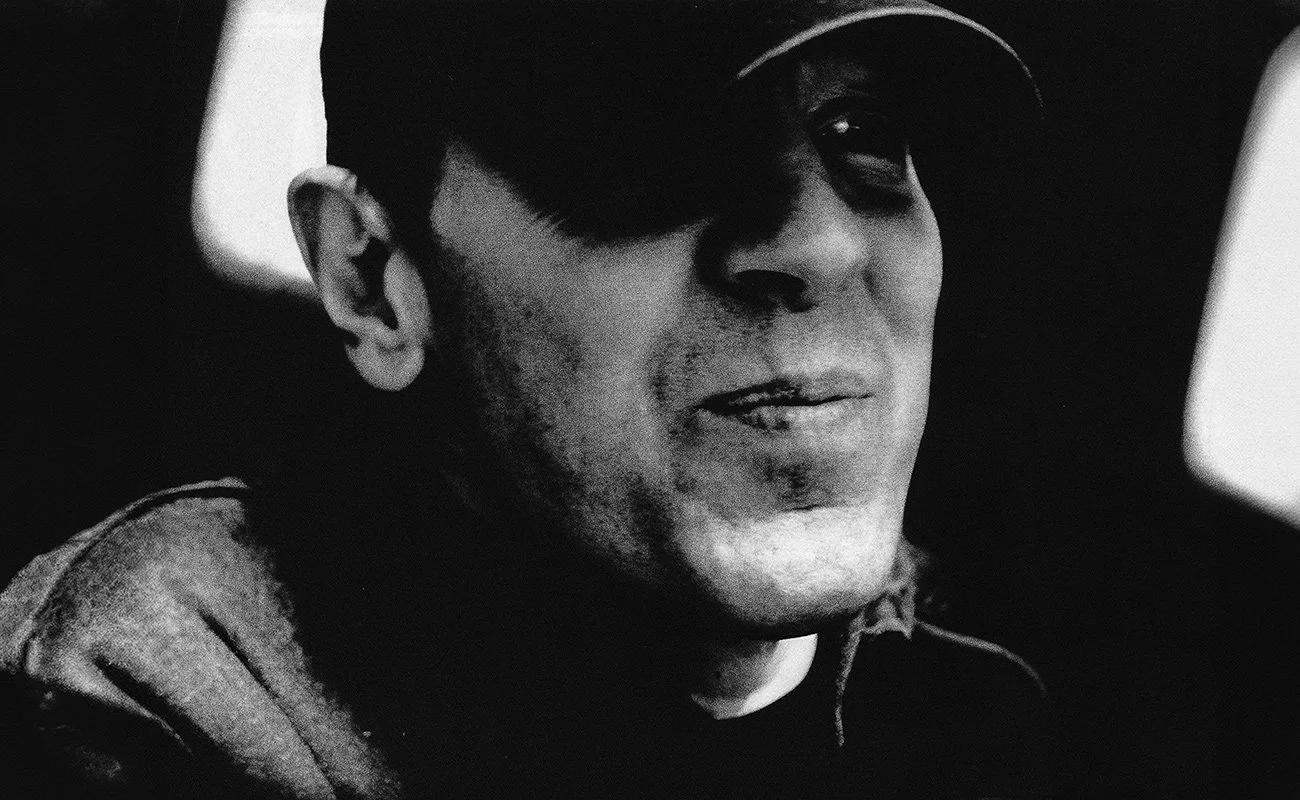
A voice - recognisably his voice, though at a considerably more relaxed pitch than usual - speaks from beneath the sunken brim of a navy blue baseball cap. “Of course,” the voice is saying, “I always surprise myself with the music, or the lyrics. You hear that from writers all the time, especially novelists. They’ll say, ‘God, I don’t know how this happened, how I did it.’ And I have that all the time. But you have to wait for that - that’s what takes the time. You gotta wait till the next piece fits. And it requires a lot of patience and frustration. If you rush it, it always sounds wrong. It never rings true.” The head lifts and yes, this lean, denim clad figure sitting on an armchair in his manager’s West London townhouse must be Scott Walker the mouth still glints with its impossible youth, the eyes, though guarded and darkened under the brim, are still glinting.
And so is the voice, that precious instrument newly removed from its velvet-lined case, where it is stored in the lengthy intervals between Walker’s record releases. It was last auditioned (briefly) on David Arnold’s Gitane-wreathed jazz song “Only Myself To Blame”, from the soundtrack to the James Bond movie The World Is Not Enough (1999), but the last ‘proper’ Walker release was Tilt (1995), whose shocks are still being absorbed after 11 years. Now that he’s embarked on The Drift, it’s clear Tilt’s unprecedented assault on the senses not to mention its challenge to the intellect - was no one-off. In fact, far from stepping back from Tilt’s precipice, The Drift has floated even further out, yanked the dynamic noose tighter. The Drift has intensified Tilt’s blocks of orchestral texture and noise, with massed string parts flapping through the tracks like a giant manta ray, or moaning like some giant theatrical wind machine; scabrous electric guitar counterpoints; spun radio dials; a newsreader; flickering electronic embers (including a sample from Mego group Fuckhead); an incredible array of percussion and sound effects such as fateful hammerings on a massive wooden crate, a rumbling that represents a gargantuan pea rolled under thimbles, and fleshy thuds thumped from a whole side of pork.
Now aged 63, he’s well aware of the common tendency to judge his recent work at best eccentric, at worst, insane. “To me, I hear it as just normal, you know,” he chuckles. “I guess I’ve been working that way for so long, it’s become a part of how I see or hear things. The problem with me is that I’m an either/or man. My imagination either gets very big, or it ends with a whimper, like all the end songs on all my records. Somewhere in between always sounds too normal to me.” But, adds the man whose fascination with English culture began while growing up in California, as a fan of Ealing comedy actors such as Terry-Thomas and Margaret Rutherford, “The album is quite funny, because if you don’t have that, the art is not balanced.
Drift: Passive travel with the current, abandonment to external influences. Walker handles his own production, aided by Peter Walsh, who has been at his right hand since 1984’s Climate Of Hunter. They are proud of their entirely analogue recording, which opens up a massive, broad sound stage upon which Commander Walker marshalls his forces. “I actually see the words as soldiers in the field - that’s my thing. So I can move them around, they have a certain space. After I’ve done that for a while, it starts to come to me, what each [lyric] needs. It’s a very abstract way to talk about it, but it’s how I see it.”
Scrawled from the poisoned inkwells that gave us TS Eliot’s The Waste Land, Ezra Pound’s Cantos, or Paul Celan’s lifelong wrestle with the ghosts of the Holocaust, Walker’s lyrics are guaranteed to perplex, confound and intrigue with each reading. It helps to view his songs as micro-dramas, with the narrative voice peopling several characters, wandering between tableaux, adopting multiple viewpoints and spanning geographies, ideologies and even archaeological time with deft, daring paces. His is The Waste Land spied through the lens of CNN or Al-Jazeera; the news is read by Samuel Beckett. Like Eliot’s modernist masterpiece, The Drift is a dust-hole of allusions, quotations from epic poetry and popular song, ironic asides, dialogues between past and present, East and West, civilisation and barbarity, disease and immunity, ‘high’ and ‘low’ culture, Christianity and Islam, gnosis and kabbala - it even leaps between species. “Buzzers”, for example, opens on a fictionalised grisly, murderous incident in the recent Balkan wars, but flips into a spectral evocation of natural selection lengthening the face of the horse, allowing the animal to remain alert while grazing. “It’s essentially a plea for love, really,” Walker elaborates. “The horses’ faces lengthen, so it’s more about longing for the time a spiritual face can stay with us… So it isn’t about the lengthening in that sense, it’s about lengthening of time, that you can hold that. Most of my stuff is about frustration,” he explains, with a nervous clapping of the hands, “of being unable to hold on to a spiritual moment, always losing it. You just get glimpses of it, and so you have to separately give an idea of it, and that’s all you can do. And it’s the frustration of not understanding what it is. So that’s how it relates - they lengthen, why can’t I have this face lengthen for me?”
People will do it, but it’s easy (and lazy) to cherrypick passages as evidence of incomprehensibility (suck on these: “… scaling/comes scaling/comes red is/ patchy snows/the silver an/other night/gotta pull/muffle bye,” from “Psoriatic”; or “From the/voice/flooded/ semen/clotting/to/paste/Can’t/swallow it/then/bury it/And the/jigger/raps pits,” from “Cue”). These mini librettos need more than a single sitting to assimilate, as each one often fosters two or three distinct poetic images, superimposed or mirrored.
“That’s the idea of the album,” Walker explains, “that it starts with something we know - a political issue and then it drifts into another world, and into something else. All kinds of disparate elements then take place.
“All the time is taken writing the words, which will inform the rest of it. Nothing is extraneous, everything is considered - that’s why it takes so long. Because you have the lyric there and you think, Oh God, there it is, now what… What can I come up with [musically] to really bring it out? And that’s the time consuming stuff.
The Drift’s Vaughan Oliver-designed sleeve is almost black: in an advanced state of decomposition, or it’s tarred and scorched – torched, perhaps, as if to eradicate all traces of its passing. As on Tilt, he prints his lyrics in brilliant white shining out of black, like the illuminated wall-script at Belshazzar’s feast. Those ee cummings-like willow tears of text dripping or weeping down the page are all minutely plotted by Walker himself – it’s no design conceit; in fact on the afternoon I meet him, he’s tutting over various errors he has found in the latest draft of the layout.
These fragments he has shored against his ruins. Because Walker, who lives in Chiswick, West London, pops his head above the parapet so infrequently, the word ‘recluse’ is routinely rolled out. He clearly values his privacy – who wouldn’t, after nearly perishing in a car upturned by hysterical fans? - but in person he’s affable and gracious, his answers frequently accompanied by non-dysfunctional laughter. He’s encountered misunderstanding so many times in his five decade career, that he’s learnt to deal with
In any case, low-key he may have been, but unemployed he wasn’t. Soundtracking Leos Carax’s Pola X lasted two years just before the end of the millennium, as Walker shuttled back and forth to Paris to attend the shooting. The film came out in 2000, the same year that, after much deliberation, he took up an invitation to curate London’s Meltdown Festival (“In the end it was fantastic, like having the best birthday you ever had”); he wrote two songs for German singer Ute Lemper, the very Drift-like “Scope J” and “Lullaby (by-by-by)”; and he was conscripted as producer to rescue Pulp’s valedictory album We Love Life in 2001. “They’re a band that has tons of character, but their production was very digital, very sterile. I thought, I’m going to give them a better sounding recording than they’ve ever had.” Walker has remained close friends with Jarvis Cocker ever since, even borrowing his baritone guitar for use on The Drift. Aside from work, there were “a couple of deaths in the family and stuff like that. And then the record company [Fontana] changed regimes about five times, some were favourable some weren’t, it was like, he loves me, he loves me not.”
Let the endgames begin…
A heap of matter driven together, as snow. Could it be that, every decade or so, Scott Walker’s inspirational demons come knocking at his head, a spooky jigger rapping on his door, out between midnight? Inspiration for The Drift appears to have begun with a BAM BAM BAM BAM: the fateful knocking of a “flugleman” that slams through “Cue”, which was the first piece of music that visited Walker a couple of years after Tilt. “That one was maybe the toughest song I ever wrote. It really is a song that is so odd,” he himself admits, “so strange in all the turns it takes, that I’m kind of loath to deconstruct that, because why did I bother to construct it in the first place? It’s hard enough…” The song is ripe with infection (“Deep as a virus”, “Herpes to clit”); nowhere on the planet is immune (“What do Seoul/Sudan have in common/Both start with an S”); infestation is ordained (“The birth of a vermin Holy Ghost”). “At the beginning it was rather a meditation on all these plagues that are coming that we have no answer for. We put it out of our minds. But they are coming, and they’re there. It started out that way, and it became something else, as with all my songs, it all comes back to the self in some way - not the ego self, but the other self.” The flugleman appears halfway through (a trumpet heralds his arrival), scything through “Dormant wards and nurseries… In the lung smeared slides and corridors”, and at his pass, the lamentations of the dying “the wah-wahs” - are beaten to death with a breeze block. Striving to achieve that sound the final nails in the casket - it was decided to build a ‘big box’ in the studio. “I know pretty much everything that can be used in percussion,” claims Walker, a veteran of countless full orchestra calls on his late 60s albums onwards, when he worked with producer John Franz and arrangers Wally Stott and Reg Guest. “And I couldn’t hear in my head anything that was gonna create that noise.” Pete Walsh’s brother in law, a carpenter, was given specifications to build the thing: “It’s a five by five foot box, and we put it on cinder blocks, and then [percussionist] Alasdair Malloy eventually began beating it with a big cinder block, so we got that real sound… that’s the sound, that’s what the sound would be. Because with all my things, they take on nightmare proportions, so everything’s out of proportion. It’s usually very big, so it’s like a dream, so this had to fall in line with that.”
The box came in handy on “Psoriatic”, which opens with the image of a “thimble-rigger” - the confidence trickster who “slyly rolls the pea” beneath one of three mixed-up thimbles - and the game is represented by a gigantic, ominous rumbling, as if the pea were thundering around in your head. “We drilled a hole in the top of the box,” continues Walker, “and we stuck a mic in the middle, and got these big dustbins and moved them around. And of course the pea became a giant bowling ball that was slowed down.”
The box has sadly been dismantled. “I suggested that my brother in law put it on eBay,” says Walsh, “but we couldn’t get it out through the door.”
The object aimed at: the meaning of words. (‘You get my drift?’…) These songs find Walker roaming labyrinths with nary a bran-trail laid down for the listener to follow. But, for The Wire, he provides several clues. His superimposed imagery is best illustrated on “Jesse”, titled after Jesse Garon Presley, the real-life twin brother of Elvis, who was stillborn. At the start of the song, the opening strums and drumbeats of “Jailhouse Rock” are deconstructed down to two slow burning guitar notes and Walker’s whispered “Pow, pow”. Pete Walsh remembers the mixing stage: “I said, ‘Let me pan those “pow, pow”s left and right.’ And he goes, ‘That’s brilliant, how did you think of that?’ And I go, ‘I dunno, it kind of sounds like they should be left and right.’ And we were mixing on these huge monitors, about 12 foot tall, and it was at that point that he told me what it was. And I went, you’re joking!” The whispered blows, prefaced by a throbbing streak of bass drone like a jet engine screaming across the sky, are intended to mimic the strikes on the Twin Towers. “I actually wrote this about a month after it happened,” says Walker, “and it came together pretty quickly, so obviously it had a pretty dramatic effect on me. The hubris of the Twin Towers - that’s just American muscle. Those skyscrapers - that’s just pumping yourself up. So I was looking for something that didn’t have any reflexive quality - in a sense it came down to Elvis’s dead twin brother - we’ve never seen him, something he imagines, but he can’t really have it. It’s once again a frustration. Then it moves into the other American image, the prairie, so you have a horizontal and then a vertical image going on as well. And finally it zeroes back in to the existential moment - the self- for the very end of it.
“As for what transpired after [11 September 2001], I mean, I just couldn’t believe what was going on. I never actually believed it, even the night before, when they said they were going to do Iraq. I thought, well, Saddam will stand down, and this is a big bluff - and then they did it, and everybody just watched.”
“Cossacks Are”, which launches the album in a flurry of drummed hoofbeats across the Steppes, samples quotes from newspaper cultural reviews, such as “‘A noble debut tackling vertiginous demands””. (Cheekily, and self-deprecatingly, he’s also included the lines “You could easily picture this in the current top ten””.)
“They’re cribbed from reviews - no, they’re not reviews of me! Most of them are backhanded compliments” - that point is reinforced by the use of backwards guitar and vocal reverse echo. “There’s also a quote from George Bush in the middle. I remember when Chirac was over in America recently, somebody asked in the press conference, ‘Are you going to take him out to your ranch, Mr President?’ And Bush said, ‘Well, I’m looking for a good cowboy,’ and I thought I’ll put that in, ‘cause that’s a real backhanded compliment. Chirac took it that way, too.”
“Clara (Benito’s Dream)” is a double portrait of Mussolini and Claretta Petacci, his lover at the time of his summary execution, who insisted on dying with him. Walker recalls seeing footage of their strung-up corpses (evoked by Malloy’s ‘meat punching’) on newsreel when he was a small boy. “I had nightmares about it for quite a while after. Part of the reason for completing “Clara” was because we have all this fascism in the air now, coming from all kinds of directions. I’m never a fan of out-and-out protest songs - someone preaching at me and strumming - so my idea is to sneak up on it. It’s a love story and it’s a very interesting relationship - she was besotted by him, and had posters of him in her room and was a real fan. But she didn’t need to die with him. In a way it’s funny, but it’s kind of moving. So I tried… [the song is] really his dream that he’s having about it all, and then it ends with me, or you, or anyone else talking at the end.”
“The Escape” is apparently set in Cartoonland - it opens with a bitter simulacrum of the Warner Brothers Looney Tunes slide guitar, mentions “foreshortened angels hunting me down”, and ends with someone (Walker himself?) hissing “What’s up, Doc?” in a demonic Donald Duck voice. But this Cartoonland is mapped onto the Holy Land, with its “Rabbi craters” and its kabbalistic terminology (“Serifot” and “kelippot” - look ‘em up). “It had to do with the secretive society business, and conspiracy theory, I think I was trying to match those two together,” is all he’ll say on the subject. It’s dedicated to “Mr K”, who, Walker reveals, is the composer György Kurtág - the song borrows one of his chord sequences. “But then I discovered he took it from Charles Ives’s Unanswered Question.”
“Hand Me Ups” enters the psyche of a conflicted television ‘personality’. “He takes it too far, he’s jealous of his children. And he wants to be the child himself, and a celebrity. I wrote it during the first Big Brother, one of those awful things. He’ll stop at nothing, including sacrificing his children on whatever altar, because they steal his youth and the focus of his attention, preventing him from living his dreams. That’s why you hear the children’s screams. And there’s some quotes in there from The Iliad. So… there we are.”
The track most likely to bring accusations of mislaid marbles is “Jolson And Jones”, with its apparently random refrain “I’LL PUNCH A DONKEY IN THE STREETS OF GALWAY!”, as well as the violent braying of that unfortunate ass. After some persuasion, Walker confides that the lines “The fair señorita don’t seem to care” and “In her voice there’s a flaw” are lifted from “Donkey Serenade”, a 1930s popular song by Allan Jones, later made famous by Perry Como. “Allan Jones was Jack Jones’s father. Did you ever see Night At The Opera, by the Marx Brothers? He’s the romantic tenor in there.” These sampled lines become conflated with Al Jolson’s “Sonny Boy”, who may not be a boy at all, and the tussle between these songs mimics an actual confrontation on the streets. But this song seems like the closest Walker will come to a hoedown. (Another vintage popular ditty, Bob Carleton’s “Ja-Da” (1918), is quoted in two other Drift songs; one of many tunes sent to raise the morale of front line troops in the trenches.)
The Drift rolls inexorably towards death, or assisted suicide. Walker, alone with guitar on “A Lover Loves”, charcoals the deathbed scene “Corneas misted, colour high”; the other side beckons “Psst psst” from the dark; a parade - a dodo, Bambi, the Kaiser, Beuys, Red Rosa (Luxemburg?), Tintin - dances before expiring eyes. “All my albums tend to end with whimpers - you were talking about Eliot earlier. Yeah, all the people named in there either don’t exist, or they’re dead, and if they are dead, they don’t exist any more, in reality.” The logic of bones is impeccable.
“When you go into a Scott record, you know that it’s not a short EasyJet hop to Paris, it’s a couple of times round the world.” Pete Walsh ought to know: he has co-produced the last three Walker albums, beginning with 1984’s Climate Of Hunter, recently remastered by Virgin. At the time Walsh was “24, and very much an 80s wonder kid” who had just produced the brittle New Gold Dream for Simple Minds. “The first time I worked with him, he put a picture of a load of scribbles drawn in pencil - on the console; I think it was a nightmare!” The soundworlds of Tilt and The Drift are the result of a dialogue between orchestral textures and the collective contribution of Walker’s core group: Brian Gascoigne (keyboards, who’s been with him since Climate), Hugh Burns (guitar), Alasdair Malloy (percussion), John Giblin (bass) and lan Thomas (drums), with occasional exotic instruments supplied by Andrew Cronshaw.
“They play it beautifully,” beams Walker, “and sometimes they’ll add something wonderful as well. They’re used to all the stuff that’s going on in there, they’re not surprised. We could run a herd of cattle through there and nobody would blink.”
“The starting point has been different on each one,” says Pete Walsh. “With Climate, the first time I actually heard anything was when I had five musicians sitting in front of me, and the arranger walked in with the music, and it was ‘1-2-3-4’ and off we go. The Drift differed quite a lot in its starting approach. A few years ago Scott bought a programmable keyboard, and he has beavered away for the last, I don’t know how many years, and he has got all these songs inside his synth. So the starting point for The Drift was, OK, press a button and then it all comes out. It was a lot more of a focused plan than he’s had before. Often Scott would have done the first half of the song, and then left the second half, and expect the guys to build on it. And then we just set about making it as dynamic and real as possible.”
“One of the prerequisites of working on one of my records,” says Walker, “is that everybody’s got to have a sense of humour. ‘Cause, you know, we would all die if we didn’t, in that situation. I’ve always said I don’t want a lot of guys in black, brooding around the studio noodling on things.”
“You don’t really want anybody showing off,” Walsh adds, “you don’t want to hear the person behind the instrument. The ego - you don’t want it to be characterised.”
The group sound is sharply set against the orchestral blocks of noise, which were captured on one fraught, time-tied day at Air Studios. “There isn’t one splice on the album,” reveals Walsh. “The whole thing is analogue, and it’s on tape, so it is done in one pass. They were changing parts on the day, actually rewriting the thing in the studio with 40 musicians sitting there waiting to play. Scott wouldn’t actually pen out the orchestral arrangements, but those clusters of notes are worked on and worked on and worked on. He gave [arrangers] Philip Sheppard and Mark Warman freedom of expression: ‘Here are the notes, but you can do a lot more. You tell them how to play it, let’s create something special.’ So the guys would go away, and get the arrangements down, and then come in and explain what they’d done.
“The string section was real fun to do,” he continues, “but when you’ve got that many musicians to pay at the end of it, and it’s well known that they will actually stop half way through a take if it goes past the clock, it’s really nail biting.” There are inevitably challenging aspects of working on Walker’s material, he admits. “Setting the tempos of the songs is a master task. You’re not hearing the vocal at the time while you’re recording, so you’ve got these long passages, and the tempos are shifting up and down within those passages.
“There is an aura around Scott, and a lot of people get frightened or embarrassed by that. But he is in fact an incredibly funny guy and has some very funny takes on life… he loves his Wimbledon, he does some running, and he’s always on his pushbike - when it’s not being stolen! There’s a little bit of tongue in cheek with the meat - we’ve asked Alasdair to do so many ridiculous things over the years…”
In his last Wire interview, in May 1995 (issue 135), Walker was called an ‘underachiever’, an insult which would never be applied to a novelist or film director, say Thomas Pynchon or Alejandro Jodorowsky. Since his retirement from public life in the mid-70s (“that hiatus I had, you know, where I became the great leper”), he has slowly gained the perspective, and the distance from his stardom, to contemplate how rock might be packed with a far richer amount of data than is expected of it. The career path has reversed: instead of the common fate of his generation of pop idols - initial flare followed by long, slow burn out - Walker’s early chapters with The Walker Brothers, the TV show, the sublime four solo albums, plus showband and Brel/Brechtian interludes - he had signed off these chapters before reaching 30. The seeds of where he’s at now can be heard in some of his early music. He’s made a signature of singing over luminous, shimmering string drones running continuously under the song: follow that particular line from “It’s Raining Today” on Scott 3, through “The Electrician” on Nite Flights, “Rawhide” on Climate Of Hunter, “Patriot” on Tilt, to “Jesse” on The Drift. And is it far fetched to imagine that his 21st century drift begins in pop’s biggest eclipse: the melancholic darkness that spreads when “the sun ain’t gonna shine any more”?
Pop music is never judged, these days, by the kind of standards he sets for himself, and his work is better compared with the kind of existential and experimental art, literature and film that beckoned him to live in Europe in the first place, 40 years ago (he’s only visited America a total of three months since the mid-60s, he tells me). Tarkovsky’s long takes echo the single-pass recording technique used on The Drift; the splintered narratives of Godard and Bergman, especially Persona, are analogous to the montage effects in Walker’s own lyrics. Béla Tarr’s The Werckmeister Harmonies, with its trudging tempo and its bizarrely incongruous giant whale deposited in the main street of a rural East European village, demands a similar degree of mental receptiveness as Walker’s latest records. (As a dedicated moviegoer, he’s familiar with the film). Significantly, he uses a visual tag when he says of his own progress, “We’re getting better and better at getting this picture together, the picture of what this is.”
He lets slip that he has “an excellent idea for an album that I could probably gig with, and I just have to find a way to do it with about five people”. But for now, the voice has been laid back in its case. How does he look after it, in the gaps between albums? “Well, I just don’t use it - I look after it great!” he giggles. “I only start singing maybe a couple of months before I start [a new record]. I’ll sing the blues or something. I’m not a trained singer, so I get it in shape by instinct. But singing is a great terror for me anyway, so it’s something that I’ve never wholly looked forward to. When I’m home, I’m just singing for myself, it’s OK, it’s relaxing sometimes. But if I’m actually going to do it, especially for things like this, it’s very worrying, it really gets on my nerves. But I have to capture that as well, because that’s part of what it is.
“It seems such an incredible thing when the singing comes out of your mouth, but if you’re doing paragraphs or sentences or whatever, you have to catch the phrasing right, it has to sound really right, and real. And I’m just afraid I’m never gonna get it. And in my mind I never do.
“I never listen to my records once I’ve made them,” he reminds me, before departing. “I spent years writing it, producing it, arranging it and singing on it… I never want to see it again, basically. I’ll let someone else live with it for ten years.” The stop button is pressed, and in an instant he’s on his feet, shaking my hand, and BAM - the room is deserted.
Interview
Uncut - June 2006
by Stephen Troussé
It’s 11 years since Tilt. Did it take that long to work on the songs until they were ready to take into the studio, or was it a question of waiting for a deal or the right time to record?
WALKER: It was a combination of many things. I’d taken on various projects including soundtracks, record production, songwriting for another artist, curation of the Meltdown Festival. The company I was with changed regimes four or five times - the last one being unsympathetic to my vision of things, proposing instead that I consider a more marketable approach. My approach is my approach; we parted. And of course it seems that it takes me an interminable amount of time to write these days.
In those years, you worked on the soundtrack to Leos Carax’s Pola X and produced Pulp. Are these collaborations creatively satisfying in themselves, or strictly professional endeavours?
It’s always interesting to divert. I’m a film addict, so working with Leos was fascinating. The Pulp project was also very interesting. That band has a lot of character. I always felt that their recordings and production were too coldly analytical and worked against this quality that you could plainly hear when they played live. They managed to overcome this due to wonderful songs and Jarvis’ unique vocal style. We tried to capture some of that and I think for the most part we succeeded, but perhaps we were a record too late to make a difference.
Tilt was an exceptionally brave, uncompromising record. The Drift seems to be even more so. Do you have any qualms about making “difficult music”? Do you remain confident that you can take an audience with you?
I am confident of nothing apart from my eventual departure from this life. I make music for myself because I’m interested and hopefully it will connect with someone else; that’s all anyone can really do.
Addressing fascism, epidemics, the attack on the Twin Towers, the catastrophes of history, The Drift is an exceptionally sombre, even bleak, record. Does this reflect your own current mood, or do you think it’s art’s duty to deal with the gravest issues?
Different listeners hear different things. Chris Sharp at 4AD saw a strong comic element running through it, so who knows?
Despite the seriousness of the subject matter, was it fun to record? You seem to have experimented with some strange effects and instrumentation.
The musicians and the people that I work with come with a prerequisite that they must have a sense of humour, otherwise we’d all die. There’s nothing worse than having a load of people dressed in black, brooding around the studio and noodling on things. You simply have to remain clear. So it is fun until [Scott’s co-producer] Pete Walsh says “rolling” and then everybody gets their heads down. And yes, we had a big wooden box 5ft x 5ft especially built in the studio for Alasdair Malloy to bash with a large concrete brick on the song “Cue (Flugleman)” and various other things, including a side of pork being punched on “Clara”, also by the aforementioned Ali.
Can we expect another 11-year wait until the next Scott Walker record?
Hopefully, I can now start to work on an album perhaps smaller in scale that can be toured or performed, so I’ll have to find a way to work much faster.
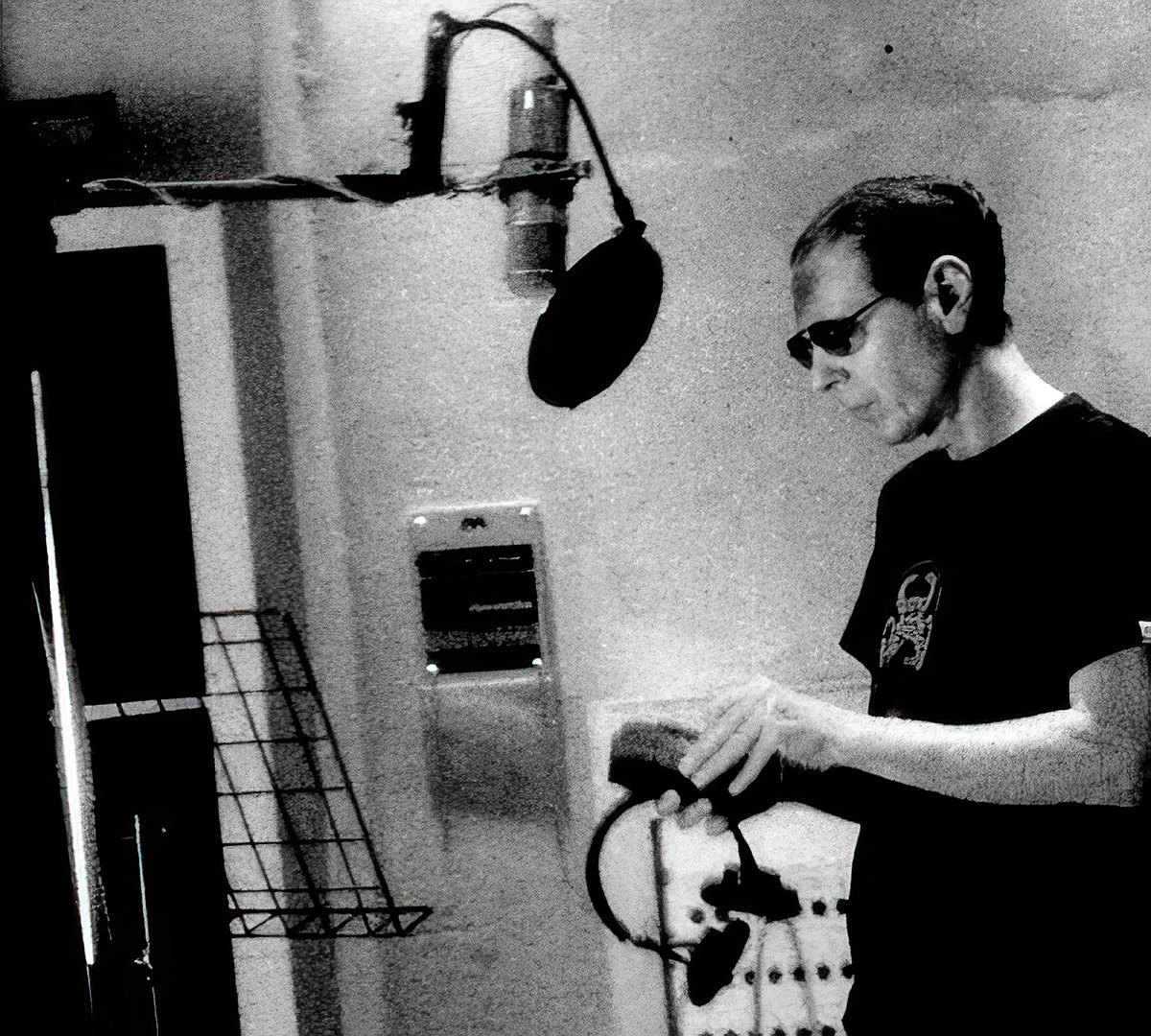
Photos by Grant Gee
Interview
De Morgen, June 17, 2006
by Dirk Steenhaut
A crooner with a dark edge
From teen idol to enigmatic recluse: Scott Walker (63) has taken a remarkable path in forty years. From orchestral sixties pop with The Walker Brothers and controversial Brel interpretations, he evolved to strange, baroque music that does not fit into any box. With The Drift, he recently made his first CD in eleven years.
‘Listening to Scott Walker is like being slowly submerged in liquid nitrogen’, wrote one critic about the man’s previous CD Tilt, a claustrophobic work that only reveals its secrets after many spins. But even though the singer with the deep baritone now releases the kind of records that only Klara can do anything with, he is idolized by the biggest pop stars of our time, from Bowie to Bono, from Radiohead to R.E.M.
During the sixties, Scott Walker (nee Scott Engel), then still the lynchpin of the American Walker Brothers, scored hits with ‘The Sun Ain’t Gonna Shine Anymore’ and ‘Make It Easy on Yourself’, inspired by Phil Spector’s Wall of Sound. The group was just as popular in England as The Beatles and The Stones, but the status of sex symbol gave the singer little satisfaction. He suffered from depression, attempted suicide and hid in a monastery until the idolatry blew over. Four sensational LPs followed under his own name, but ironically, success waned as his work became more ambitious and unique.
Walker’s career reached a low point when his employer CBS forced him to release colourless middle-of-the-road records that he himself did not support. Once freed from his contractual obligations, the singer resolved never to be anyone’s servant again. He opted for a hermit’s existence, developed his own idiom with 1984’s Climate of Hunter, and since then his work has become increasingly baroque and impenetrable. On his latest records, Scott Walker sounds as if Penderecki, Bartok and Shostakovich are fraternizing with Kurt Weill and Nine Inch Nails in his head.
He has released only three LPs in the past 28 years. Does he suffer from a pathological form of perfectionism?
“The crisis in the music industry and the ever-changing regimes at record companies have not made things any easier,” Walker explains. “It’s true that I’m a slow worker: on my records, every detail counts and all the pieces of the puzzle have to fall neatly into place. Music and instrumentation always serve the text for me. Everything is aimed at making the words come out, so you have to wait patiently until the right sounds present themselves in your head.”
In addition, Walker’s work has deviated so far from the norm in recent decades that you hardly have any criteria left to form an opinion about it.
“That’s a problem, because I too can’t possibly predict how the listener will react to my music. On The Drift, you don’t hear any real arrangements, because they no longer have a reason to exist in the context of the songs. I only use massive blocks of noise.”
For Scott Walker, every project is a step into the unknown.
“But I do try to show the musicians a blueprint beforehand. As a child of the sixties, I made my debut when things were still very disciplined in recording studios. So once I start on something, I usually have a clear image in mind. Most of my songs start with a political idea, but as they go along they drift off into a completely different world. That’s why I called my new CD The Drift. In my music, everything is always in motion and things are rarely what they seem.”
The Drift is ‘uneasy listening’, just as Picasso’s Guernica is ‘uneasy viewing’. With themes such as abuse of power, violence, death and the advancing neo-fascism, Walker’s work sounds rather dark anyway. Does an artist have a moral duty to warn humanity against phenomena that threaten society?
“I just write about things that are in the air. Take ‘Clara’, about Mussolini’s mistress, who chose to be executed with him. When I was six, an aunt took me to a cinema where newsreels from the Second World War were being shown. The graphic images of Benito and Clara, their bodies hung upside down and spat on and beaten with sticks by an angry crowd, have always stayed with me.
“Ten years ago I read a biography of Il Duce and that whole episode started to go through my head again. Also, more and more articles were appearing in newspapers about the growing popularity of the far right and that’s how I came up with the idea of writing a song about it. I don’t like protest songs because I can’t stand preachiness. But in ‘Clara’ the ideology is just a starting point to talk about something completely different.
“Actually, the protagonists of that song are absurd figures. Clara Petacci was a superficial girl who covered the walls of her room with posters of movie stars. She could have easily saved her skin, but her decision to die with her lover makes her special. Isn’t it fascinating that a monster like Mussolini was able to arouse love, warmth and loyalty in others. I find it a hopeful observation that fascism was unable to eradicate such feelings.”
Scott Walker’s work is complex and theatrical and shows similarities with a radio play or an opera. Does the singer still have an affinity with popular culture?
“Certainly, after all, I started out as a bassist in rock bands. I don’t really believe in stylistic categories. I use what the text needs and try to create a total experience. But it always starts with ingredients from rock music; that is my background.”
As an author, Walker frequently uses collage techniques and intertextuality. His songs are full of quotes from news magazines and the listener often does not know what to do with the many voices that speak. According to the artist, reality has become so complicated in the 21st century that it can no longer be represented linearly.
“The information blows at you from all directions, but you can no longer find a common thread. So I look for images and metaphors to connect all those loose strands and give them meaning. Many people consider my lyrics to be poetry, a misconception because poems have a different intention. For a song, it is essential that it is sung. The form in which I package my work apparently causes confusion.
“Silence is at least as important as sound on my records. It is the source of every language system. That is why there are so many gaps in my songs: the contrast between what is absent and what is present makes certain details shine brighter. Some people feel intimidated by classical music and therefore do not like listening to it. But if you let it wash over you, it turns out that it is not so bad. The same goes for my CDs: just give them a chance.”
Walker’s arrangements, full of dissonant strings, noise eruptions and martial rhythms are an assault on the senses and have already unsettled more than one listener. For example, in ‘Clara’ the percussionist pounds a lump of pork with his bare fists. Scott Walker literally sculpts with sound. Yet he does not wish to be counted among the category of experimental composers.
“They are people with a concept and a vision, while my way of working is quite primary. I invent a soundtrack for words, feverishly searching for something that defines the whole. Sure, the sound serves the meaning, but your interpretation is worth as much as mine. I don’t consciously seek obscurity. I just don’t want to be fitted with a straitjacket.”
According to the German philosopher Theodor Adorno, modern man is so overwhelmed with music that he no longer really hears it. Dissonance is a means of sharpening his attention again.
“I feel that we are even more deaf today than when Adorno was still alive. Also because many contemporary American composers have renounced dissonance. That minimalist stuff à la Philip Glass, doesn’t it drive you deaf? You even get it in hotel elevators.
“When I use dissonant sounds, I don’t do it to indulge my perverse nature, but because I want to get rid of musical clichés and predictable chord sequences.”
As a singer, Scott Walker aims for a certain neutrality: he wants to purify his voice of emotion and also prefers not to hear the musician behind the instrument. That seems utopian. Because can what you do be separated from who you are?
“I don’t mean it that clinically, otherwise I might as well hire machines or robots. But emotionality is often exaggerated or magnified. What bothers me is that most singers are constantly guilty of overacting. When I sing, I try to erase my ego until I reach a point in the song where I am really overcome by emotion. If that happens naturally, then I won’t suppress it. But if you manage to keep your feelings small, people listen more attentively. And as for my statement about those musicians: I don’t want them to keep performing the trick on my CDs that they owe their reputation to. I’m looking for something more authentic.”
Since he achieved success and fame as a member of The Walker Brothers and became the object of mass hysteria-like adulation, Scott Walker has had a deeply ambivalent relationship with stardom. Is that why his work, since Climate of Hunter, has been so far removed from the mainstream?
“It’s certainly not a calculated manoeuvre or a perverse act of revenge. I hate many aspects of the pop milieu, but at the same time that culture has produced a lot of fantastic things. Making records is an adventure for me. And even though I do it primarily for myself, I hope to appeal to others. Like Radiohead, I mentally reject complacency and musical uniformity, I want to make something that can stand on its own. But I certainly don’t want to bomb the pop tradition.”
Ever since his early childhood in L.A., Walker has felt much more drawn to European art and culture than to American.
“When I saw Ingmar Bergman’s The Virgin’s Well as an adolescent, the film so fired my imagination that I have spent almost all my days in cinemas ever since. Bergman suggested a way of seeing that was completely new to me and that attracted me irresistibly. This contributed to my settling in Europe in the mid-sixties, although it was also a way of escaping the army.”
Shortly afterwards, Scott Walker became the most acclaimed Jacques Brel interpreter in the English-speaking world.
“In a way, Brel’s chansons liberated me. At the Playboy Club, where I went with The Beatles, I met a German girl. We ended up in her flat and she let me play a record by a guy I didn’t know, but when she translated his lyrics for me I was petrified. I knew straight away: I want to record those songs. Brel’s music gave me a sense of recognition and opened countless doors for me. I myself had only just taken my first steps as a songwriter. Jacques Brel helped me on my way.”
Walker hasn’t set foot on a stage for almost thirty years. Still, he’s toying with the idea of performing again one day.
“Back then I dropped out because of stage fright. But in the sixties and seventies, the concert circuit was much more primitive than it is today. The sound reproduction has improved a lot since then: if you sing a subtle number now, you no longer go wrong. My previous CDs were so ambitious in design that I couldn’t possibly perform them live: it would have been an unaffordable undertaking. That’s why I want to make a record with more sober material that I can play with a regular band. But it’s stronger than me: I keep coming back to big orchestrations. Hopefully I’ll finally be able to rein in my imagination a bit.”